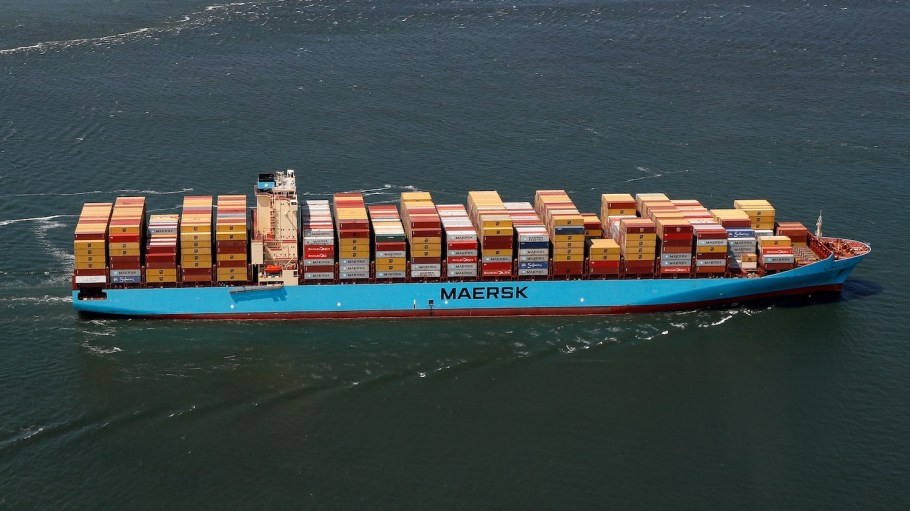
Maersk may be ushering in a good sign for the state of the Panama Canal upon reinstating transit on its Oceania-to-the Americas “OC1” service through the waterway in May.
Since January, when the container shipping giant halted the service, goods on OC1 have been transported via rail over a “land bridge” across the roughly 50-mile country.
OC1 will return to its pre-existing rotation on May 10, with the land bridge set to be phased out by the end of May, Maersk said in a customer advisory Friday.
Related Stories
Under the temporary shift, Maersk created two separate “loops” on each side of the canal—one in the Atlantic Ocean and another in the Pacific Ocean—for container vessels.
The two-loop setup meant that containers headed east were unloaded at Panama’s Pacific-side Port of Balboa, before crossing the isthmus by train to the Port of Manzanillo on the Atlantic coast, where they were loaded onto a ship destined for Philadelphia and Charleston.
The move comes a month ahead of the start of Panama’s rainy season, which lasts from May to December.
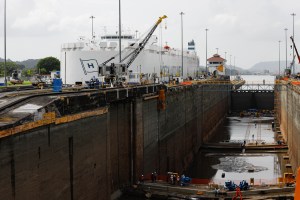
A months-long drought in 2023 kicked off the traditionally damp period, which negatively impacted water levels at Gatún Lake, the manmade lake which provides the water to move ships through the Panama Canal’s lock system.
The drought led the Panama Canal Authority (ACP) to begin implementing restrictions for both daily transit bookings and vessel draft, ultimately creating backlogs that surpassed 120 ships in the late summer and fall months.
Since its locks were expanded in 2016, the Panama Canal had capacity for 34 to 38 daily transits, but this was steadily reduced throughout 2023 to 22 vessels per day.
The ACP began easing the restrictions at the start of 2024, increasing the number of bookings it accepts each day to 24 in January and 27 in March. Maersk said it had been closely monitoring the added transit slots by the ACP in recent weeks before deciding to revive the OC1 service.
If the country’s current water totals and future projections are any indicator, more restrictions could be lifted in the future.
As of Friday, Gatún Lake’s official water levels are 80.3 feet deep, which is 2.6 feet shallower than the 82.9 average in April over the five previous years. The 2.6-foot difference is a major improvement from the 5.5-foot average differential just three months ago in January, when water levels were 81.4 feet deep compared to the usual average of 86.9 feet.
By May, the ACP forecasts that the depth will drop to 80 feet by mid-May, representing a 2.5-foot gap from the 82.5-foot-deep, five-year average.
MSC faces possible $63 million fine from FMC
While Maersk is capitalizing on the potential improvements at the canal, its biggest rival is in hot water with the Federal Maritime Commission (FMC).
The FMC’s Bureau of Enforcement, Investigations and Compliance (BEIC) has asked Mediterranean Shipping Company (MSC) to pay a civil penalty of no less than $63.3 million on allegations of “knowingly and willfully” violating the U.S. Shipping Act.
MSC is being accused of charging excessive late fees on non-operating reefers and billing third parties that were not originally part of the contractual agreement using a broad definition of “merchant” in its bills of lading. The investigation into MSC has been under way since August 2023, the commission said.
The probe found 18 violations related to the use of its “merchant clause” to assess and collect charges from third parties and more than 3,000 violations related to non-operating reefers.
“The fact that MSC failed to conduct an internal audit and proactively reconcile its billing processes, resulting in at least 2,629 reefer overcharges and 1,704 undisputed reefer charges, is a clear display of MSC’s reckless disregard and plain indifference to the requirements of the Shipping Act,” the FMC said in its 81-page complaint.
Sourcing Journal reached out to MSC.
MSC ran afoul of Bed Bath & Beyond last year, with the bankrupt home retailer suing the carrier for $316 million in the biggest lawsuit filed with the FMC to date. The retailer is accusing the company of failing to meet service commitments during Covid, coercing Bed Bath & Beyond into paying extra for peak season surcharges and other fees and charging excessive demurrage and detention costs.