Maersk plans to deepen its commitment with India as the country forges ahead with its ambitious $1 trillion maritime and shipbuilding transformation.
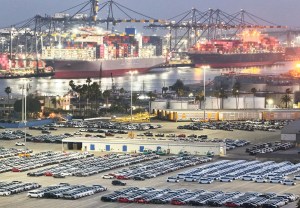
The ocean carrier’s APM Terminals subsidiary, which already operates and partially owns the Pipavav Port in India’s western-most state Gujarat, signed a formal agreement with the state’s maritime board to expand the gateway with an investment of $2 billion.
The terminal operator aims to enhance the port’s capacity and capabilities with state-of-the-art container and liquid cargo-handling infrastructure, while strengthening multimodal connectivity with India’s major railways and inland infrastructure.
Related Stories
APM intends to add multiple berths within the Pipavav terminal and deepen the channel beyond its current 48 feet. The expansion is designed to help Pipavav Port better compete with other major ports in the region, including Mundra Port, which is India’s largest container port and is also located in the state of Gujarat.
Currently, the enhancements are subject to a long-term concession agreement with Indian authorities. APM’s concession rights at Pipavav are currently due to end in 2028.
“This investment plan is not just about expanding Pipavav Port, it’s about unlocking new opportunities for Gujarat, for India, and for global trade,” said Jon Goldner, CEO of APM Terminals Asia and Middle East, in a statement. “We are building the capacity, resilience and sustainability needed to serve India’s economy for decades to come. Our goal is to make Pipavav a model of world-class efficiency and green growth, while creating lasting prosperity for local communities and strengthening India’s leadership in maritime trade.”
The APM investment is part of a wider initiative from Maersk launched earlier this year, in which the container shipping giant already said it would commit $5 billion to India’s ports and terminals, as well as landside infrastructure development.
The company’s wider footprint in India includes two APM Terminals across Pipavav and Mumbai’s Jawaharlal Nehru Port, facilitating throughput of over 3 million containers every year. Across the country, Maersk operates 26 warehouses spread across 3.8 million square feet.
APM’s announcement was made during India Maritime Week 2025, which was held in Mumbai from Oct. 27-31 as way for stakeholders to showcase the growth opportunities within the maritime industry.
India’s ministry of ports, shipping and waterways, the hosts of the weeklong event, has laid out both a medium- and long-term roadmap to propel the South Asian nation into a maritime powerhouse. Under the dual roadmaps, the government plans for India to be a top-10 shipbuilding nation by 2030, before escalating into the top five by 2047.
The latter goal aligns with Prime Minister Narendra Modi’s ambitions for India to become a developed economy by 2047.
Maersk is also assisting India with its wider shipbuilding goals by reflagging two vessels, Maersk Vigo and Maersk Vilniu, under the Indian flag.
The company is also deepening its collaborations with Indian shipyards for vessel repair and maintenance activities, signing multiple agreements with different yards to explore repair, maintenance and newbuilding opportunities.
Additionally, Maersk is exploring local manufacturing and seeking out more chances to procure containers from Indian companies. As part of that decision, the company is working with partners to share technical specifications and quality requirements for procuring seaworthy containers, with the aim of establishing a robust domestic production roadmap.
“India possesses significant infrastructure capabilities that Maersk wishes to capitalize on,” said Ahmed Hassan, head of asset strategy, at A.P. Moller-Maersk in a statement. “By flagging vessels under the Indian flag, manufacturing seaworthy containers in India and engaging local yards for maintenance and repair work, we’re not just expanding our operational flexibility; we’re investing in the development of India’s maritime ecosystem and demonstrating our belief in the country’s technical capabilities.”
Following Maersk’s moves, chief ocean carrier rival Mediterranean Shipping Company (MSC) has confirmed it will deploy 12 of its container ships under the Indian flag, following CEO Soren Toft’s discussions with Modi during Maritime Week.
Toft confirmed the reflagging via a LinkedIn post Monday, saying “India is a key country for MSC,” and that the move strengthens the parties’ long-term partnership.
Earlier in October, CMA CGM also signed a letter of intent with Cochin Shipyard Limited to build six dual-fuel liquefied natural gas (LNG) container ships in India, marking the first time a major international container shipping company has ordered LNG vessels from an Indian shipyard. The vessels will be registered under the Indian flag with deliveries scheduled between 2029 and 2031.