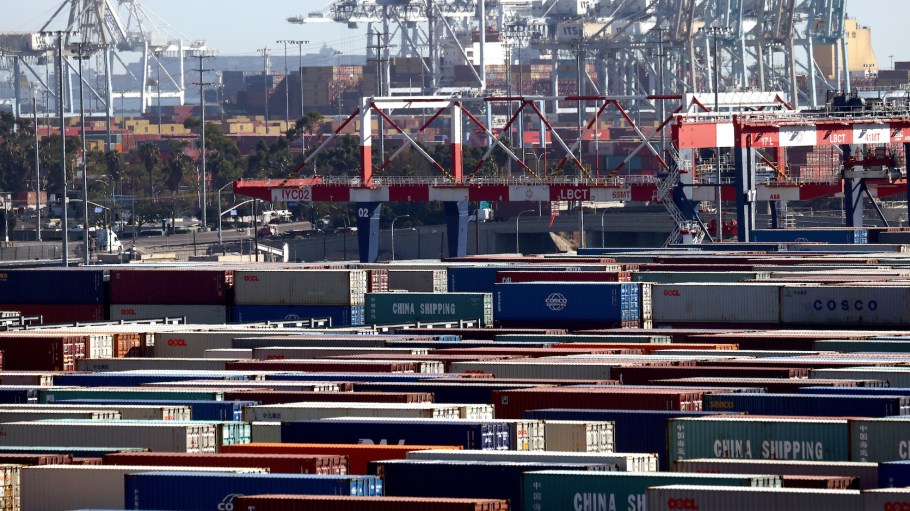
Container demand has been muted this year, but a recent forecast is bullish on the remainder of the year, even while the peak shipping season seems less hectic than usual.
Port throughput for shipping containers in July is down 12.4 percent year over year, with major U.S. gateways handling 1.91 million 20-foot equivalent units (TEUs) in the midsummer month, according to the Global Port Tracker from the National Retail Federation (NRF) and Hackett Associates.
But the number ticked up on a monthly basis after dropping in June. Total TEUs increased 4.4 percent from June.
Related Stories
Ports have not officially reported August numbers, but the tracker projected the month at roughly 2 million TEU, down 11.4 percent year over year but the first month since October 2022 to reach the 2 million mark.
Data from Descartes seemed to back up the NRF and Hackett Associates findings. August U.S. container import volumes increased 0.4 percent from July to more than 2.196 million twenty-foot equivalent units (TEUs). Versus August 2022, TEU volume was 13.2 percent lower, Descartes said.
According to the Global Port Tracker, September and October are also forecast to bring in 2 million TEU each for a potential three-month streak. This would be a 1.8 percent year-over-year drop for September but a 0.1 percent year-over-year gain for October.
When peak shipping season concludes, November throughput levels will fall off to a projected 1.96 million TEU. But the month-over-month declines shouldn’t be as bad as last year, meaning holiday numbers could top 2022, up 10.4 percent year over year. Similarly, December should see a downswing to 1.94 million TEU, or up 12 percent year over year.
Those numbers would bring 2023 to 22.3 million TEUs, down 12.5 percent from last year. Imports for all of 2022 totaled 25.5 million TEUs, down 1.2 percent from the annual record of 25.8 million TEUs set in 2021.
When incorporating end-of-year projections, the 2023 numbers ticked up 1.4 percent from 2020’s 22 million TEUs, and up 3.2 percent from a pre-pandemic 21.6 million TEUs.
NRF and Hackett Associates expect an improvement around the turn of the year, with January 2024 forecast at 1.91 million TEUs, up 5.4 percent.
“These are strong numbers and a sign retailers are optimistic about the holiday season since they don’t import merchandise unless they think they can sell it,” NRF vice president for supply chain and customs policy Jonathan Gold said. “The holiday season is now the top priority for everyone in the retail supply chain as merchants prepare for the rush of shoppers who will soon be buying gifts for friends and family.”
In the statement, Gold highlighted the recent ratification of the long-awaited dockworkers labor agreement for providing “supply chain stability and certainty for retailers utilizing the West Coast ports.”
In a report, real estate investment trust Prologis said the contract resolution will help bring some business back to the West Coast. The ports of Los Angeles and Long Beach are expected to regain about half the market share they lost starting in 2022 through this year, Prologis said.
The market should stabilize six to 12 months after the contract was finalized, according to Prologis. It expects the LA/LB port complex will handle about 33 percent of U.S. containers when the market gets back to normal, an increase from the recent low of 27 percent.
U.S. import activity has slowed this year, with S&P Global Market Intelligence research finding that seaborne containerized freight imports fell 12 percent year-over-year in August. While maritime freight represents 32 percent of total imports by value, it suggests that supply chain activity is slowing as the peak shipping season begins.
Falling consumer discretionary goods shipments were led in absolute terms by a 22 percent decline in apparel imports, including fewer back-to-school products. Declines were also seen in shipments of leisure goods such as toys and fitness (22 percent) and consumer electronics (14 percent).
The survey said firms across apparel, home goods and electronics have indicated weak demand for the rest of the year and/or continued destocking.
Online container logistics platform Container XChange is also less optimistic about container demand improving anytime soon. In a recent report, it said the structural shift in consumer spending is likely to challenge the container market for some time. Container XChange doesn’t anticipate demand rebounding to normal in the next 12 to 18 months.
“This will likely lead to an increased imbalance in the container supply-demand dynamics, with excess containers in some regions and low demand on the transpacific route,” it said.