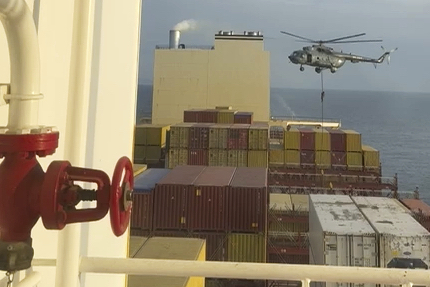
Container vessels traversing waters near the Middle East may have more potential concerns on their hands after Iran’s Islamic Revolutionary Guard Corps seized a Portuguese-flagged cargo ship in the Gulf of Oman Saturday.
The Israel-linked MSC Aries was detained for “violating maritime laws,” Iran’s Foreign Ministry said on Monday. Video footage provided to The Associated Press showed paramilitary forces raiding the ship of 25 crew members via helicopter.
MSC leases the Aries from Gortal Shipping, an affiliate of Zodiac Maritime. Zodiac is partly owned by Israeli businessman Eyal Ofer. The 14,300 20-foot equivalent unit (TEU) ship was carrying shipments totaling over 3,600 TEUs and a cargo value exceeding $174 million, according to data from container tracking platform Vizion.
Related Stories
Sourcing Journal reached out to Mediterranean Shipping Company (MSC). MSC had previously said it was working “with the relevant authorities” for its safe return and the wellbeing of its crew.
The seizure, which occurred near the Strait of Hormuz, spells trouble in two separate trade chokepoints on both sides of the Arabian Peninsula.
On the western side of the peninsula, container ships have been rerouting away from the Bab-el-Mandeb Strait for months amid the heightened attacks from Yemen-based Houthi militants—preventing most container trade from entering the Red Sea and transiting the Suez Canal.
And on the eastern side, the Strait of Hormuz flows into the Persian Gulf, with roughly one-fifth of the world’s daily oil supply passing through, according to the U.S. Energy Information Administration.
According to International Monetary Fund (IMF) PortWatch, 34,000 ships transit the Strait of Hormuz annually, 62 percent of which are oil tankers. Another 15 percent are container ships.
The helicopter had boarded the MSC Aries 50 nautical miles northeast of Fujairah, U.A.E., and has since been transferred closer to Iranian waters near the city of Bandar Abbas.
Peter Sand, chief analyst at ocean freight and air freight benchmarking platform Xeneta, said that the targeted nature of the attack on Israeli interests, rather than as a random hijacking, may limit the likelihood of repeat instances.
“There would be far more concern in the industry if this was the start of sustained and indiscriminate attacks, but that doesn’t appear to be the case and container ships are continuing to sail through the Strait of Hormuz,” Sand said. “Unless the situation deteriorates further, the seizure of MSC Aries is unlikely to result in the kind of supply chain disruption we have witnessed recently in the Red Sea and Gulf of Aden where almost any ship is at risk of attack by Houthi militia.”
That’s not to say shipping firms shouldn’t be concerned at all, with Sand pointing out that the Saturday seizure represents another example of nation states attempting to weaponize international supply chains.
One area that could see an impact is ocean freight rates, he said. Freight rates saw a brief spike in December and January due to the continued avoidance of the Red Sea, but have lowered again in the two months since.
“Whenever there is uncertainty in the market there is the potential for ocean freight shipping rates to increase, as we have seen most recently following the escalation of conflict in the Red Sea,” said Sand. “However, oil prices have not spiked as some feared they may do, and ships are seemingly sailing through the Strait of Hormuz without issues, so any direct impact on rates may be limited.”
Container trading and leasing platform Container XChange said the situation remains fluid, with potential shifts dependent on Israel’s response. But the company is prepping for higher freight rates due to the seizure, with CEO and co-founder Christian Roeloffs cautioning in a customer advisory that “war-risk” insurance premiums will increase, leading to heightened volatility in shipping markets.
“The Strait of Hormuz’s strategic importance, coupled with its role as a key transit point for maritime traffic, emphasizes the significance of this latest escalation. We anticipate that freight rates may rise in response to the increased tension and uncertainty,” Roeloffs said. “Furthermore, while the possibility of diversions around the region, potentially impacting hubs like [Dubai’s] Jebel Ali, exists, we believe it’s unlikely given the hub’s importance in global shipping networks.”
The International Chamber of Shipping condemned the move, calling for the immediate release of the seafarers and the ship.
“Iran’s seizure of the MSC Aries is a flagrant breach of international law and an assault on freedom of navigation,” said Guy Platten, secretary general of the International Chamber of Shipping in a statement. “This reprehensible attack against a merchant ship once again places innocent seafarers on the front lines of geopolitical conflict. Our thoughts are with the 25 seafarers who are now captives of Iran, and with the families who are now in fear of their loved ones’ safety. Iran must release the ship as a matter of urgency.”
According to the trade association, ships transiting the region should conduct a thorough threat assessment and liaise closely with military forces to ensure they are fully protected against further possible aggression by Iranian forces.
On the same day of the seizure, Iran launched nearly 350 attack drones and missiles against Israel. Most of the drones and missiles were intercepted outside of Israeli airspace by Israeli, U.S., British, French, Jordanian and Saudi forces, officials said. Iranian officials said the move was in retaliation for an April 1 Israeli airstrike on its consulate in Syria that killed a top Iranian general and others.