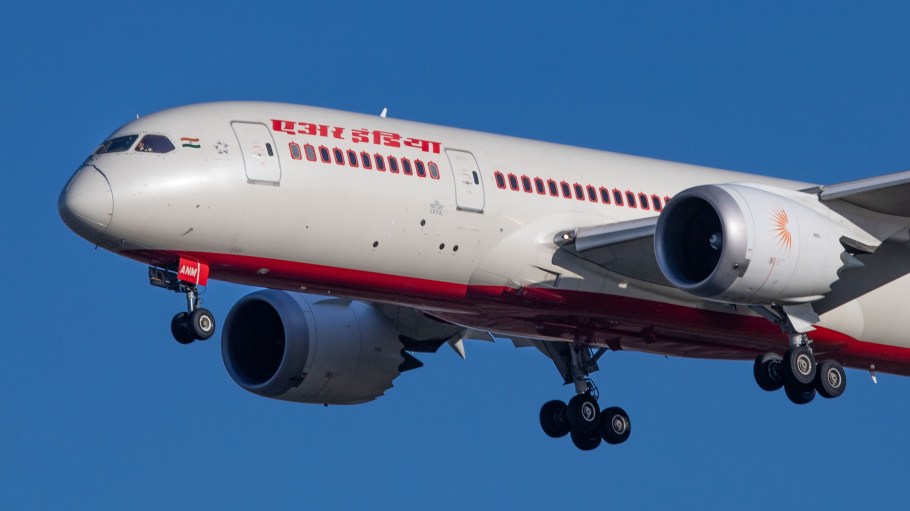
Air cargo exports from India to the U.S. have sunk since the Trump administration doubled tariffs on the country’s goods in late August.
In the week the new 50 percent duties took effect, cargo volumes slumped 12 percent, before falling another 14 percent in the first week of September, according to data from air cargo market data provider WorldACD.
The U.S. had previously levied a 25 percent tariff on India as part of its “reciprocal” duties on trade partners, which went into effect on Aug. 7. President Donald Trump upped the ante to 50 percent by Aug. 27 as a penalty for India’s continued purchases of Russian oil.
Related Stories
The declines followed a sharp, but brief uptick in air freight from India to the U.S. as exporters sought to ship product out of the country ahead of the tariffs in week 34 (Aug. 18-24). Air cargo flowing in that direction increased 28 percent week over week, representing a year-over-year increase of 35 percent.
“India-to-U.S. air cargo tonnages have generally been up, year on year, in recent months, in part due to pressure on U.S. importers to seek alternatives to Chinese suppliers,” World ACD said. “But India-to-U.S. tonnages dipped slightly in the first half of last month after Washington imposed 25 percent ‘reciprocal’ tariffs on imports from India from Aug. 7.”
Reduced volumes are having a stark impact on air freight rates on the trade lane. Spot rates from India to the U.S. have also dropped below $4 per kilogram for the first time in several months, to $3.99 per kilogram in week 36 (Sept. 1-7), or roughly 22 percent below their elevated levels this time last year.
Regardless of transportation mode, the declines correlate with a wider plunge in exports to the U.S. India’s exports to the U.S. fell 14.4 percent to $6.86 billion in August from $8.01 billion in July, trade ministry data released on Monday showed.
The tariffs have hampered India’s textile and apparel exports, which contracted by 2.7 percent in August to $2.9 billion, according to the Confederation of Indian Textile Industry. The number is down from the 5.4 percent annual increase in July to $3.1 billion, attributed to efforts to front-load the goods into the U.S. ahead of the original Aug. 1 trade negotiation deadline imposed by the Trump administration.
When accounting for separate most-favored nation (MFN) duties, apparel sees an even higher tariff than the current 50 percent rate, complicating matters further. Knitted apparel has a 13.9 percent additional MFN tariff, while woven apparel tacks on another 10.3 percent.
As these tariffs—and the Aug. 29 suspension of the duty-free de minimis provision for parcels from all countries—put a dent in India’s air cargo flow out of the U.S., freight is instead moving elsewhere globally.
Air cargo volumes from India to Europe have been rising steadily in the past three weeks to fill some of the void, said WorldACD, with the Sept. 1-7 week’s freight coming in 8 percent higher than the year prior.
Notably, volumes from nearby Sri Lanka to the U.S. have increased “significantly” since the start of August, noting a 13 percent year-over-year jump over to kick off September 2025 based on the more than 500,000 weekly transactions covered by WorldACD’s data. Sri Lanka’s Bandaranaike International Airport in Colombo serves as a transshipment hub for cargo exiting India to other markets.
For the Sept. 1-7 week, worldwide air cargo tonnages were down 3 percent from the week prior. Approximately half of that was due to lower volumes from North America origins, mostly attributable to Labor Day.
WorldACD also highlighted several other emerging air cargo traffic patterns in recent weeks.
Across the past 10 weeks, overall year-over-year tonnages from Asia Pacific to the U.S. are up roughly 5 percent, despite lower volumes from China and Hong Kong, which are down by an average of 5 percent to 10 percent. Additionally, volumes from South Korea have been consistently down by between 20 percent and 30 percent in that time frame.
Taiwan, Vietnam and Thailand are among the markets propping up air freight demand, with tonnages across the three countries on average increasing 40 percent annually.
China and Hong Kong are mirroring India’s shifts, with more products headed toward Europe last month. While China/Hong Kong-to-U.S. volumes in August were flat compared with July, those tonnages were down 5 percent from 2024. In comparison, product flown from those markets to Europe dipped 1 percent month-over-month, but jumped 12 percent on an annual basis.
“Those figures back up reports from multiple sources of freighter capacity being shifted from China/H.K.-U.S. markets to other markets, and particularly to China/H.K.-Europe destinations, in response to the changes in U.S. ‘de minimis’ rules for China/H.K., and higher tariffs,” said WorldACD.