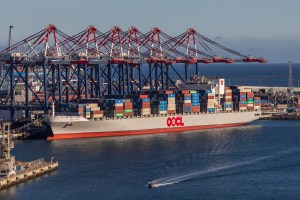
Import cargo volume is projected to drop during the first half of 2026 at the busiest container ports in the United States, and the culprit has become all too familiar.
A “significant” year-over-year decline is expected as American importers continue to contend with the impact of sweeping tariffs on their margins, according to the Global Port Tracker report released Monday by the National Retail Federation and Hackett Associates.
The U.S. ports covered by Global Port Tracker handled 1.99 million TEUs in December, absent delayed reporting from the Ports of Houston and Charleston. This figure represents a 1.7 percent decline from November and a 6.6 percent fall from the same period in 2024. Imports for the full fiscal year totaled 25.4 million TEU, a 0.4 percent drop from the year prior, which saw 25.5 million containers enter the country.
Related Stories
While January data is not yet available, Global Port Tracker projected that the month would see 2.11 million TEU—a jump from December as importers tried to get their shipments in before the Lunar New Year holiday in Asia, which sees factory sputter to a standstill for a matter of weeks. Even with the month-over-month growth, though, the experts believe TEU volumes will be down 5.2 percent from January 2024.
Meanwhile, February is forecast at 1.97 million TEU, a 3.1 percent decline from the same period last year, while experts believe March will see a total of 1.89 million TEU (down 12 percent) and April will ring in at 2.05 million TEU (down 7.1 percent).
Volumes will begin to tick back up in May, when they project U.S. ports will handle 2.13 million TEU (up 9.3 percent from 2025), and in June, when they expect to see 8 percent year-over-year growth to 2.12 million TEU. Global Port Tracker reported that this year’s increases will reflect a contrast with the distinct drop-off in imports during May and June of 2025 following President Donald Trump’s “Liberation Day” tariff announcements in April.
All numbers taken into account, the first half of 2026 is projected to see 12.27million TEU—2 percent lower than the 12.53 million containers handled during the first half of 2025.
Trade and logistics experts are also waiting with bated breath on an impending decision from the Supreme Court on the fate of Trump’s “reciprocal” tariffs, which were implemented using the International Emergency Economic Powers Act (IEEPA). The court will decide whether the president overstepped his authority in leveraging the little-known 1977 statute, signed into law by Jimmy Carter, which allows the president to “regulate” international commerce in the face of a national emergency caused by an “unusual or extraordinary threat” to national security or the American economy.
The Supreme Court did not offer up a ruling in January, and the next possible decision day for the high court is Feb. 20. The court does not indicate which rulings it plans to hand down ahead of time, so stakeholders will have to wait until at least next week for a possible resolution.
Global Port Tracker highlighted, however, that even if the IEEPA tariffs are struck down, concerns abound regarding the administration’s next move. Cabinet officials like Treasury Secretary Scott Bessent—and even the president himself—have indicated that they will pursue alternate avenues within in trade law to levy tariffs on America’s trading partners.
“With tariffs still a matter of debate in the courts and in Congress, their effect on imports is being clearly seen,” NRF vice president for supply chain and customs policy Jonathan Gold said. “The situation underscores the need for clear and predictable trade policies that support supply chain certainty and reliability, business planning and consumer affordability. Tariffs are a tax on U.S. businesses that is ultimately paid by consumers through higher prices.”
Hackett Associates Founder Ben Hackett said tariffs have brought “a global change in trade relations” that is affecting import volumes.
“The continuing use of tariffs against friend and foe alike combined with the uncertainty of when or if they will be implemented makes trade forecasting very difficult,” Hackett said. There’s also a lack of data available from the period that the government was shut down last fall, meaning that assessment of last year’s performance and projections about this year’s decline may be based on insights that could remain incomplete.
“Following essentially flat container import volumes in 2025 compared with 2024, we expect a decline during the first half of 2026 and likely longer,” Hackett added.