Ikea is doubling down on cleaner container shipping.
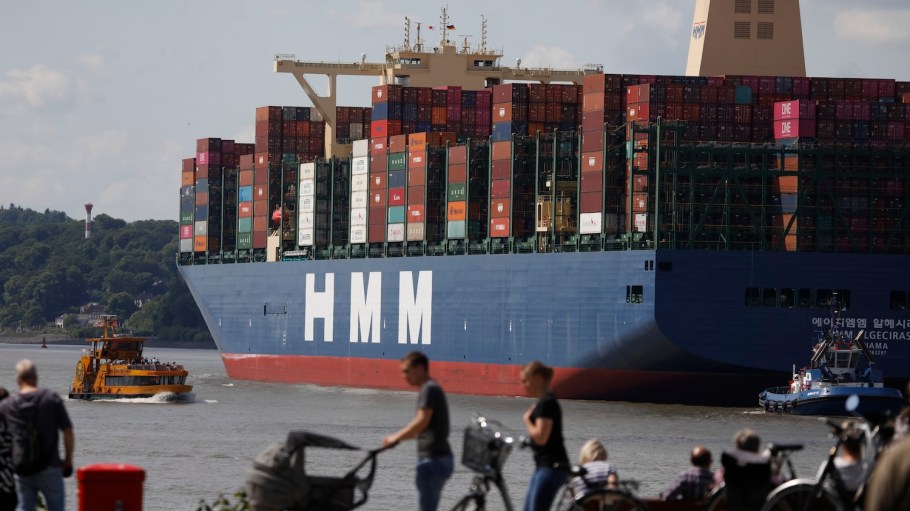
The Swedish home retailer’s supply chain operations unit is teaming with ocean carriers Hapag-Lloyd and Hynduai Merchant Marine (HMM) to decarbonize more of its container shipments.
Ikea aims to reduce the relative greenhouse gas (GHG) emissions from their product transportation by 70 percent by 2030 and to only use zero-emission heavy-duty vehicles and ocean vessels by 2040.
Related Stories
From March 2024 through February 2025, Ikea has agreed to use Hapag-Lloyd’s “Ship Green 100,” a solution which relies on waste- and residue-based biofuel instead of conventional marine fuel oil.
Ikea will leverage the biofuel-filled vessels on shipments originating from Asia, but didn’t elaborate on the particular regions or service lines where it would use the green alternative.
Hapag-Lloyd launched the Ship Green product to offer its customers emission-reduced ocean transports. With Ship Green, customers can choose among three different options, representing different levels of avoidance in carbon dioxide equivalent (CO2e) emissions: 100 percent, 50 percent or 25 percent of their shipment’s ocean-leg CO2e emissions. Ikea is selecting the 100 percent avoidance option.
The expected result for Ikea during this period is a CO2 emission reduction of around 100,000 metric tons.
“It’s through efforts like this one that we can reduce immediate emissions from ocean shipping in the short-term”, said Dariusz Mroczek, category area transport manager, Ikea Supply Chain Operations, of the Hapag-Lloyd partnership. “However, biofuel is not the ultimate solution and we need to continue to collaborate to make the necessary shift toward zero emission fuels and technologies.”
According to Danny Smolders, managing director of global sales at Hapag-Lloyd.
Ship Green brings the ocean freight giant a closer to its goal of net-zero fleet operations by 2045.
With HMM, Ikea signed an agreement to use the container liner’s own low-carbon ocean transportation solution Green Sailing Service.
Like Ship Green 100, the Green Sailing Service revolves around the substantial reduction of CO2e emissions, achieved by substituting conventional fossil fuels with environmentally responsible, waste-based biofuels to ship Ikea products.
Biofuels used for this service are ISCC-certified, and are manufactured from waste-based biomass, HMM says. The company is deploying sustainable biofuel for its Far East-India- Mediterranean (FIM) service.
Notably, the agreement will help reduce around 11,500 metric tons of CO2e emissions from March 1, 2024 till February 28, 2025 with the deployment of such biofuels for the whole of IKEA ocean cargo shipment with HMM.
The amount of CO2e emissions saved through this green partnership with Ikea is capable of transporting 14,534 TEU worth of zero-emission cargo from Busan, South Korea, to Rotterdam, the Netherlands.
Hapag-Lloyd debuted the Ship Green solution in May 2023, while HMM launched the Green Sailing Service early in 2024.
In the 2023 fiscal year, Ikea produced 1 million metric tons of CO2e emissions. By using biofuels in ocean shipping, the retailer reduced 25,500 metric tons of CO2e in FY23, a reduction of 6,100 metric tons more compared to the previous fiscal year.
The home furnishing giant has reduced the average emission per transport by 25 percent since 2017. Vessels currently account for 39.2 percent of total emissions at the company, with the majority emanating from trucks (55.7 percent).
Along with the company’s 2040 zero-emissions goal across vessels and trucks, Ikea seeks to reduce relative emissions by 70 percent from 2017 totals by 2030. In that time frame, the retailer aims for 100 percent renewable energy across its logistics units, whether it be electricity, heating, cooling and internal shunting.
The effort from Ikea comes as major shipping lines have sought to make a wider commitment to decarbonization at sea.
Hapag-Lloyd CEO Rolf Habben Jansen is among execs in the wider ocean shipping industry including Mediterranean Shipping Company (MSC) CEO Soren Toft and Maersk CEO Vincent Clerc, who urged stronger climate action by the International Maritime Organization (IMO) in December 2023.
Those CEOs want a firm cutoff date when the shipping industry must stop building new ships powered only by fossil fuels, and want the IMO to set new regulatory conditions to accelerate the wider transition to green fuels.
Additionally, the co-signatories support the adoption of a new GHG pricing mechanism to make green fuels like methanol or ammonia competitive with traditional fuel during the transition phase when both are used.