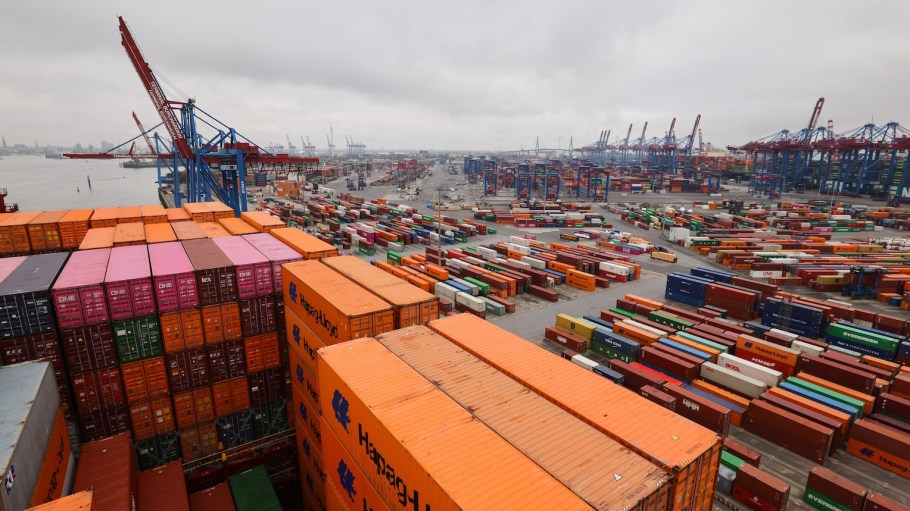
Hapag-Lloyd CEO Rolf Habben Jansen isn’t ruling out a pre-Lunar New Year rush of imports ahead of a second Trump administration, but stopped short of calling the scenario an inevitability.
The caution from the container shipping chief follows concerns from many supply chain stakeholders of a spike in container prices if President-elect Donald Trump goes ahead with plans to levy universal tariffs of 10 percent to 20 percent on all U.S. imports, and duties ranging from 60 percent to 100 percent for China-made goods.
Related Stories
In a third quarter earnings call, Habben Jansen said it was “difficult to judge” how much of the expected increase in imports is due to front-loading cargo into the U.S. ahead of Trump’s inauguration, but described current demand as “very healthy.”
“When we look at the impact of the change in administration, I think that remains to be seen,” said Habben Jansen. “The first time when Trump was in power, we have certainly seen some effects of the tariffs that he imposed, in particular for goods coming out of China. We saw also, on the other hand, that that did not necessarily mean that global trade went down, but it’s more that flows have changed. And I would not be surprised if that’s going to be something similar this time.”
Habben Jansen pointed out the early summer surge in imports as a potential harbinger of things to come as the inauguration and the Lunar New Year get closer. In that period, shippers brought product into the U.S. earlier than usual ahead of the typical peak shipping season and the anticipated Oct. 1 East and Gulf Coast port strikes.
“That would have most likely an effect on short-term rates,” Habben Jansen said. “How big that is going to be, that’s too early to tell.” He also said it was still too speculative to acknowledge whether there will be some destocking or restocking after the Lunar New Year.
Although concerns of a second strike at the East and Gulf Coast ports persist throughout the apparel supply chain, Hapag-Lloyd is “not preparing for that at the moment,” said chief financial officer Mark Frese in the call.
Global container volumes have risen by 6.3 percent year-to-date, marking the highest growth rate since 2021, the company said, with Habben Jansen saying “demand has been much stronger than everyone expected.”
Hapag-Lloyd expects container market demand growth to be roughly 3 percent throughout 2025, in line with expected global gross domestic product (GDP) growth numbers from the International Monetary Fund.
Like its container shipping contemporaries, Hapag-Lloyd’s rising volumes have funneled plenty of money to fortify its top and bottom lines. Revenue at the ocean carrier jumped 28 percent to 5.26 billion euros ($5.55 billion), with total profit jumping to 955 million euros (roughly $1 billion).
The earnings were so strong that Hapag-Lloyd raised its profit guidance for a third time in October.
Average freight rates offered by the company increased 23 percent to $1,612 per 20-foot equivalent units (TEUs) in the quarter, from $1,312 in the year-ago period.
After Hapag-Lloyd released its earnings report Thursday, maritime research consultancy Drewry’s World Container Index (WCI) illustrated that ocean spot freight rates remained flat week over week at $3,440 per 40-foot equivalent container unit.
In line with the index, Habben Jansen said rates have stabilized over the past three to four weeks
“We see that the decline in spot rates that we have seen since the peak mid-July has sort of stopped,” Habben Jansen said. “If you look at where we are now and you compare that to what we had in March, April of this year, we’re actually not that far apart.”
On a year-over-year basis, WCI rates are up 134 percent, with rates starting their acceleration in December after ocean carriers began avoiding the Red Sea.
The ongoing barrage of Houthi attacks in the conflict-ridden waterway has forced Hapag-Lloyd’s upcoming vessel-sharing agreement with Maersk to prepare its East-to-West network exclusively to sail around the Cape of Good Hope.
Bookings for the Gemini Cooperation will start in December, with accessibility to 57 services across 340 vessels, and roughly 3,700,000 TEUs of cargo capacity available. The network will go into effect Feb. 1, 2025.
Hapag-Lloyd and Maersk want to boost schedule reliability rates above 90 percent with the sharing agreement in part by planning fewer port calls in Asia and Europe.
“The big benefit of the structure that we have chosen with Gemini is that on average, our ships will be better utilized because you won’t have these long shoulders of the services in Asia and Europe where you have very low utilization in the first [three to six] ports,” Habben Jansen said. “If you have better asset utilization, you can transport more cargo with the same number of ships across the entire network.”