A U.S. House committee passed legislation aimed at strengthening the authority of the Federal Maritime Commission (FMC) to help protect American shippers and carriers from anti-competitive maritime practices of other nations, namely China.
On Sept. 17, the House Transportation and Infrastructure Committee passed the bipartisan Federal Maritime Commission Reauthorization Act of 2025, which was introduced by Rep. Dusty Johnson (R-S.D.) in June.
The bill, which builds on the Ocean Shipping Reform Act of 2022 (OSRA) still awaits consideration in the House Chamber and a debate on the Senate floor.
Related Stories
“The East Coast, West Coast, America’s heartland and everywhere in between rely on ocean shipping,” said Johnson. “Ocean shipping transports American products around the world and brings in foreign products that help fuel our economy.”
Representatives Mike Ezell (R-Miss.), John Garamendi (D-Calif.) and Salud Carbajal (D-Calif.) co-sponsored the act.
“If we don’t have a functional FMC, we do not have a functional American economy,” Johnson said during his testimony on the bill.
Stating his case to the committee on Capitol Hill, Johnson highlighted the two major “policy wins” in the legislation, identifying both the reinforcing of the FMC’s mission to protect American companies from unfair practices from foreign-flagged ocean carriers, as well as the push to “get tough on China.”
To fortify the FMC’s mission, the bill would reauthorize the FMC through the 2029 fiscal year, and expand the commission’s advisory committees to ensure non-government stakeholders can provide their insight and expertise.
Additionally, the bill would reinforce the FMC’s independent nature by requiring a majority vote of the agency to disclose its investigation efforts to outside parties.
On the China deterrence front, the bill establishes a formal process to report complaints against shipping exchanges like the state-owned Shanghai Shipping Exchange, to the FMC for investigation.
The legislation also codifies the definition of “controlled carrier” under OSRA to encompass state-controlled enterprises in non-market economies like China, and directs the FMC to report on anticompetitive business practices or nonreciprocal trade practices.
Johnson said the bill would ensure Chinese ocean carriers are subject to “rate review standards” to ensure that they are not leveraging their government-supported positions against other market entrants by providing anti-competitive, below-cost pricing.
According to a press release, the Reauthorization Act also updates and improves the purposes of OSRA to better reflect current federal policy governing international ocean shipping, and prohibits the FMC from requiring ocean carriers to report information already reported to other federal agencies.
Garamendi, who along with Johnson introduced the updated version of OSRA in 2021, said the proposed legislation “gives U.S. businesses a fairer playing field in the global marketplace.”
In 2022, former President Joe Biden signed OSRA into law, effectively expanding the FMC’s oversight over the ocean carriers to ensure they were compliant with maritime shipping laws and establish a fair environment for American importers and exporters.
The law went into effect in the wake of numerous accusations by American brands and retailers that container shipping giants had spurned service commitments and charged excessive late fees during the Covid-19 pandemic. At the time, carriers had made record profits due to the unprecedented supply chain congestion, putting them under scrutiny from U.S. lawmakers.
Fast forward to 2025, and OSRA has now become one of multiple footnotes of the ongoing trade war between the U.S. and China under the Trump administration.
High tariffs have been the central theme of the tit-for-tat trade war, with U.S. duties on Chinese goods reaching as high as 145 percent before being knocked back down to 55 percent upon the countries’ agreement to a tariff truce that has been extended multiple times. Throughout the negotiations, China elevated the tariff bar to 125 percent before pulling the number back to 10 percent.
The global ocean freight ecosystem has had to adapt to the geopolitical tug of war, with the U.S. set to slap fees on China-built and -operated vessels that dock at American ports starting Oct. 14.
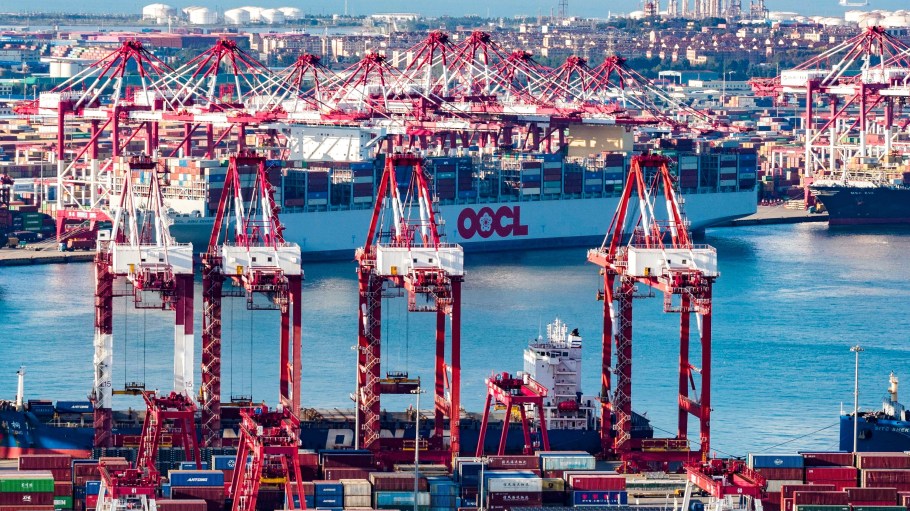
Chinese carriers Cosco Shipping and subsidiary Orient Overseas Container Line (OOCL) will be the two heaviest impacted container shipping lines, as operators out of the country will be charged a heavier fee. Various reports have estimated the combined fines for the companies would range between $1 billion and $2 billion in 2026.
On Sunday, Chinese Premier Li Qiang signed a state decree that opened the door for the country’s government to retaliate to the port fees and other restrictions on Chinese operators and vessels, although it didn’t directly name the U.S. as part of the order.
That decree includes a revision to international maritime transport rules, in which China could potentially charge special fees on vessels when calling at Chinese ports or prohibit or restrict these vessels’ port access in China.