Tariff-related headwinds are expected to deliver a $170 million hit to FedEx in the first quarter, primarily as the company adapts to revenue pressures out on the trans-Pacific trade lane.
FedEx chief customer officer Brie Carere said in an earnings call Tuesday afternoon that China-to-U.S. volumes “deteriorated sharply” in early May, resulting in flat international export revenue for the fourth quarter.
“Within that, the vast majority is the impact of de minimis,” said Carere, referring to the recently closed-off trade exemption for low-value packages entering the U.S. from China. Businesses that had supply chains rooted in China, like Shein, Temu and Amazon, all used de minimis to ship goods into the U.S. tax-free via air freight before the Trump administration banned the provision as of May 2.
Related Stories
The bilateral China-to-U.S. lane represents around 2.5 percent of consolidated revenue at FedEx and is the company’s most profitable intercontinental lane, said chief financial officer John Dietrich.
The headwinds have been reflected in FedEx’s first quarter guidance with range of flat revenue to 2 percent revenue growth, and an adjusted earnings per share range between $3.40 and $4. Company stock fell 5 percent in after-hours trading Tuesday on the muted earnings guidance.
“Internationally, we expect revenue from the China-to-U.S. lane to remain pressured consistent with what we saw exiting Q4,” Carere said.
The Memphis, Tenn.-based carrier did not issue guidance for revenue and earnings estimates in 2026.
However, the company remains optimistic it can be well prepared to continually alter shipping routes to match demand.
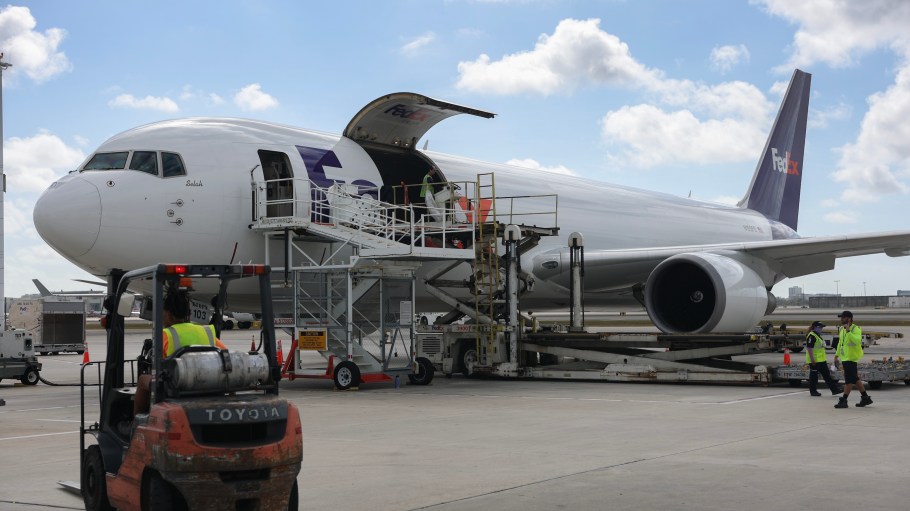
FedEx has shifted its air operations substantially as it adapts to the tariff-driven demand environment and implements its “Tricolor” network redesign strategy, having reduced capacity on the Asia-to-Americas lane by more than 35 percent in May compared to April.
“The patterns are changing as we speak,” said FedEx CEO Raj Subramaniam in the call. “Clearly, we are seeing growth from Southeast Asia, for example, Vietnam.”
Subramaniam highlighted the April launch of the company’s first direct flight from Singapore to Anchorage, Ala., which operates six times a week and allows shipments picked up in Singapore, Vietnam, Malaysia and Thailand on Saturday to arrive in the U.S. on Monday.
Another $120 million in headwinds from the expiration of FedEx’s air cargo contract with the U.S. Postal Service (USPS) is a major factor in the shifting air freight capacity. In the fourth quarter, the company took a $21 million impairment charge upon retiring 12 aircraft from its rotation.
Over the last three years, FedEx has removed a net 31 jet aircraft from its fleet, a 7 percent reduction versus fiscal year 2022. This brings total aircraft at the company to 698, when including feeder planes operated by partner airlines.
The reevaluation of the air fleet comes as the courier is two years into a wider $6 billion cost-cutting and consolidation plan.
FedEx is targeting $1 billion in cost savings through its upcoming 2026 fiscal year after hitting its $4 billion Drive cost reduction goal through 2025.
As part of the company’s Network 2.0 delivery network consolidation embedded within Drive, Subramaniam revealed that FedEx is planning on removing roughly 30 percent of the company’s service facilities by the completion of the initiative at the end of 2027.
Thus far, Network 2.0 has resulted in the closure of 100 stations and the integration of 290 stations. The company says it is still looking to hit the $2 billion savings goal by the conclusion. Roughly 2.5 million in average daily volume flows through Network 2.0-optimized stations
“The best way to describe it is that we’re on track. This was a long game exercise and initiative,” said Dietrich. “We’re seeing the 10 percent improvement on our PUD,” referring to reduced pickup and delivery costs in markets that have fully rolled out Network 2.0.
The package delivery giant expects to share more updates on the Network 2.0 plan at its investor day in early 2026.
As for the fourth-quarter results, FedEx generated revenue of $22.2 billion, up 1 percent from the year prior, on net income of $1.65 billion, or $6.88 per share. Both revenue and earnings exceeded Wall Street expectations.
Total average daily package volume climbed 5 percent in the quarter to 16.8 million packages per day.
U.S. domestic average daily package volume increased 6 percent to 13.8 million, while ground delivery volumes jumped 10 percent to 6.9 million daily parcels on average. Internationally, export volumes out of the U.S. increased 3 percent to 1.1 million parcels.
For the soon-to-be spun off FedEx Freight segment, revenue declined 4 percent to $2.2 billion, while total average shipments dipped 1 percent to 92,100 per day.
The earnings report followed the death of FedEx chairman and founder Fred Smith just three days earlier. Smith launched FedEx, then Federal Express, in 1973, and served as the CEO of the company until his retirement in 2022.
FedEx named Brad Martin, who was recently appointed as chairman of FedEx Freight, to replace Smith in the chair position.