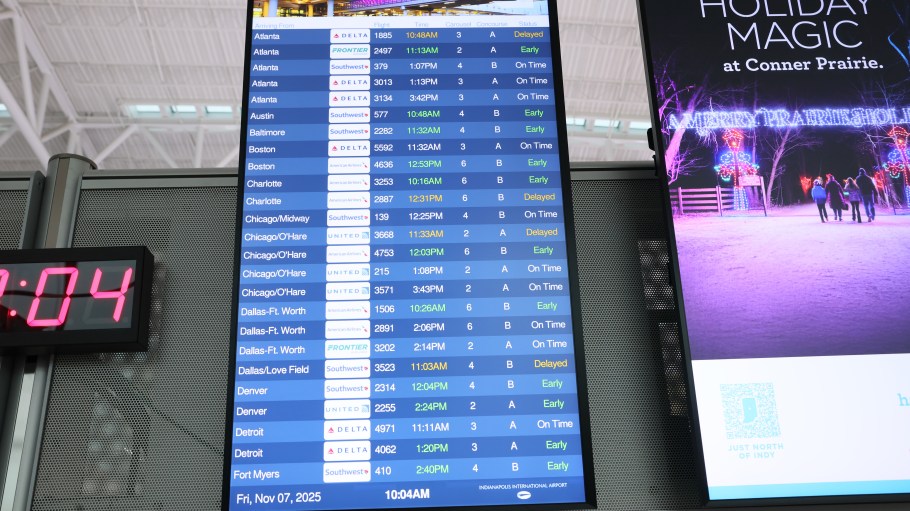
Dozens of major airports across the U.S. began cutting flights Friday morning after a directive from the Federal Aviation Administration (FAA) as the ongoing government shutdown has left air traffic controllers working without pay.
In total, 40 high-volume airports have seen a reduction in flights starting Friday morning across major metropolitan areas such as New York, Chicago, Los Angeles, Atlanta, Dallas to prioritize air traffic safety and alleviate any bottlenecks from the labor concerns.
Related Stories
As of 1 p.m. Eastern time, there have been more than 850 cancellations for flights in and out of the U.S., along with more 2,300 flight delays.
The FAA said the reductions would start at 4 percent of total flights and escalate to 10 percent by Nov. 14. They are to be in effect between 6 a.m. and 10 p.m. and impact all commercial airlines.
The slowdown comes at an awkward time shippers as look to move goods via air ahead of the holiday season. But reactions are largely being mixed over direct impacts on cargo movement through the U.S.
“If there are reductions then it is usually the smaller passenger planes that are most affected, which are less relevant for air cargo,” said Niall van de Wouw, chief air freight officer at Xeneta, told Sourcing Journal. “Even then, air cargo makes up a very small percentage of total flights so this issue is likely to have limited impact on air freight services.”
There is still concern among some players in the logistics industry, with the Airforwarders Association (AfA) warned that the FAA’s reductions airports will deepen the disruption already being felt across the aviation sector.
“Forwarders and their customers need answers,” said Brandon Fried, executive director at the Airforwarders Association in a Thursday statement. “Air cargo depends on every part of the aviation ecosystem working in sync. When capacity is cut and federal employees are stretched thin, the supply chain slows, and the longer this shutdown continues, the worse it will get.”
Fried warned that with essential federal employees, including air traffic controllers, Transportation Security Administration screeners and Customs and Border Protection officers already missing paychecks, staff shortages will continue to mount.
Xeneta’s van de Wouw agreed that services outside of the flights themselves could pose problems to deliveries.
“Inefficiencies in ground operations, such as customs and regulatory checks, would be of more concern in terms of impact on air freight if it slows down the release of goods,” he noted.
FedEx said it has made the necessary operational modifications to meet the FAA’s requirements. According to a company spokesperson, the majority of its flights operate at night, outside of the FAA-restricted daily timeframe. The company confirmed with the FAA that international flights will continue without interruption.
The courier’s primary air cargo sorting and handling facility is located at Memphis International Airport, which is one of the airports affected by the cutbacks. Its second national air hub is located at Indianapolis International Airport, which is also impacted.
“Contingency plans are in place to flex our integrated air and ground network to help protect time-sensitive, critical shipments such as lifesaving pharmaceuticals, medical devices and other products move through our network without disruption,” said a FedEx spokesperson. “As always, safety remains our top priority.”
UPS did not return comment, but the company’s Worldport air cargo hub is located within another of the selected airports, Louisville Muhammad Ali Airport. That 5-million-square-foot sorting and handling site temporarily closed midweek due to a cargo plane crash on location, already causing shipment delays ahead of the FAA mandate.
The Atlanta-based courier also has four other regional U.S. air hubs, three of which are on the restriction list, including Philadelphia International Airport, Dallas Fort Worth International Airport and California’s Ontario International Airport.
DHL, which operates its U.S.-based global air hub in Cincinnati/Northern Kentucky International Airport, said it has not experienced any flight cancellations directly related to the shutdown, but remains “vigilant.”
“Should air freight capacity become constrained, DHL is prepared to activate trusted contingency plans,” a spokesperson said. “Our global network and flexible logistics infrastructure enable us to maintain service continuity and minimize disruption to customer shipments.”
The logistics giant also has major air hubs in affected airports including Los Angeles International Airport, New York’s John F. Kennedy International Airport, Chicago O’Hare International Airport and Miami International Airport.
The FAA said the cutbacks are necessary to relieve pressure on air traffic controllers who have been working without pay for more than a month since the start of the government shutdown.
Many are working six-day weeks with mandatory overtime, with FAA Administrator Brian Bedford saying 20 to 40 percent of controllers were not showing up for work at the top 30 airports.