Congestion at European ports has been a common theme throughout the first half of the year, and there’s very little sign that it will letting up any time soon.
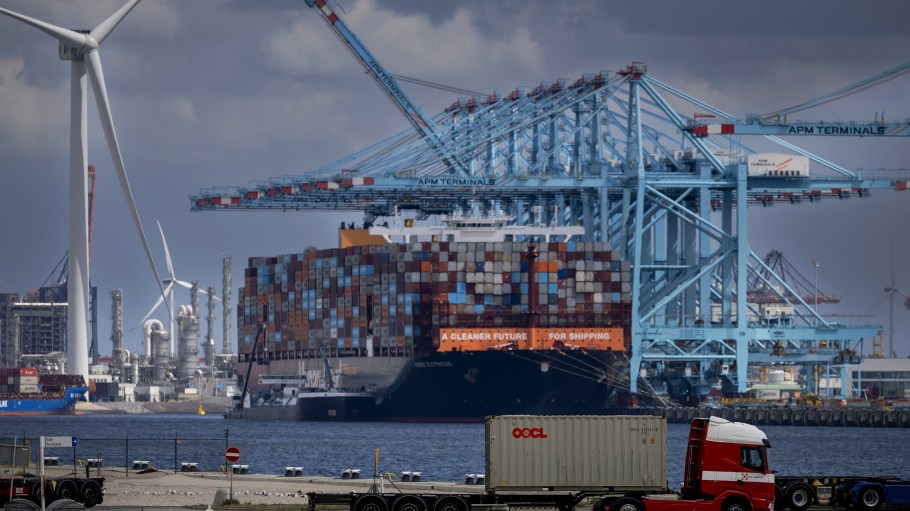
Vessels are enduring wait times of up to 10 days for a berth in the Port of Rotterdam’s World Gateway Terminal, according to a customer advisory from HMM (Hyundai Merchant Marine) released Tuesday.
The port’s other major terminal, ECT, has a two-day wait for late arriving ships, but is enduring low labor turnout and longer-than-usual waiting times for trucks during peak hours.
Related Stories
On Tuesday, Europe’s largest seaport acknowledged what it called “exceptional congestion” that has led to the wait times, mainly on land.
“Various causes, such as the transition to new sailing schedules (phasing in and out of services), high call sizes, changing alliances, work interruptions and challenging weather conditions at the beginning of the year have led to increasing waiting times on the land side of the deep-sea terminal operations,” the Netherlands-based port said.
Although the Rhine River has experienced low water levels in 2025, the situation has “not yet had a demonstrable negative effect on container handling” in the first half of the year, according to the port.
Linerlytica data says Rotterdam has the fifth-most 20-foot equivalent units (TEUs) at anchorage among all ports, only behind three of China’s biggest ports (Shanghai, Ningbo and Qingdao) and Singapore.
Operational issues have befallen the Port of Antwerp-Burges as well, with its Noordzee Terminal seeing an average waiting time of 1.5 days, according to HMM. While the ocean carrier said dwell times were slowly improving, it also noted the period where containers can be accepted at the terminal’s yard has been reduced from seven days to five days.
Like Rotterdam, Antwerp has also dealt with heavy trucking congestion outside the port, complicating matters PSA, the terminal’s operator, is suggesting truckers to consider truck slots during the night, and is imposing extra costs for those picking up cargo during peak hours.
The port also attributed its own problems to other areas, including multiple labor strikes in recent months and supply chain shifts.
“Container ship arrivals remain irregular due to disruptions dating back to the Covid crisis, further exacerbated by rerouting around the Cape of Good Hope to avoid the Red Sea. The recent reshuffling of container alliances has temporarily led to simultaneous vessel calls and high cargo volumes,” said the port in a press release. “Poor schedule reliability is complicating terminal planning: containers remain on site longer, and vessels are arriving with increasingly large loads.”
Adding to the concerns at Europe’s top two ports, as well as others like Hamburg and Bremerhaven in Germany and Valencia and Algeciras in Spain, more ships are flowing throughout the continent, particularly throughout Northern Europe.
Intra-North European service capacity has grown by 17 percent, or 43,000 TEUs, compared to July 2024, according to data from Alphaliner. Carriers deployed more ships (235 compared to 223) in intra-North European services with a larger average size (1,253 TEUs vs. 1,128 TEUs).
“In terms of seasonality, July is typically the month wherein the most cargo is loaded from Far East to Europe, which means arrival into European ports in August and September,” said Lars Jensen, CEO of container shipping consultancy Vespucci Maritime, in a LinkedIn post. “The lack of progress in removing port congestion in Europe is worrying seen in the light of this coming peak load of cargo.”
According to E2open’s Ocean Shipping Index, Rotterdam and Hamburg were the top two global ports contributing to longer export time performance in the second quarter.
Vessels out of Rotterdam took 42 days to get to their destination on average, a three-day (7 percent) increase from the year prior.
Ships sailing from Hamburg had an average journey of 43 days, or two days (5 percent) more than the prior-year period.
“The bad news is [port congestion is] here to stay for the remainder of 2025, causing operational disruption and pushing freight rates up,” said Peter Sand, chief analyst at freight benchmarking platform Xeneta, in commentary posted July 8.
As of Friday, average spot rates from the Far East to Northern Europe were up 18 percent compared to end-June, Sand noted. The trade lane has seen container prices skyrocket 78 percent since the end of May to $3,410 per 40-foot equivalent unit, driven heavily by the congestion.
“Carriers have been forced to revise service schedules, whether that is avoiding port calls in congestion hot spots or calling at ports they would not ordinarily do so,” said Sand. “This causes disruption that becomes exponentially difficult to unwind and another painful headache for shippers.”
This month, Gemini Cooperation partners Hapag-Lloyd and Maersk announced their NE4/AE5 service on the Asia-to-Europe trade lane will temporarily operate with a revised port rotation starting in September. Hamburg will be called before Bremerhaven, and ports in Aarhus, Denmark and Gothenburg, Sweden will be added to the rotation.
With these adjustments, the carriers aim to improve schedule reliability and address the fluctuating congestion.
Additionally, Mediterranean Shipping Company (MSC) has adjusted its Asia-to-Northern Europe services, taking two port calls out of Antwerp. The Swan service will swap out Antwerp for the U.K.’s Port of Felixstowe, while its Britannia service will drop an inbound call at the Belgian gateway.
Changing port calls isn’t the only way carriers are trying to improve service throughout the ongoing disruptions.
Hapag-Lloyd is introducing a 125-euro ($146) booking cancellation fee from Northern Europe as of Aug. 15.
This fee applies to containers that are cancelled, reduced, rebooked within five calendar days before the scheduled estimated time of departure, or not loaded for any other reason. The fee is valid for all trades and container types.
“This update supports our efforts to reduce operational disruptions and maintain a high level of service reliability by minimizing the impact of last-minute booking changes, improving planning accuracy and equipment availability and ensuring fair access to vessel space for all customers,” Hapag-Lloyd said.