Two of Bangladesh’s top apparel trade associations are teaming up to establish a temporary warehouse at Hazrat Shahjalal International Airport (HSIA) in Dhaka following a fire that broke out at its cargo-handling hub earlier this month.
The Bangladesh Garment Manufacturers and Exporters Association (BGMEA) and the Bangladesh Knitwear Manufacturers and Exporters Association (BKMEA) are jointly setting up a modular Rubb Hall structure near the airport’s newly constructed Terminal 3 to store imported raw materials and other imported goods.
Related Stories
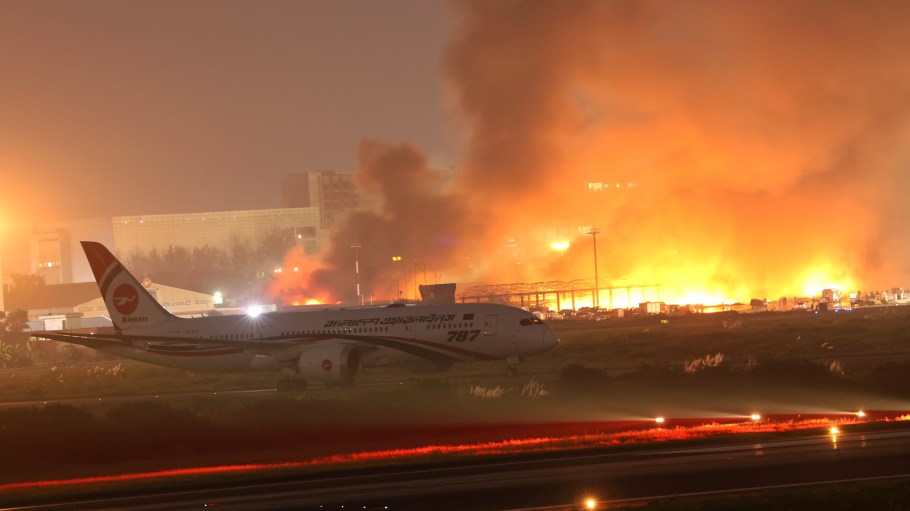
The fire blazed through the airport’s “cargo village” on Oct. 18, causing roughly $1 billion in damage to a site that handles anywhere between 800 and 1,000 metric tons of cargo daily during high-demand periods.
The incident “severely damaged” the import shed, rendering it temporarily unusable and disrupting import operations for the apparel sector. To address this situation and ensure uninterrupted export activities, both industry bodies agreed to establish the interim storage solution.
According to the BGMEA, a supplier has already been assigned to install the tent-like structure. No exact timetable has been given for its completion, other than that it is expected to be concluded in a short timeframe.
“BGMEA reaffirmed its commitment to ensuring the smooth continuation of the industry’s import and export operations with full government cooperation,” the trade group said in a statement. “The association believes this joint initiative will play a vital role in securing imported goods and supporting the country’s overall export trade continuity.”
The setup of a new tent to safely store cargo is essential to Bangladesh’s apparel manufacturing capabilities, especially for an industry that relies heavily on the timely import of raw materials into the country.
Ready-made garments (RMGs) are central to Bangladesh’s export economy, making up 81.5 percent of the total value of goods shipped out of the country during the 2024-2025 fiscal year, according to the country’s Export Promotion Bureau (EPB). Of Bangladesh’s $48.3 billion in total exports, apparel comprised $39.3 billion.
High-value goods and urgent air shipments including raw materials, finished garments and product samples were destroyed in the fire, BGMEA senior vice president Inamul Haq Khan told Reuters. According to Khan, the loss of the product samples could jeopardize future business, as they are “essential for securing new buyers and expanding orders.”
Roughly 200 to 250 factories send their products out of the country every day via air, according to the association.
The industry is currently enduring challenges posed by U.S.-imposed tariffs of 20 percent, which both the BGMEA and BKMEA attributed to a year-over-year decline in apparel exports in September. For the month, RMG exports dipped 5.7 percent to $2.8 billion, EPB data says.
With the duties in place, representatives from both associations said most buyers are either delaying or not placing new orders.
On Oct. 20, BGMEA president Mahmud Hasan Khan, BKMEA president Mohammad Hatem and senior leaders from both associations met with commerce, civil aviation and tourism advisor Sheikh Bashir Uddin to discuss the fire’s impact and explore recovery measures. At the meeting, the parties decided to establish the temporary storage facility.
Faisal Samad, a director at the BGMEA, previously told Sourcing Journal that the association was working on a portal where its member manufacturers and exporters could input the names of factories that have suffered losses.
Dhaka’s customs house remained open last Friday and Saturday to assist with the clearance of import consignments and ease congestion at the airport.
In recent years, HSIA has been a hotspot for congestion as Bangladesh’s primary air cargo hub, with the cargo village initially built to handle 300 metric tons per day. But with the area seeing as much as 1,200 metric tons during peak periods and the congestion (and higher freight rates) incentivizing exporters to instead ship goods out of India, the airport decided to build out the third terminal.
Terminal 3 has still not fully opened to the public, with delays pushing its launch to December. Once fully operational, the terminal is expected to triple the airport’s annual passenger capacity and double its cargo handling capability.
After India revoked transshipment privileges for Bangladeshi exporters earlier this year, the Civil Aviation Authority of Bangladesh established cargo operations in Osmani International Airport in Sylhet to free up some of the congestion in Dhaka.
The authority was also working to resume cargo flight services at Chattogram’s Shah Amanat International Airport for the first time since 2022 to give exporters more direct opportunities to Europe and China. But the renovation of the export cargo station is still in tender processing and unlikely to be completed this year, delaying the initiative.