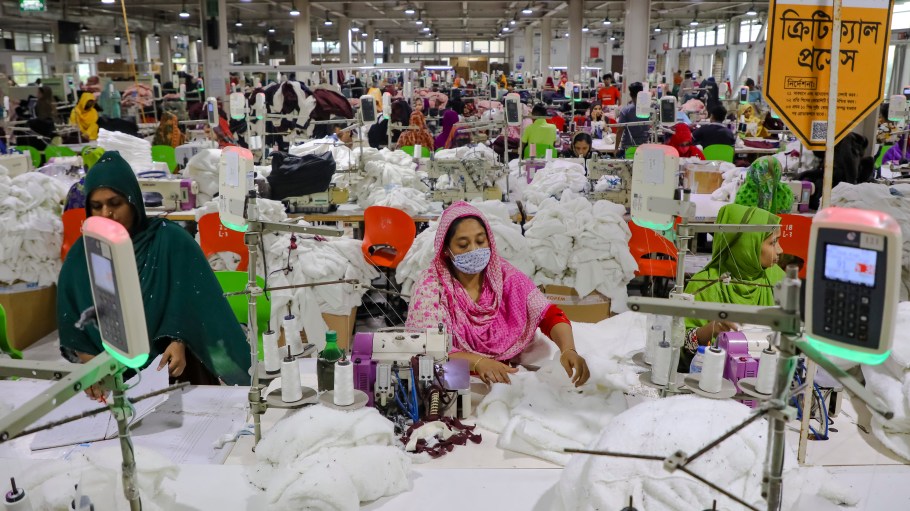
How long can workers endure heat stress as the climate crisis accelerates?
Stand.earth, along with Oxfam Bangladesh and the Bangladesh Center for Workers Solidarity (BCWS), has developed a series of recommendations directed specifically at fashion brands sourcing from the nation. According to the Roadmap for Accelerating the Shift Towards a Just Energy Transition for the fashion industry in Bangladesh, launched Tuesday at the OECD Forum in Paris, there is extreme urgency for a fast and fair switch to clean energy, backed by a step-up in financing from global brands.
Related Stories
Bangladesh is the world’s second-largest apparel exporter and the ninth most climate-vulnerable country globally, placing it at the center of the fashion industry’s climate and labor challenges.
Despite this, the roadmap finds that brands are failing to provide meaningful support for either decarbonization or climate adaptation: Only six of 42 major fashion brands assessed in Stand.earth’s 2025 Fossil Free Fashion Scorecard reported any decarbonization financing for suppliers, and only one provided non-loan-based funding. Complicating matters, not one brand provided clear evidence of financing or training to support climate adaptation for workers, even as factory temperatures reach 40 degrees Celsius and climate-related disruptions intensify, according to the report.
“Brands need to be more equitable partners to create a more just energy transition for the garment sector,” Rachel Kitchin, senior corporate climate campaigner at Stand.earth told Sourcing Journal. “Financing is one of the biggest obstructions to decarbonization and other forms of energy rationalization,” she said, underlining the urgent need for capital to support climate-resilient factory infrastructure as well as the retrofitting of existing facilities. “Without dedicated capital for adaptation, the threats to worker health and safety, as well as productivity, will be stark.”
Stand.earth is a North American environmental NGO headquartered in San Francisco.
Kitchin said that while the report focuses on Bangladesh, the same framework could be applied to other countries in the future. “Local solutions in each country are key to the way forward,” she emphasized.
Accounts from workers detailing severe heat stress, unsafe drinking water and a lack of ventilation and cooling systems underpin many of the report’s findings. Worker representatives also raised concerns about automation and energy transition technologies, warning that they could lead to further job losses if not managed carefully.
Over the past year, uncertainty around tariffs, rising production costs, and declining exports have slowed growth. A 2025 study by the Bangladesh Labour Foundation (BLF) found that technological upgrades in the apparel sector have resulted in a 30.58 percent reduction in overall employment, disproportionately affecting entry-level jobs. According to an official from the Bangladesh Knitwear Manufacturers and Exporters Association (BKMEA), around 250 garment factories have shut down over the past 18 months, resulting in more than 220,000 job losses.
Kitchin said manufacturers face price “blackmail” driven by power imbalances between buyers and suppliers, where price remains the dominant decision-making factor and buyers exert significant downward pressure on factories. This dynamic, she said, discourages investment in renewable energy and electrification, particularly when factories have no assurance of continued orders from brands.
Speaking during a panel discussion Tuesday, Razequzzaman Ratan, president of the Samajtantrik Sramik Front (SSF), stressed the importance of creating safe spaces for workers to speak freely about climate, health, and labor issues. He proposed convening hearings in specific industrial zones, facilitated by trade unions, where workers could openly share local challenges.
Kalpona Akter, founder and executive director of BCWS, said that concepts like “green energy” and “decarbonization” often feel abstract to workers. “These are very big words,” she said. “Our workers are fighting for basic rights and wages. They want to know why they are facing heat stress, floods during heavy rain, and no electricity at home.” She added that information must be shared clearly, along with accountability: “Is it the government’s responsibility? The manufacturers? Or the brands as well?”
While emphasizing that responsibility must be shared among all stakeholders, Akter urged brands to step forward and take ownership of their role in the transition.
Vidiya Amrit Khan, vice president of the Bangladesh Knitwear Manufacturers and Exporters Association (BGMEA) and deputy managing director of Desh Garments Limited, noted that manufacturers are already “inundated with compliance.” Bangladesh, she said, has the highest number of green factories globally, and green buildings have improved lives—but they do not necessarily guarantee greener manufacturing processes.
“One of the ways to meet environmental targets set by brands is to significantly increase renewable energy use,” she said. “We have targets of increasing renewable energy usage by 30 percent by 2030. We are almost halfway there in time—but we are still at only 4 percent.”
Khan also pointed to the realities of implementation at the factory level. “Financing exists, but even within Bangladesh there is a lot of red tape,” she said, noting that while large factories can access loans more easily, small and medium enterprises face greater barriers.
“A ‘just transition’ is not just about my house or my factory,” Khan said. “It has to benefit the entire industry, with every stakeholder—including brands and the government—involved.”
The report echoes this urgency, noting that brands are often hesitant to support ring-fenced climate financing for single investments, such as solar installations, preferring instead to embed support within broader operational strategies. Some brands also cited seasonal sourcing patterns as a challenge in calculating long-term financing commitments.
The report argues for pooling funds across the industry, rather than relying solely on individual brand-supplier relationships, and highlights the importance of collective initiatives such as the Future Supplier Initiative. Many brands agreed, however, that financing must be paired with technical assistance, diagnostics, and capacity building, along with strong governance and grievance mechanisms to ensure transparency.
As part of its roadmap, the report recommends that brands engage in constructive dialogue with the Bangladesh government and institutions such as Bangladesh Bank and the Bangladesh Climate Change Trust Fund to develop new financing mechanisms. These should support not only large manufacturers but also small and medium-sized factories, ensuring access across the sector.
“There’s going to need to be a shared cost,” Kitchin said. “The key is shifting 50 percent or more of that cost to brands—ensuring they contribute to upfront investments while also paying fair prices in more sustainable ways.”
Rather than naming and shaming, the report focuses on outlining concrete solutions. “This isn’t about calling out leaders or laggards,” Kitchin said. “It’s about identifying what works.” She noted that brands such as H&M have taken meaningful steps through funding, loans, and grant-based financing, while others, including Marks & Spencer, have been active in different areas. “The goal is to build on existing best practices and create a roadmap other brands can follow.”
Kitchin also pointed to the role the RMG Sustainability Council (RSC) could play in implementing and monitoring progress. “We don’t want to increase pressure on suppliers with more requirements,” she said. “We want to build on systems that already exist. The RSC has strong supplier connections and experience with worker safety, which could be expanded to include climate adaptation and energy efficiency.”
Based on consultations with brands and other research, Kitchin said awareness of climate risks is growing, but action remains limited. “Brands know climate is important, but what’s expected of them— and how to act—often isn’t clear. We hope this roadmap helps define that path.”
While a small number of brands have begun adjusting procurement policies and financing models, she added, change has yet to materialize across the industry. “This is our call to action,” Kitchin said. “It’s the start of the conversation we want to have with brands and stakeholders.” She suggested that engagement could begin with brands publishing just energy transition plans, increasing transparency, and committing publicly to action.