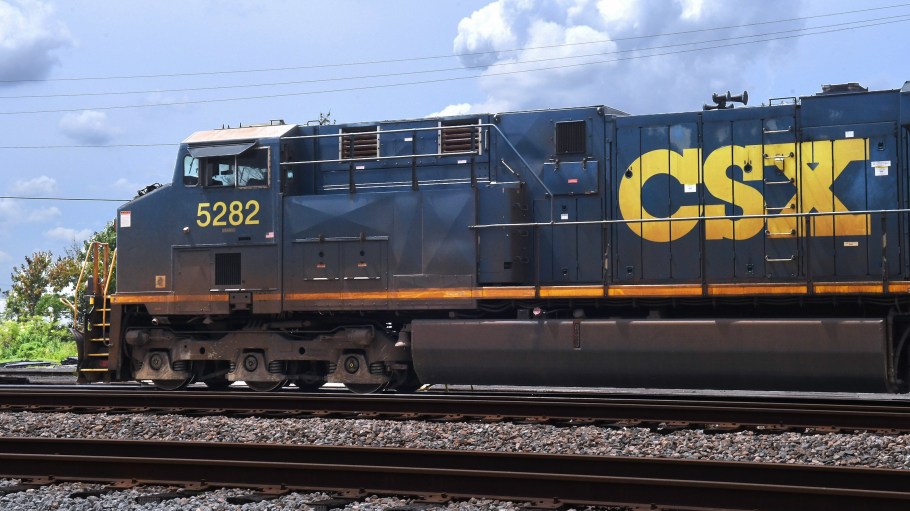
CSX executives announced Thursday that the rail company beat expectations with its Q3 earnings.
The company struggled to shrug off the impacts of a difficult coal market despite its intermodal growth, executives noted. Overall revenue declined by about 1 percent year on year, and expenses climbed 3 percent.
Still, the company, based in Jacksonville, Florida, said it made 37 cents per share, or $694 million, in Q3, which is down $200 million since the same timeframe last year. The company said that a $164 million goodwill impairment charge dragged that figure down by 7 cents a share; the adjusted figure beat analysts’ expectations by a cent.
Related Stories
And while Sean Pelkey, executive vice president and chief financial officer of CSX, said executives “still expect to deliver volume growth for the full year,” investors had their eye on a different issue: mergers.
Analysts took the call as a chance to ask the company’s new CEO, Steve Angel, about mergers and acquisitions. The questions came as Union Pacific and Norfolk Southern continue pursuing the $85 billion merger, which the companies formally announced this summer.
While Union Pacific and Norfolk Southern’s intentions are clear—and they have received backing from organizations like SMART Transportation Division (SMART T-D), the U.S. rail industry’s largest union, and from President Donald Trump—they still face regulatory hurdles. Any such merger would require the express approval of the Surface Transportation Board (STB).
The deadline for public comments to the STB was Thursday. During the comment period, rail player BNSF called on its customers to share the issues they might have with a Union Pacific-Norfolk Southern merger after publicly noting that it doesn’t believe the merger would be beneficial for the industry or its customers.
Angel didn’t seem ready to rebuke the possibility of a Union Pacific-Norfolk Southern merger on Thursday, but he did note that Union Pacific and Norfolk Southern will need to take the regulatory requirements associated with a merger seriously.
“It’s kind of hard to really say standing here today how all this is going to shake out because there’s a lot of it that hasn’t been determined yet. There is a very rigorous approval process that [these] two parties are going to have to go through. And when I read the language of the evaluation criteria from the STB, it’s pretty onerous,” Angel told investors.
In that vein, Angel didn’t seem bullish on proposing any merger between CSX and another major rail company in the immediate near term. The CEO highlighted the importance of operating CSX as a “standalone company” and said that, in doing so, leadership could uncover opportunities to grow margins and the business in the future.
“I can say right now, we can improve the performance of the base business, capitalize on the opportunities in front of us. And if there’s a better path to shareholder value that presents itself later on, we will 100 percent pursue that,” he told investors Thursday.
BNSF and CPKC have said publicly that they lack interest in completing a merger that would see the creation of a transcontinental railroad. Instead, they have taken the Union Pacific-Norfolk Southern plans as an opportunity to collaborate with other rail companies. Activist investors have put pressure on CSX to pursue a merger.
That’s, in part, because the proposed merger would see the companies handling cargo coast to coast without interruptions, so the companies that want to continue operating as standalone rail players are looking for a way to compete and streamline rail cargo shipments.
Angel, who comes from Linde, where he oversaw the company’s merger with Praxair, said that under his new tenure as CEO, the company will work to build value by focusing on how it can bolster its own business—like by capitalizing on market trends, including softer trucking outlook.
“The opportunity set has always been there for railroads to work more closely together to take trucks off the road, for example, and so we see those opportunities. We’re working on those opportunities. You can look at our numbers and see we’ve already had some success, and I think that’s definitely additive to our base case going forward, and we’ll continue to pursue those opportunities,” Angel said.