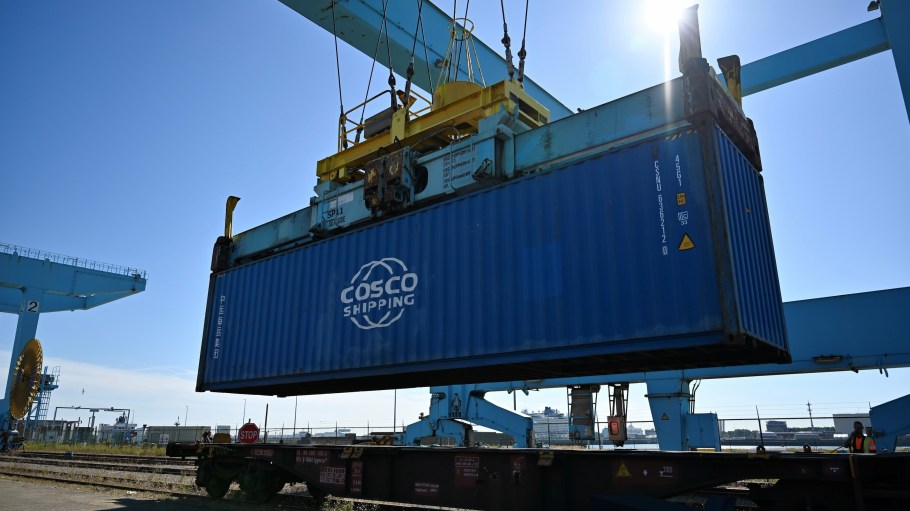
Although the U.S. is set to slap new fees on Chinese ships planning to dock at American ports, Cosco Shipping is reassuring customers that its service levels will remain “stable and reliable.”
Port docking fees levied by the U.S. Trade Representative (USTR) are set to take effect on Oct. 14. Starting then, USTR will charge Chinese vessel operators an extra $50 per net ton for every voyage that includes U.S. ports. Starting April 17, 2026, carriers will incur an additional fee of $30 per net ton per year through 2028, when the charge will total $140 per net ton.
Related Stories
“While the port service fees may pose certain operational challenges, Cosco Shipping Lines remains confident in our ability to ensure stable and reliable services in the United States,” Cosco said in a customer advisory Tuesday. “We are committed to maintaining stable capacity deployment and service quality, consistently delivering reliable, secure and high-quality logistics solutions.”
In the advisory, the state-owned ocean carrier said it is “actively enhancing” its product portfolio to meet evolving demands of the U.S. market, but did not elaborate on the changes.
“We will maintain competitive rates and surcharges, along with related policies that align with market conditions,” the company said. Cosco also emphasized that it had been compliant with U.S. laws and regulations.
The fees are expected to carry significant financial ramifications for Cosco Shipping.
Between Cosco Shipping and its subsidiary, Orient Overseas Container Line (OOCL), both companies combined have been projected to pay $2.1 billion in fines in 2026, according to a report from HSBC. For Cosco on its own, the fines would put a 5.3 percent dent in revenue forecasts for the 2026 fiscal year and erode 74 percent of consensus earnings forecasts.
OOCL acknowledged in August that it was anticipating a “relatively large impact” on its overall business. The Hong Kong-based company said it intended to take advantage of the situation by seeking out more opportunities to expand in Southeast Asia and South America.
All the roughly 70 vessels Cosco deploys on trans-Pacific services were built in China, according to Linerlytica. The container shipping giant said 18 percent of its total cargo volume, including OOCL, was deployed on the the trans-Pacific trade lane in the first half of 2025.
The fees stem from the USTR’s investigation into China’s maritime, shipbuilding and logistics practices, which concluded that the country had an “unreasonable” dominance over those industries that harmed U.S. commerce.
While most of the major ocean carriers have indicated that they are unlikely to see noteworthy impacts to service or their top line because of the fees, they still have plenty of capacity on the trans-Pacific trade lane that hasn’t been shifted out.
According to freight rate benchmarking platform Xeneta, eight of the largest ocean carriers have a combined 566,000 TEUs of Chinese-built ship capacity still in rotation to the U.S. as of September.
But the number of vessels expected to get hit with fees has been falling since the summer.
Between May and August, the number of China-built ships sailing from Asia to the U.S. West Coast dipped 19 percent to 102 vessels, according to Drewry. Similarly, those voyaging to the East Coast have contracted 20 percent to 33 active China-built vessels.
Forty-four China-built ships navigated trans-Atlantic routes in August, a 6 percent decline from May numbers.
Given that the USTR dialed back the fees from harsher penalties originally mocked up in February, with some alterations including reduced fees for non-American auto carriers, there’s still time for more changes to occur ahead of next month’s start date.
“Not everyone is convinced that the Oct. 14 USTR port call fees on China-made vessels and operators will materialize, as the issue may be part of the ongoing U.S.-China negotiations,” said Judah Levine, head of research at Freightos, in a Tuesday update. “But carriers are making moves to minimize their exposure nonetheless. And these adjustments may have also put some temporary upward pressure on rates as vessels and services were being shuffled.”
The U.S.-China trade negotiations remain ongoing, with Presidents Donald Trump and Xi Jinping expected to speak on Friday. In August, ahead of the end of the 90-day tariff truce between the countries, both parties extended the trade ceasefire another three months to Nov. 10.