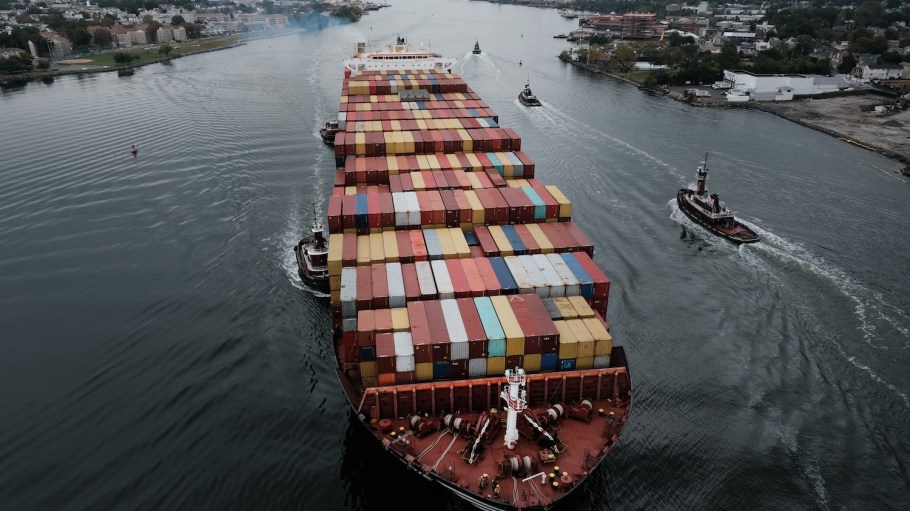
The container shipping industry took a major hit to close out 2023, with major ocean carriers incurring a $684 million net loss in its fourth quarter as cargo prices fell drastically throughout the year ahead of the recurring Houthi attacks in the Red Sea.
According to analysis from container shipping expert John McCown, non-resident senior fellow at the Center for Maritime Strategy, the quarter marked the first deficit after 14 straight profitable quarters for the industry.
But this performance has been in the cards since the peak of pandemic-era supply chain congestion, with ocean carriers seeing six straight declines in earnings following a $63.1 billion windfall in the 2022 second quarter.
Related Stories
McCown compiled the financial results of 11 global ocean carriers, including Maersk, CMA CGM, Cosco Shipping, Hapag-Lloyd, Zim, Evergreen, HMM and Yang Ming, as well as Ocean Network Express (ONE) shipping lines K Line, Mitsui OSK and NYK.
“All 11 companies reported sharply lower net income for the quarter, with every company having a negative net income variance of more than $400 million, with most larger,” McCown observed.
The fourth-quarter numbers are a stark reminder of the turnaround the ocean carriers have experienced: the quarterly net loss reflects an annual decrease of $35.4 billion from the year-ago quarter, or 102 percent, from last year’s $34.7 billion profit.
In the wake of the Red Sea skirmish, container shipping giants should end up back in the black, at least in the short term, due to the brief winter uptick in ocean freight rates.
One survey of stakeholders indicates that there is some feeling that freight rates will again rise in the short term.
Container XChange’s Container Price Sentiment Index (xCPSI) a sentiment analysis tool used by the company to concurrently survey supply chain professionals on their short-term price expectations, surged from 26 to 61 points between March 18 and March 29.
According to the container logistics platform, such a marked increase suggests that the industry is anticipating container prices to increase in the coming weeks—while the suddenness of the index’s move highlights rising uncertainty in the market.
“The sharp rise in sentiment could be linked to ongoing market volatility, the perceived emergency on the U.S. East Coast due to the Baltimore collision, and the resulting sustained pressure on the market.” said Christian Roeloffs, co-founder and CEO of Container XChange, in a statement.
Despite the sentiment measured by Container XChange, spot freight rates have continued a two-month descent since their rapid acceleration through December and January, according to the Drewry World Container Index (WCI). Since Jan. 25, rates have come down 28.5 percent to $2,836 per 40-foot container per week.
Some parties still don’t expect the ocean freight rates to be impacted much, if at all, by the diversions away from the Port of Baltimore.
“From an ocean freight cost, it would be the same,” said Joseph Firrincieli, sales supervisor at OEC Group’s New York office, who told Sourcing Journal that trucking rates were likely to increase instead depending on the end location of the transported goods and the premiums drivers want to charge.
In an April 1 blog post, container shipping analysis firm Linerlytica concurred, saying the “Baltimore bridge incident failed to lift freight rates, with trans-Pacific rates still sliding after initial fears of disruptions to the U.S. supply chains receded. The brief spike in both import and export spot rates from the U.S. East Coast were quickly reversed.”
Nevertheless, Container XChange said in its April forecaster that it expects container prices of goods entering West Coast ports in Los Angeles, Long Beach and Vancouver to rise this month and beyond, depending on the intensity of the diversions and its aftermath.
“As we move forward, we anticipate increased wait times and processing fees at the ports where traffic is diverted in the U.S.,” Roeloffs said.
McCown has been quick to point out in his ongoing reports that spot rates aren’t always the best determinant of the state of container prices since they move a small minority of loads on the ocean. He noted that during the ramp up in container prices, that the majority of contracts were not renewed at the then-current spot rate.
“The best approach in order to understand pricing in the container shipping sector is to view spot rates and contract rates separately and to focus on the latter as the truest measure with regard to the level and trend of real pricing,” said McCown in the April report.