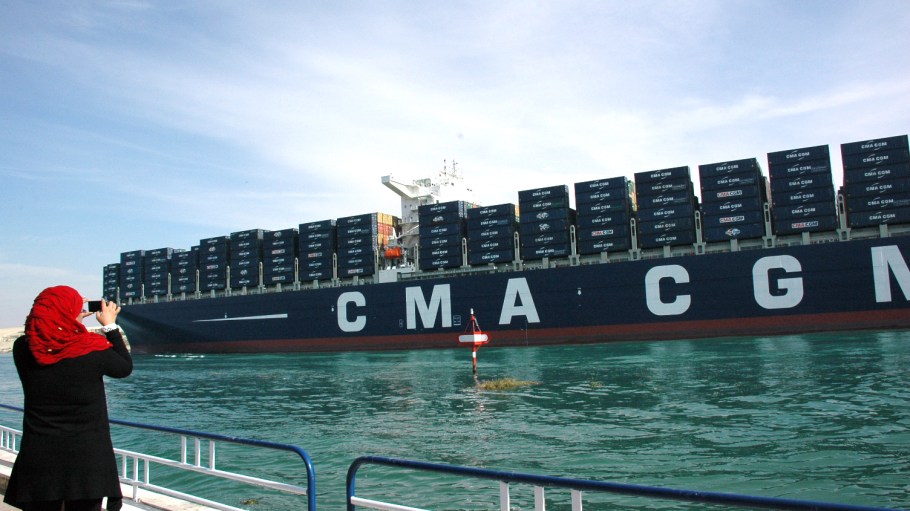
CMA CGM is dialing back its Red Sea push after recently unveiling a small-scale resumption of activity in the waterway.
The container shipping company said Tuesday it has rerouted vessels deployed on three weekly service lines—French Asia Line 1 (FAL 1), French Asia Line 3 (FAL3) and Mediterranean Club Express (MEX)—back around southern Africa’s Cape of Good Hope “in light of the complex and uncertain international context.”
The situation will be reviewed regularly, CMA CGM said.
Related Stories
According to data from ocean and air freight benchmarking platform Xeneta, loop transit times on the FAL1 service decreased a full week, from 105 days to 98 when ships began transiting the Suez Canal again. One vessel slot had been removed after the Red Sea return.
CMA CGM had trialed multiple ships on the three loops through the Red Sea in recent weeks, marking the first series of attempts of any major ocean carrier to sail ultra-large container ships through the Suez Canal in two years. The trials included several transits via eastbound backhaul voyages from Europe to Asia.
The trials began after the Houthis had signaled they would stop their attacks on commercial ships in the Red Sea. The continued drone and missile attacks throughout 2024 and 2025 had forced ocean carriers to avoid the area altogether, leading them to
The company’s about-face follows Maersk’s recent announcement that its MECL service from India to the U.S. East and Gulf Coasts would resume this month.
Although the shipping line may be less concerned about shipping safety or security, headhaul shippers and insurance companies may still not yet be comfortable with the transit, cited Lars Jensen, CEO of container shipping consultancy Vespucci Maritime, in a LinkedIn update Wednesday. Headhaul cargo travels on the outbound route from an origin port to its destination—or in these cases, northbound through the Suez Canal on an Asia-to-Europe .
“The backhaul vessels are mostly loaded with empty containers and relatively low-value backhaul cargo with less time sensitivity than the headhaul,” said Jensen. “Why was the headhaul direction not shipped via Suez as presumably more cargo owners would appreciate this?”
But Jensen offered another possible explanation related to shipping cadence ahead of February’s Lunar New Year, and its implications on its wider fleet.
“The first vessels on FAL-1 and FAL-3 to go back via Suez will make it to China from late January and into February, in the process having overtaken some of the vessels on the same service going around Africa. This brings more vessels on site in Asia for the peak loads immediately prior to Chinese New Year,” said Jensen. “Reverting to round-Africa now creates a ‘gap’ in arrivals in China in the post-CNY period. This is operationally advantageous as this is a period where we seasonally see blank sailings.”
Although the move could benefit CMA CGM, Destine Ozuygur, senior market analyst at Xeneta, warned in a Tuesday update that the unpredictability of the switch could spread to other carriers as they make decisions on a Suez return, and ultimately leave their shipper customers leaving less confident in schedule reliability.
“Unpredictability is toxic for supply chains. Shippers want certainty over when containers arrive at port, even if that means longer transit times around Cape of Good Hope,” said Ozuygur. “Ironically, CMA CGM’s decision to play it safe and return services via Cape of Good Hope may lead shippers to perceive them as the riskier choice against their peers. What if a shipper paid a higher freight rate for the FAL1 or MEX service due to faster transit times through the Suez Canal, only to find shipments are moved back a week?”
Of the major ocean carriers, CMA CGM has been the most willing to sail through the Suez Canal since the start of the Red Sea crisis in late 2023, as it can get escorted through the waterway via the French Navy.
Operating on a case-by-case basis throughout the crisis, the logistics giant moved nearly 1.5 million 20-foot equivalent units (TEUs) through the trade artery in 2025, according to data from Alphaliner. In July 2024, the company started running a regular weekly rotation through the Red Sea for the Ocean Alliance’s MED5 Asia-to-Mediterranean service line. The company supplied a fleet of 12 ships for the shared route.
This month, CMA CGM also reintroduced the weekly India America Express (INDAMEX) service to the Red Sea, with its ships currently still scheduled to transit the Suez Canal on both the fronthaul and backhaul legs.
“There has not been a CMA CGM announcement on the INDAMEX service, but shippers will look at the decision on FAL and MEX services and fear containers will be arriving later than planned,” Ozuygur said. “Do shippers plan for a transit time of 40 days or 36 days? What impact does this have on warehousing or detention and demurrage fees?”