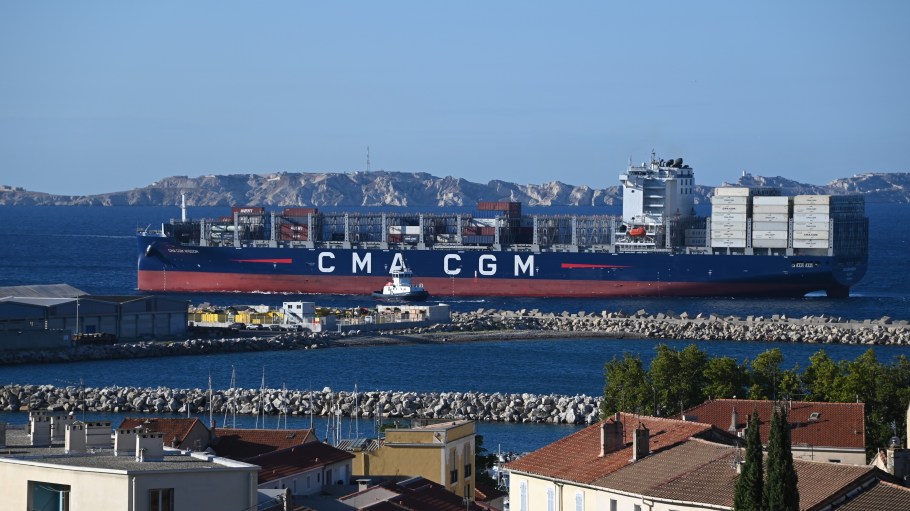
CMA CGM does not plan to add a surcharge on U.S. shipments that are potentially impacted by port docking fees levied on Chinese-operated and -built ships going into effect next month.
The French container shipping giant said it was “fully prepared” to make necessary adjustments for customers and maintain its service levels.
The announcement followed an HSBC analyst report estimating that the liner’s partners in the vessel-sharing Ocean Alliance, state-owned Chinese ocean carriers Cosco Shipping and Orient Overseas Container Line (OOCL), could stand to pay more than $2 billion in port fees in 2026.
Related Stories
With the changes, Cosco and OOCL are likely to sit out more trans-Pacific U.S.-bound routes in favor of CMA CGM and their other partner, Evergreen. Overall, the vessel-sharing alliance operates 18 service lines on the trans-Pacific trade lane, according to data from CMA CGM. It is unclear how many vessels each company provides for these service loops.
CMA CGM said less than half of its 670 vessels are built in China, with container shipping research firm Linerlytica indicating in February that 36 percent of the company’s existing tonnage was Chinese built.
“During the 180-day grace period following the April 17 U.S. Trade Representative (USTR) announcement, CMA CGM has taken the necessary steps to implement a robust and adaptive contingency plan,” said the container shipping line in a statement Wednesday. “Thanks to the fleet and operational adjustments we are now implementing ahead of Oct. 14, we currently expect to both maintain our service coverage to all scheduled U.S. ports and minimize any impacts of the upcoming USTR fees.”
In a May earnings call, CMA CGM had already said it had sufficient shipping capacity to adapt to the situation and avoid paying the fees, but it is still unclear as to whether the wider alliance will be impacted when it comes to costs borne by the Chinese carriers and overall service levels.
On Oct. 14, the USTR will tack on an extra fee of $50 per net ton on Chinese vessel operators for every voyage that includes U.S. ports. An additional $30 per net ton will be tacked on each year through 2028.
For operators like CMA CGM, the fees will only apply to the companies’ ships that dock at U.S. ports. These carriers will be charged $18 per net ton, with annual fee increases of $5 over the next free years.
The punitive action was part of the USTR’s determination that China violated Section 301 trade laws, deeming that the country had an “unreasonable” dominance in its maritime, logistics and shipbuilding capabilities.
Gemini Cooperation suspends one trans-Pacific service
Aside from the concerns about port fees, container shipping companies also are navigating declining demand on the trans-Pacific routes, particularly as inbound U.S. cargo volume is expected to contract through the remainder of the year.
The Gemini Cooperation of Maersk and Hapag-Lloyd is suspending the shared TP9/WC6 service as more container shipping companies cut capacity to match the demand. The suspension will last through the fourth quarter.
The service was introduced in late May in response to rapidly growing demand after the U.S. eased its tariffs on global trade partners, particularly China.
The TP9 service used six ships that could hold a range of 4,250 to 5,000 TEUs, and originated from Xiamen, China, before stopping in Busan, South Korea and the Port of Long Beach.
Shippers moving product directly out of Xiamen will instead have to use an intra-Asia feeder service to ports like Busan and Singapore. Products sailing out of Busan can be moved via two active trans-Pacific services that stop at the Port of Los Angeles.
In a sign of things to come, on Sept. 3, Maersk and Hapag-Lloyd had already blanked the service for three weeks in October.
According to EeSea, there are 184 expected sailings on the Asia-to-North America West Coast trade lane in October, down from a prior scheduled 205 sailings due to the blank sailings. There are 49 liner services scheduled to sail the Pacific during the month, down from September’s 52.
Falling freight rates have been a byproduct of the slowing container demand, with Drewry’s World Container Index (WCI) measuring a 3 percent weekly decline to $2,044 per 40-foot container. This marks the 13th consecutive week of decreases aggregated across eight major trade lanes.
Although overall rates have continued their descent, trans-Pacific rates have increased in the past two weeks to both New York and Los Angeles, according to Drewry. This is due to general rate increases (GRIs) implemented by the carriers to kick off September to soften the blow of the capacity declines.