China’s exports to the U.S. tanked 30 percent to $34.2 billion in December, closing out a turbulent year for trade between the two countries.
The December total marks China’s second-steepest annual drop in monthly outbound shipments to the country after August’s 33.1 percent plunge, and represents the ninth straight month of declines since the U.S. first slapped tariffs on the country in April.
For the full year, outbound shipments to the U.S. totaled $420 billion, a 20 percent decline from 2024 numbers.
Related Stories
But the rocky relations have not stopped China from recording its biggest annual trade surplus ever, coming in at $1.18 trillion across 2025, according to China’s General Administration of Customs. The annual data follows last month’s revelation that China’s trade surplus surpassed the $1 trillion mark for the first time.
Powering the surplus, China’s exports across all nations increased 5.5 percent to $3.77 trillion, illustrating the sourcing superpower’s adjustments to the tariffs.
“Trade partners are more diversified, and the ability to resist risks has significantly increased,” said Wang Jun, a vice minister at China’s customs administration, during a Wednesday press briefing.
On a monthly basis, China’s exports globally increased 6.6 percent to $357.8 billion, well surpassing the 3 percent increase expected by economists polled by Reuters.
In December, China’s exports to the European Union and the Association of Southeast Asian Nations (ASEAN) rose 11.6 percent and 11.1 percent to $51.9 billion and $66.4 billion, respectively.
Exports to Vietnam totaled $18.9 billion for the month, a 20.5 percent increase, while shipments to Thailand jumped 20.7 percent to $10.4 billion.
As India and China seek to improve ties, the former imported 22.1 percent more goods than it did the year prior, taking in $12.8 billion for the month.
Latin American countries also saw near-double-digit spikes in goods from China, at 9.8 percent to $25.7 billion.
Across all of 2025, ASEAN trade partners Vietnam and Thailand were two of the biggest beneficiaries of the shifts in U.S. trade policy. China’s exports to Vietnam increased 22.4 percent for the full year to $198.1 billion, while shipments to Thailand escalated 20.3 percent to $103.5 billion.
Vietnam’s exports to the U.S. increased 28.1 percent to $153.1 billion across 2025 as the country took on a larger role as an American trade partner. But the country has also been an alleged transshipment hub for Chinese exporters to skirt the U.S. tariffs.
Collectively, African markets saw the largest annual increase in imported goods from China in 2025, at 25.8 percent. For the year, China exported $225 million in goods to the continent.
China has done plenty of maneuvering since early 2025 as the tariffs against the country shifted multiple times.
After President Donald Trump’s “Liberation Day” announcement on April 2 tacked on 34 percent additional duties on Chinese exports, the figure escalated to a 104-percent total duty days later. The countries came to a trade truce in May by knocking the tariffs down to 55 percent.
The average U.S. tariff on Chinese exports sits at 47 percent after a deal was made between Trump and his counterpart President Xi Jinping in October, which cut down fentanyl-related tariffs on Chinese goods from 20 percent to 10 percent.
U.S. ports have continued to be impacted by the slowing cargo from China into the country. According to the Global Port Tracker from the National Retail Federation (NRF) and Hackett Associates, inbound cargo volume is projected to decrease 6.6 percent year over year in December to 1.99 million 20-foot equivalent units (TEUs).
China’s top ports handle record throughput in 2025
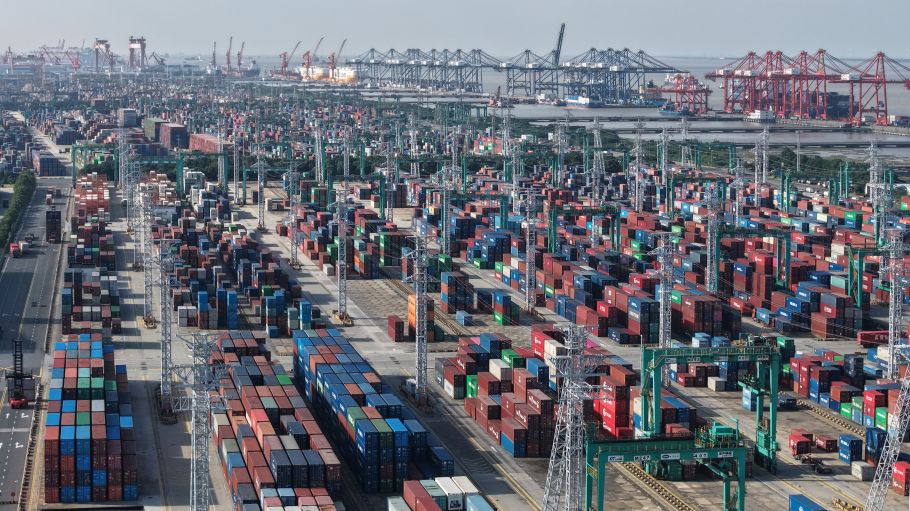
The overflow of goods leaving China is reflected in the data from the country’s two largest seaports, which also happen to handle the most and third-most containers in the world.
The Port of Shanghai saw a throughput of 55.1 million TEUs throughout 2025, a 6.9 percent increase from the year prior.
Throughput at Yangshan Deep-Water Port, the port’s core facility, increased by a more robust 10.4 percent and accounted for more than 52.2 percent of the port’s total container volume—a larger share than the 50.5 percent experienced in 2024.
In the second half, the Yangshan port implemented a synchronized berthing and unberthing cycle that timed the arrivals and departures of three vessels at a time based on tidal windows.
Since its introduction, the method has reduced vessel turnaround times by an average of two hours per port call and unlocked additional handling capacity equivalent to 1.08 million TEUs.
International transshipment volume reached 7.91 million TEUs, up 10.6 percent, reflecting the Port of Shanghai’s growing role as a global transshipment hub.
As for China’s second-largest port, the Port of Ningbo-Zhoushan handled more than 43 million TEUs across 2025, a 9.4 percent increase over 2024 numbers. In total, the throughput amounted to more than 1.4 billion metric tons of cargo.