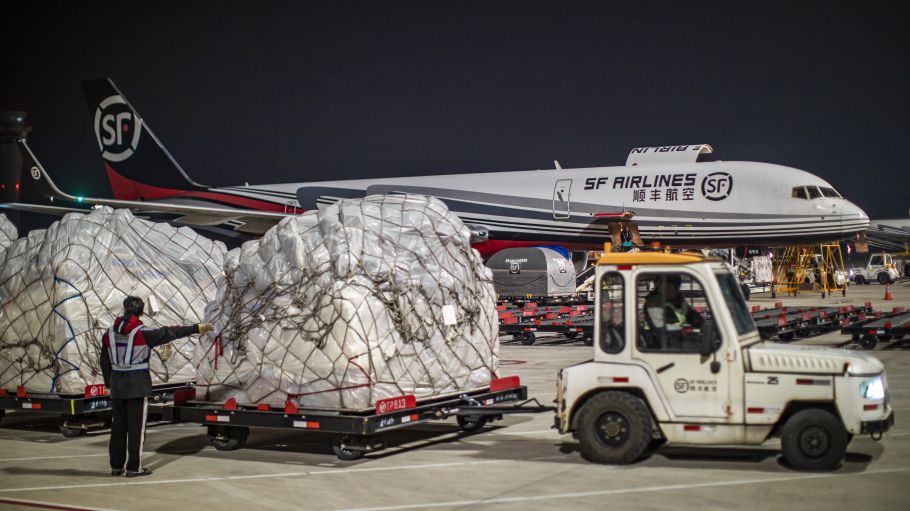
Air cargo in and out of China is seeing a brief spike in rates amid tit-for-tat tariff drama as more U.S. businesses scampered to get product out of the country.
During the week from March 31 to April 6, pricing out of the wider Asia-Pacific region escalated 4 percent from the week prior, according to data from WorldACD. When judging the most recent two weeks versus the prior two weeks, rates kicked up 6 percent.
The average spot rate out of the region escalated 5 percent on a weekly basis, to $3.94 per kg.
Related Stories
With President Donald Trump’s repeatedly swelling tariffs on Chinese imports rising to 145 percent, including a 20-percent fentanyl-related duty, as well as the current 10-percent baseline tariffs on other U.S. trade partners, WorldACD says the impact is expected to be more clearly visible on certain trade flows in its report next week.
The increased rates happened despite a 1 percent decline in weekly demand out of China and Hong Kong to the U.S., the first such drop since the start of 2025.
“Flows from China and Hong Kong to Los Angeles show a more pronounced drop of 5 percent week over week, now at par with the volumes 12 months ago,” said WorldACD in its weekly air cargo trends report. “Other countries in the Asia Pacific region also saw a significant decline, especially ex-Japan and ex-Taiwan (both 7 percent week over week).”
Despite the demand drop in the March 31 to April 6 week, freight booking platform Freightos said it saw a “short burst of demand” before April 9, which could mean “some increased volumes” in the lead up to May 3, the date when 25-percent tariffs on global automotive parts take effect.
That date comes a day after the duty-free de minimis provision for all goods out of China officially gets the axe—further driving a stake into the ambitions of e-commerce players like Shein and Temu that flew low-value shipments directly to the U.S. without paying taxes.
The cancellation of de minimis, alongside the imposition of even steeper fees on products that once qualified for the trade exemption, is likely to drive down air cargo demand when the May 2 date passes, according to Judah Levine, head of research at Freightos
“The de minimis exemption has been a big driver of the surge of B2C e-commerce goods going by air from China to the U.S., and its cancellation is expected to lead to a sharp drop in China-to-U.S. air cargo demand and rates,” said Levine in a weekly update Tuesday. “Freightos Air Index data shows that China-U.S. rates—still elevated at about $5.50 per kg last week—have yet to spike ahead of the May deadline.”
Across all trade lanes, WorldACD says air cargo demand plummeted 7 percent from the week prior, in line with much of this year’s numbers that have indicated that Asia-to-U.S. cargo has largely held up overall global air freight demand. Rates across all trade lanes as of April 6 are at $2.52 per kg, having increased 2 percent in the same week. These prices have increased 8 percent from the $2.33 per kg four weeks prior.
A report from supply chain publication The Loadstar suggests air freight cost increases out of the U.S. into China have been much more drastic ahead of the latter’s tariff escalation to 125 percent duties on American exports. One Shanghai-based forwarder suggested that prices quickly soared from a typical 50 cents to 80 cents per kg sent from Los Angeles to $2 per kilogram. From the East Coast to China, this jump was more drastic, going upwards of the $5 per kg range.
The uncertainty related to the mass tariffs has led shippers to opt into more shorter-term deals than usual around this time of year, according to freight benchmarking platform Xeneta.
Shippers negotiating contracts in the first quarter of 2025 preferred shorter-term agreements of three months or less, representing 79 percent of contracts—an increase of nearly 20 percentage points year-on-year. Meanwhile, freight forwarders continue to place approximately 45 percent of their volumes in the spot market.
“With the growth of rates slowing overall, we’d normally expect to see shippers making longer capacity commitments to achieve more competitive rates, but, right now, this is clearly a gamble few shippers are ready to take—and this is before we’re even seeing tariffs impacting volumes,” said Niall van de Wouw, Xeneta’s chief air freight officer in a blog post April 3.