On the same day the U.S. started charging Chinese-owned and -built ships extra to dock at American ports, China opened a probe into the Section 301 investigation that led to the fees and sanctioned multiple segments of a Korean shipping giant with close American ties.
According to China’s Ministry of Transport, various governmental departments are conducting a joint investigation into how the sourcing superpower’s shipping, shipbuilding and industrial supply chains have been impacted by the U.S. probe.
Related Stories
“Corresponding measures will be introduced in a timely manner based on the results of the investigation,” according to the Transport Ministry.
Trade tensions between the U.S. and China have been the prevailing theme of the Trump administration, with the tit-for-tat regarding tariffs being at the center since April. More recently, the spat has spilled over to export controls over rare earth minerals.
But the ongoing trade negotiations between the parties haven’t been the only back and forth. Days before the U.S.-levied port fees took effect, China retaliated with a move of its own by slapping U.S. ships with similar fees, while also leaving the door open for access limits at the ports.
As an extension of its Tuesday probe, China has sanctioned five U.S. subsidiaries of South Korean shipbuilding company Hanwha Ocean, officially banning the firms from dealing with Chinese interests.
The sanctioned subsidiaries are Hanwha Shipping LLC, Hanwha Philly Shipyard Inc., Hanwha Ocean USA International LLC, Hanwha Shipping Holdings LLC and HS USA Holdings Corp, according to a statement from China’s Commerce Ministry.
China sees South Korea as a proxy in the trade conflict with the U.S., seeing as the latter is a major U.S. shipbuilding and military partner.
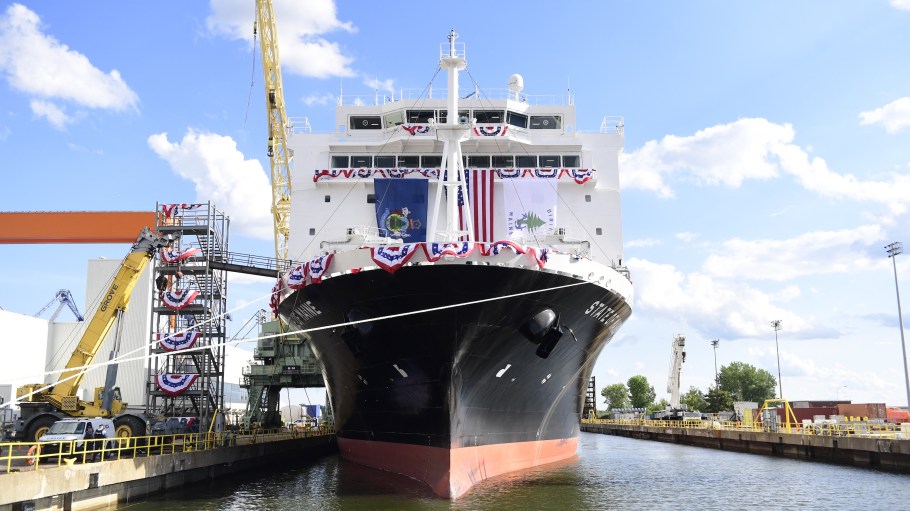
South Korea recently pledged $150 billion to help revitalize the U.S.’s sputtering shipbuilding industry and close its gap with China. Additional seeds had already been planted last year when Hanwha acquired the Philly Shipyard for $5 billion, with a goal to expand the shipyard’s annual production volume from less than two vessels to up to 20.
Hanwha Ocean also secured contracts with the U.S. Navy in 2024 to perform maintenance, repair and overhaul work for U.S. naval vessels.
Undoubtedly, China’s shipbuilding rivalry with South Korea plays a role in the sanctions. As of June, China-made ships account for 34.8 percent of the global maritime fleet, just ahead of South Korea’s 30.9 percent, according to Clarksons. The U.S. only accounts for 0.4 percent of that total.
The U.S. Trade Representative (USTR) opened the Section 301 trade investigation in April 2024, finding that China had an “unreasonable” dominance across the logistics, maritime and shipbuilding sectors that harmed U.S. commerce. Among the allegations, the USTR determined that China uses state subsidies to lessen competition and create dependencies on the country for non-market entrants.
At the time, five U.S. labor unions had petitioned the office to investigation.
AAFA warns port fee policy could backfire
The American Apparel & Footwear Association (AAFA) was critical of the U.S.-levied port docking fees, urging the Trump administration to reconsider the policy.
The AAFA urged both countries to “step back” from the escalating fees.
While the trade group supported the goal to strengthen domestic shipbuilding, it noted that the surcharges fail to achieve their stated objectives.
“Rather than reducing reliance on Chinese shipbuilding, carriers have simply reshuffled their fleets by deploying non-Chinese-built ships on U.S. routes while continuing to expand orders at Chinese shipyards,” said Nate Herman, executive vice president of the AAFA. “China’s global market share in shipbuilding continues to rise, climbing above 65 percent in June and reaching 84 percent in August. At the same time, Chinese carriers are shifting calls from U.S. ports to Canada and Mexico to maintain North American service while avoiding the fees.”
Herman noted that these shifts divert business away from U.S. ports and reduce work opportunities for American longshoremen.
“Instead of imposing punitive port fees that create inefficiencies and divert business away from U.S. ports, the focus should be on creating strong domestic incentives and providing sustained support to revitalize American shipbuilding,” said Audrey Clark, AAFA trade and transportation specialist, in a statement. “Only by investing at home can we strengthen U.S. competitiveness and secure our maritime future.”
Although the major carriers have largely committed to not passing along any extra surcharges to consumers with the fees kicking in, the escalation of the fees starting in April delivers an added risk that the costs could get too high and begin to be passed along to shippers.
According to the AAFA, apparel and footwear companies may raise prices for consumers due to the rising transportation costs.
Although the non-Chinese carriers have worked their schedules around the fees via their vessel-sharing alliances, they are not entirely immune to them, keeping the possibility that costs can be passed on. For example, ZIM is expected to pay $510 million in fees in 2026, according to Alphaliner.
Even when not accounting for Cosco Shipping and Orient Overseas Container Lines (OOCL), the rest of the top 10 container liners are expected to have to pay almost $1.7 billion in fees in 2026, according to the data.