Chinese port activity has reportedly stalled in the wake of President Donald Trump’s tariffs, in a prime indicator that exports out of the country are set to see a monumental slowdown.
According to China’s ministry of transport, cargo handled by the country’s ports including Shanghai, Ningbo and Shenzhen from April 7-13 slipped 9.7 percent from the week prior to 244 million tons. This marked a steep drop from the 0.88 percent decline registered in the week before, when Trump first announced his batch of “reciprocal” tariffs that initially stunned global markets.
Related Stories
The transport ministry also said container throughput dropped 6.1 percent on the week, a stark difference from the 1.9 percent rise a week earlier.
A report from U.S.-based nonprofit news service Radio Free Asia paints a grimmer picture for Chinese exports to the U.S., saying “virtually no cargo ships were bound for the U.S.” out of ports in Shanghai and Guangdong as of Thursday. Additionally, operations at export factories throughout the country have ground to a halt.
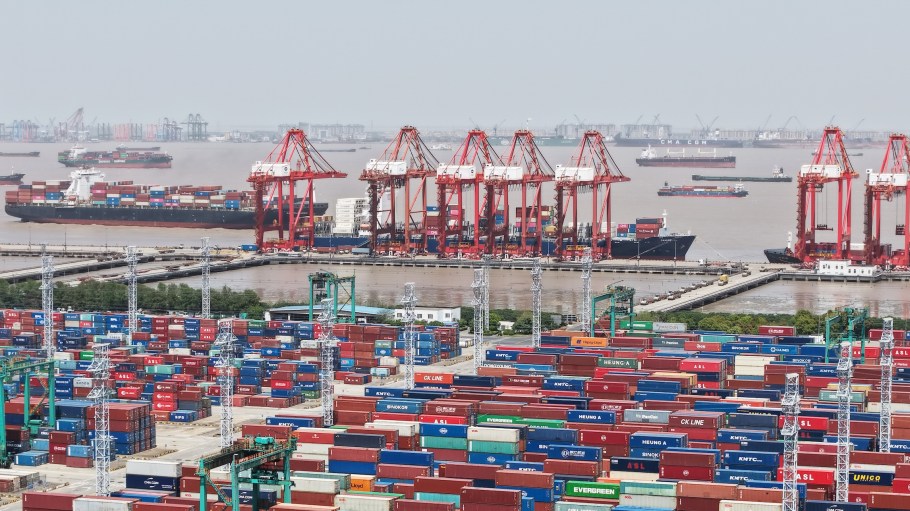
Containers that weren’t moved to the U.S.-bound vessels by the April 9 tariff implementation deadline are now piled high at these ports, the report said.
Another report from China-based business publication Caixin Global said that nearly half the vessels docked at Shanghai’s Yangshan and Waigaoqiao terminals on April 7 and 8 were bound for the U.S., requiring port dockworkers to expedite cargo movement onto the ships. That’s because any goods already on the water before April 9 were exempt from the reciprocal tariffs.
The dip in port activity after the tariff deadline comes as many U.S. importers have been forced to take a wait-and-see approach to manage inventory and costs, with bookings of product entering the U.S. plummeting dramatically amid a vat of cancelled and delayed orders.
Imports from China already had nosedived 64 percent in the April 1-8 period from the week prior, according to data from supply chain visibility provider Vizion.
U.S. West Coast ports and industry bodies have predicted significant inbound cargo declines for the back half of the year, with some estimates saying imports could fall off 20 percent on the wider tariff concerns.
China’s exports surged 12.4 percent in March, severely exceeding forecasts and reversing a previous decline, according to China’s customs authority. This helped boost China’s gross domestic product (GDP) by a better-than-expected 5.4 percent in the first quarter. But much of the growth is largely because factories have rushed shipments out of the country ahead of the tariffs, which had been anticipated for months since he won the 2024 presidential election.
Trump’s initially tacked on a 20-percent fentanyl-related tariff on all Chinese imports before his April 2 “Liberation Day” announcement, where he placed higher tariffs on dozens of countries worldwide and set a 10-percent baseline tariff for all trading partners. The U.S. temporarily halted the country-specific tariffs for 90 days in an effort to make room for negotiations.
After a tit-for-tat which saw both countries escalate the duties, most Chinese imports into the U.S. now have a 145-percent tariff attached, with Beijing retaliating with a 125-percent tariff on American goods headed to China.
The turbulent tariff scenario is expected to lead to a substantial decline in exports in the second quarter, with both the U.S. and China essentially imposing trade embargos on each other.
Major freight rate indices out of China reveal the declining demand of Chinese goods into the U.S.
Last Friday, the Shanghai Containerized Freight Index showed a 5 percent drop in Shanghai-to-U.S. West Coast rates, to $2,202 per 40-foot container, and a 2 percent dip in Shanghai-U.S. East Coast rates, to $3,226 per 40-foot container. Linerlytica said that the West Coast rates are set to drop below $2,000 in the next two weeks.
“There’ll be further turbulence as carriers adjust rates downwards over the coming days to deal with falling cargo volumes from China,” said the shipping consultancy.
For the same week ended April 11, the Ningbo Container Freight Index reported an 18-percent week-over-week slide in freight rates to the U.S. West Coast and a 10.8 percent decline in East Coast-bound rates.
On Wednesday, China’s foreign affairs spokesperson called on the U.S. to stop using “maximum pressure, threats and blackmail” throughout the trade war, and instead engage in dialogue “on the basis of equality, respect and mutual benefit.”
“This tariff war was started by the U.S. China has taken necessary countermeasures in order to defend its legitimate rights and interests and international fairness and justice. This is fully justified and lawful,” said spokesperson Lin Jian in a media briefing. “China’s position has been very clear. Tariff and trade wars have no winners. China does not want to fight these wars but is not scared of them.”