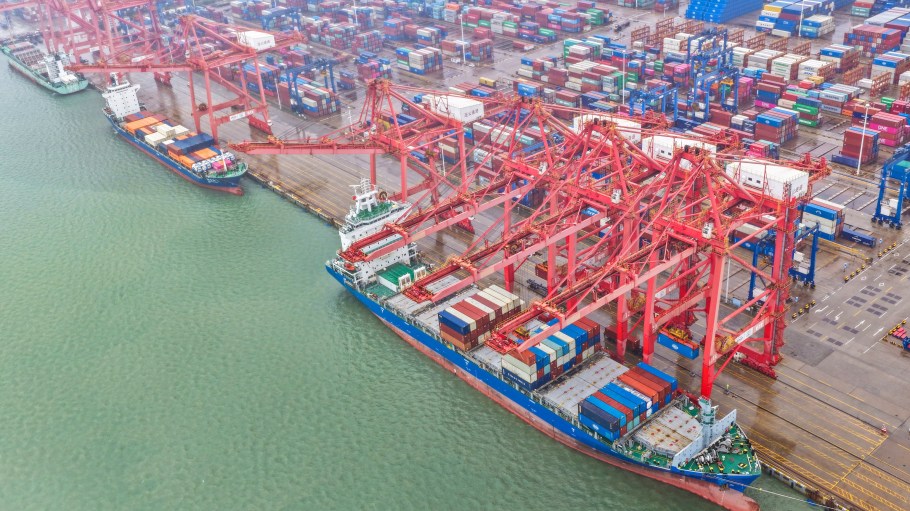
China’s export ecosystem continues to roll full steam ahead despite its ongoing trade war with the U.S.
Shipments out of China rose 8.3 percent in September to $328.6 billion, with exports flowing out at the fastest pace in six months, according to data from China’s General Administration of Customs. Imports jumped 7.4 percent from a year ago to $238.1 billion, marking the strongest increase since April 2024.
The export figures surpassed growth estimates from both Bloomberg (6.6 percent) and Reuters (7.1 percent), and only fails to surpass March’s 12.4 percent export growth in 2025. March was the final month before the “Liberation Day” country-specific tariffs were levied by the Trump administration, which tanked China’s exports to the U.S. in the months after.
Related Stories
Exports to the U.S. are still plummeting from year-ago totals at a pace of 27 percent to $34.3 billion in September, with tensions between Beijing and Washington appearing to heat up again.
The numbers came in Monday three days after President Donald Trump threatened to impose another 100 percent tariff on Chinese goods on Nov. 1., on top of any existing tariffs already in place. In a Truth Social post late Friday, the president also said the U.S. would slap export controls on “any and all critical software.”
The moves were in response to China’s recent export controls placed on rare earth minerals, which are critical components for production of defense technologies, automobiles and semiconductors.
Along with the tariff threat, Trump suggested early Friday that “there seems to be no reason” to meet President Xi Jinping at the upcoming Asia-Pacific Economic Cooperation summit in South Korea later this month, spooking U.S. markets before close of business.
But later in the day, Trump seemingly walked back those comments, with Treasury Secretary Scott Bessent echoing Monday morning that he believed the meeting would still take place.
On Saturday, China’s Commerce Ministry said Trump’s tariff threats and remarks about the export controls “reflect textbook double standard”
While the volatile U.S. relationship brought a hit to China’s export economy, the expansion into other partner markets has more than offset any trade war-related slowdowns.
Exports to the 10-member Association of Southeast Asian Nations (ASEAN), the European Union and Africa accelerated 15.6 percent, 14.1 percent and 56.4 percent, respectively.
The E.U. took in $48 billion in Chinese goods, while the ASEAN countries led the way in importing $53.7 billion from the country.
Vietnam continues to be a beneficiary of the shifts in export patterns, with Chinese exports to the apparel and footwear manufacturing country spiking 24.5 percent to $16.7 billion.
The U.S. levied a 40 percent transshipment tariff on Vietnam due to the country’s alleged role in hosting Chinese exports that are later shipped to the U.S. so that China can skirt the other tariffs.
On Friday, in a seeming decision to prevent transshipment disputes with the U.S., the Vietnamese government ordered a decree aiming to tighten control over the temporary importation of goods for re-export activities. The decree introduces a maximum storage period of 60 days for these goods, extendable only twice for up to 30 days each.
Elsewhere in Southeast Asia, China’s exports to Thailand grew 19.7 percent to $8.2 billion, while exports to Indonesia saw 17.1 percent growth to $7.1 billion.
Shipments out of China to regional rival India increased 14.4 percent to $11.8 billion, an all-time high, while exports to Latin American countries accelerated 15.2 percent to $26.5 billion.
China’s trade surplus fell to $90.5 billion in September, from $102.3 billion a month prior.
China’s port fee retaliation kicks in Tuesday
On Friday, China also unveiled its countermeasures to the U.S.-imposed docking fees on Chinese-built and -owned ships at American ports. The U.S. fees will go into effect Tuesday.
With its retaliatory measures, U.S.-owned, operated or flagged ships would be subject to a 400 yuan ($56) per net ton fee per voyage if they dock in China, according to China’s Transport Ministry.
The fees would be applied on the same ship for a maximum of five voyages each year, and would rise every year until 2028, when it would hike to 1,120 yuan ($157) per net ton, the ministry said. They would also take effect Tuesday.
U.S. shipping isn’t expected to see a major impact from the measures, as only 24 U.S.-flagged container vessels visit Chinese ports in total, according to Linerlytica.
“The U.S. practice disregards facts, fully exposing its unilateralist and protectionist nature,” said a Transport Ministry spokesperson of the port fees on Chinese ships. “It is clearly discriminatory and severely damages the legitimate interests of China’s shipping industry, seriously disrupts the stability of the global supply chain, and seriously undermines the international economic and trade order.”