With one potential railroad merger in the U.S. already being the topic of speculation, another Class I railroad could end up exploring its own takeover that shakes up the landscape of the industry.
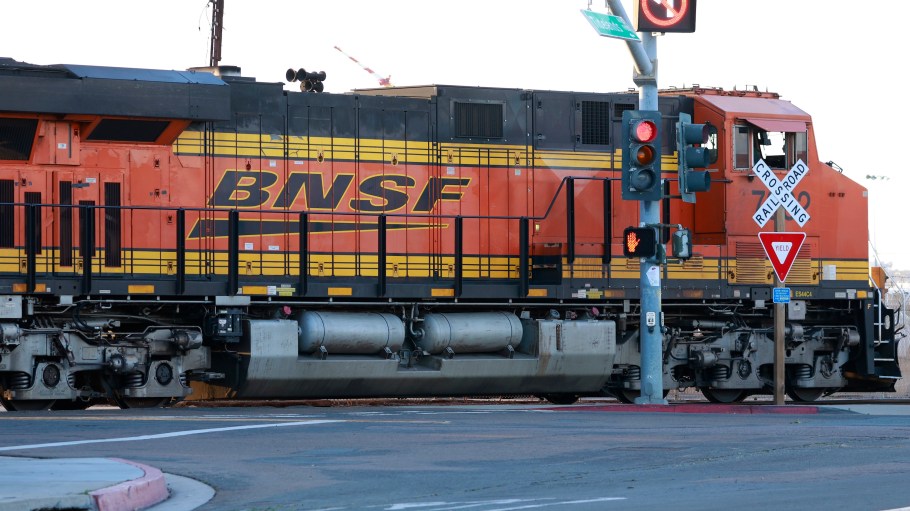
Just days after a report surfaced that Union Pacific was pursuing an acquisition of Norfolk Southern, two Monday reports indicated BNSF Railway Co. is seeking to acquire a rival railroad, and that it was working with Goldman Sachs to facilitate a deal.
Semafor and Reuters reported on the BNSF deal, with the latter also indicating that CSX is in talks to bring on its own financial advisors. Analysts have suggested BNSF might bid for the Jacksonville-based rail company as a defensive measure to remain competitive with Union Pacific.
Related Stories
Sourcing Journal reached out to BNSF.
Goldman Sachs and CSX would not comment.
Warren Buffett, the longtime CEO of BNSF’s parent conglomerate, Berkshire Hathaway, denied the Goldman connection in an interview with CNBC Tuesday morning. The 94-year-old “Oracle of Omaha” said no one from Goldman had spoken to him or his successor, Greg Abel.
Buffett did not address BNSF’s potential takeover interests.
Berkshire Hathaway could certainly afford to pay for a railroad on its own without bringing in outside bankers, with the company holding cash and cash equivalents of $347.7 billion as of March 31. A potential acquisition of CSX based on market cap, not counting any premium paid, would cost the firm $65.7 billion.
“Although our official view is that Berkshire is not inherently in favor of a transaction, leadership likely recognizes that the die could soon be cast,” Baird Equity Research analysts said in a note Monday, ahead of Buffett’s interview. “From that perspective, the real risk is not what Berkshire would have to pay to own the company it believes it is best positioned to merge with, it’s what it could cost not to. We think Buffett is likely less focused on whether the price is perfect and more concerned with the implications of a long-term strategic loss that affects competitive positioning and franchise value.”
On Monday, TD Cowen upgraded both Norfolk Southern and CSX shares to “buy” from “hold” on the recent reports “as likelihood of rail consolidation moves up considerably.”
If a UP-Norfolk Southern deal were to occur, it would merge the largest and fourth-largest railroads in the U.S. by market cap and move the companies closer to creating America’s only coast-to-coast rail network.
Farrukh Bezar, a former senior vice president and chief strategy officer at CSX, told the TD Cowen team Friday that he did not expect an immediate response from BNSF based on the potential deal among its rivals. However, he noted they would likely need an eastern partner if Union Pacific and Norfolk Southern merged.
BNSF Railway, headquartered in Fort Worth, Texas, operates a rail network of 32,500 route miles in 28 states and three Canadian provinces. The railroad namely serves the American Midwest, West and South, but covers minimal ground east of the Mississippi River.
CSX’s network would cover the areas BNSF doesn’t reach, operating entirely east of the Mississippi, and covering more than 20,000 route miles across 26 states, Washington, D.C. and two provinces.
The last Class I rail merger took place in 2023, when Canadian Pacific acquired Kansas City Southern to form Canadian Pacific Kansas City (CPKC). The CPKC deal formed the first railroad network that spanned the U.S., Mexico and Canada.
Goldman Sachs helped broker the CPKC acquisition.
“We believe any transaction would result in the rail industry going from four U.S. Class Is to two (with the acknowledgment of both Canadian players having significant U.S. exposure),” said TD Cowen analyst Jason Seidl, in an analyst note. “If Union Pacific makes a bid for Norfolk Southern, then BNSF may wait to see how the process evolves (i.e., not make an offer immediately following UNP) before possibly making an offer for CSX.”
Any merger between two Class I railroads would be subject to approval from the Surface Transportation Board (STB) and the U.S. Department of Justice.
In response to executive orders from President Donald Trump requiring federal agencies to review their policies related to competition and regulatory barriers, the STB unveiled Monday that it would host a series of meetings to discuss updating its regulatory framework.
Currently, there are only four board members on the STB. President Trump still needs to appoint a fifth member that would be up for a Senate vote.
According to Seidl, the regulatory hurdle would be the biggest challenge for a potential rail merger to be approved.
“It is our view that Union Pacific could have an inclination of who will fill the fifth STB board seat,” Seidl said, noting that the board is currently split between two Republicans and Democrats, which would heighten the risk of a merger being struck down.
Union Pacific “may have a nod from Washington (we don’t think UNP would hire bankers if they didn’t get some form of acknowledgment from Washington),” said Seidl, who also acknowledged that the railroad likely sees significant revenue and cost synergies, “both of which are necessary to clear regulatory hurdles.”