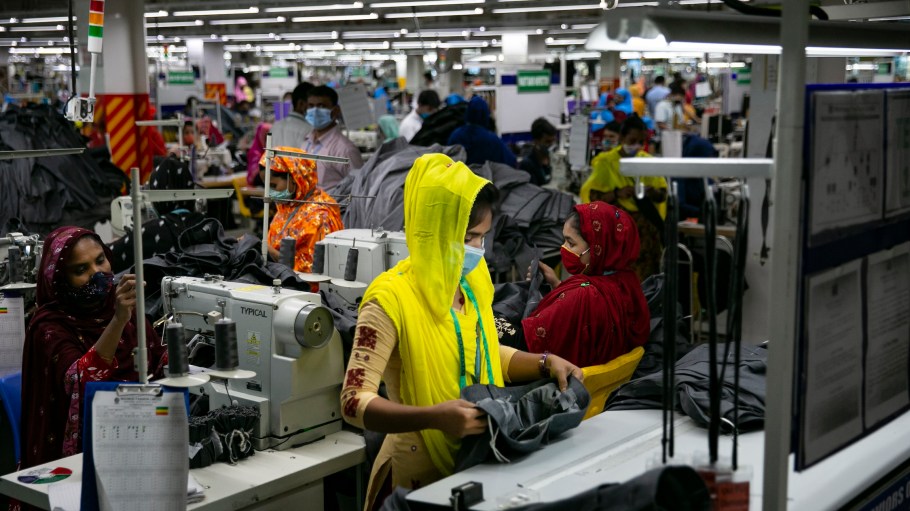
Bangladesh’s apparel industry is calling on the country’s interim government to help reduce freight costs and federal interest rates to preserve the sector’s competitiveness amid ongoing tariff tensions and a more tenuous relationship with neighboring India.
On April 12, members of multiple apparel trade associations met in Dhaka to discuss the industry’s roadmap to 2030 and plan for navigating through current ongoing geopolitical uncertainty.
Kutubuddin Ahmed, chairman of Envoy Textiles Limited and a former president of the Bangladesh Garment Manufacturers and Exporters Association (BGMEA), drew attention to the high cost of air freight—an escalating problem for Bangladeshi exporters as air cargo space is limited.
Related Stories
“Air cargo from Bangladesh is among the most expensive in the world, prompting many exporters to use Indian ports for third-country shipments,” said Ahmed. But the Indian outlet has largely been cut off, with the country recently revoking Bangladesh’s access to its transshipment services.
In using that service, Bangladesh could export goods via its land borders using India’s customs stations. Cargo flowing through these stations usually ends up being transported to Indian ports and airports.
According to data from the Bangladesh Freight Forwarders Association, roughly 18 percent of Bangladesh’s garment air cargo was flown through Indian airports prior to the transshipment ban.
Lobbyists including the BGMEA have urged India to reconsider the ban, which they say will increase freight costs and lead times.
To be less reliant on its neighbor, Bangladesh is ramping up cargo-handling capabilities at its international airports, with Hazrat Shahjalal International Airport (HSIA) in Dhaka building out a third terminal expected to be operational by the end of the year. The expanded terminal will nearly triple airport’s annual cargo-handling capacity from 200,000 metric tons to 547,000 metric tons.
Cargo services will open in Sylhet on April 27, with Chattogram following suit and an undisclosed date.
Anwar-ul-Alam Chowdhury Parvez, another former president of the BGMEA, shared his disappointment in customs inefficiencies endured throughout Bangladesh.
“Why does it take 10 days to clear goods at ports when it should take only three?” Parvez said. “And after a decade of consistency, why has the HS code product assessment process abruptly changed?”
Parvez also pointed to some of the current economic concerns Bangladesh is facing, on top of the 10-percent baseline tariff applied on all exports to the U.S. Bangladesh initially had a 37-percent tariff slapped on its goods on April 2, before President Donald Trump put a halt to the country-specific duties to make room for negotiations.
“Interest rates remain high, gas prices have tripled, and though we’re being asked to operate in economic zones, those zones are far from fully developed,” said Parvez.
Parvez also dismissed the idea that cheap labor has given Bangladesh any other cost advantages to its peers.
“If we compare ourselves to Vietnam, their transportation, financing, and logistics costs are much lower,” said Parvez. “Factoring these in, our production costs are nearly the same,” he said, calling for long-term policy consistency and stable governance.
“These issues stem from government policies, not from the private sector,” he said.
Another meeting on April 10 held at the office of Dhaka’s Chamber of Commerce & Industry (DCCI) involved more discussion on Bangladesh’s desire to keep logistics costs down.
Derek Loh, Singapore’s high commissioner to Bangladesh, told delegates at the meeting that the southeast Asian city-state is keen to invest further in Bangladesh’s infrastructure sector.
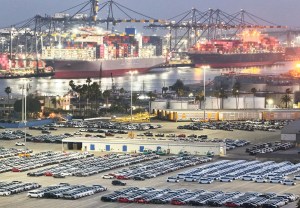
Singapore hosts the largest transshipment port in the world, and second-largest port overall, and has emerged as a global trade center through efficient port management, Loh noted.
“By improving the efficient management of Bangladesh’s ports, it is possible to reduce the business operating costs of entrepreneurs largely, which will increase the capacity of Bangladeshi entrepreneurs in global competition,” Loh said.
Bangladesh is looking to cut these costs amid heightening tensions with India. The Bangladeshi government halted the import of yarn via India’s land ports, which angered local apparel exporters concerned that they can’t compete with cheaper imports.
Internal pressure came from domestic textile mills seeking to expand their market share. With the ban, which went into effect April 13, all yarn imports must now arrive by the more expensive transportation options including sea or air.
During a late March visit to Beijing, Bangladesh chief interim government adviser Muhammad Yunus pushed for more Chinese investment in his country, referring to India’s northeast as being “landlocked.”
“We are the only guardian of the ocean for all this region. So, this opens up a huge possibility [and] could be an extension of the Chinese economy,” Yunus said, noting Bangladesh can “build things, produce things, market things, bring things to China, and bring it out to the whole rest of the world. That’s a production house for you.”