Multiple air cargo operations will launch at Bangladesh airports days after India revoked the country’s access to its transshipment services.
The Civil Aviation Authority of Bangladesh (CAAB) is set to launch cargo services in the international airports in the cities of Sylhet and Chattogram, with Sylhet set to open for operations on April 27.
“Chattogram will follow shortly,” said air vice marshal Monjur Kabir Bhuiyan, chairman of CAAB, in a statemetn.
Related Stories
The first flight out of Osmani International Airport in Sylhet is scheduled for Spain at 7 p.m. local time, and is set to carry roughly 60 metric tons of ready-made garments.
Industry lobbyists like the Bangladesh Garment Manufacturers and Exporters Association (BGMEA) had called on India to reverse the transshipment ban, saying it would increase freight costs and lead times for Bangladesh exports.
Additionally, BGMEA president Faruque Hassan urged the Bangladeshi government to immediately incentivize more airlines that serve Dhaka, Chattogram and Sylhet.
However, the government’s solution isn’t bulletproof. According to a report from Bangladeshi newspaper The Daily Observer, parties are concerned that a larger warehouse would be needed to host the inevitable overload of goods out of Sylhet. Construction on several private sector warehouses in the area are expected to be completed within six months.
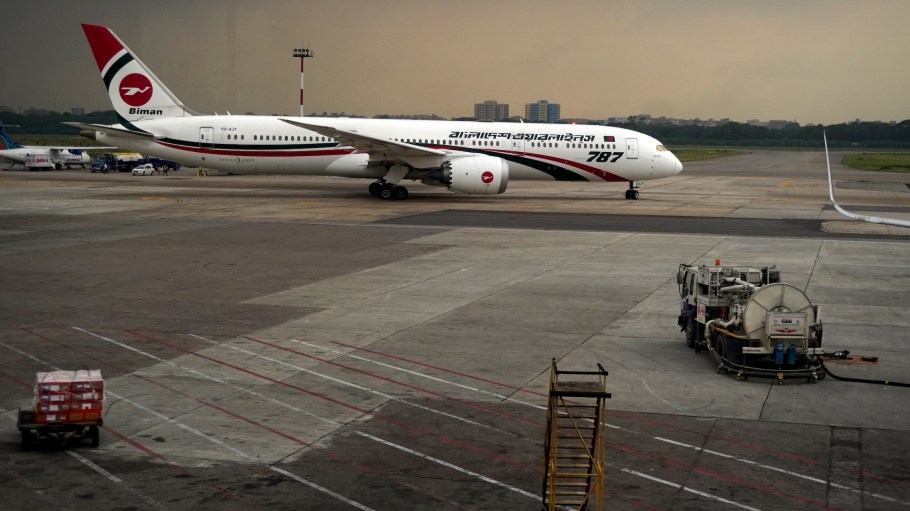
The introduction of the two cargo services would take the pressure off Hazrat Shahjalal International Airport (HSIA) in Dhaka, which is where most air freight out of Bangladesh exits the country.
While that airport’s cargo operation is designed to host just 300 metric tons per day, the area handles more than 800 metric tons daily, and up to 1,200 during peak periods. This has caused enough congestion that has pushed many exporters to consider the Indian options.
Dhaka is in expansion mode to help the growing problem, currently building out a third terminal to be completed by mid-2025. The expanded terminal will more than double the airport’s annual cargo-handling capacity from 200,000 metric tons to 547,000 metric tons.
“With the third terminal and its increased capacity, plus a fully automated system, we’ll be able to handle our own cargo,” said Bhuiyan. “That will also boost our revenue.”
Kazi Wahidul Alam, former director of Biman Bangladesh Airlines, told Bangladeshi publication The Business Standard that more work needs to be done to improve air cargo operations in Dhaka.
“The current capacity at Dhaka airport needs urgent enhancement—but that’s not happening,” he said. “Out of three scanning machines, one is almost always out of order.”
With the transshipment facility in place, exporters could use India’s land customs stations before the cargo was moved through India’s seaports and airports. A government official confirmed to Bangladesh publication The Daily Star that cargo going through India to Nepal and Bhutan via the Bhomra land port in Bangladesh remains unaffected by the transshipment ban.
According to data from the Bangladesh Freight Forwarders Association, roughly 18 percent of Bangladesh’s garment air cargo was flown through Indian airports, namely out of Delhi and Kolkata. Before the transshipment ban, Bangladesh exported about 3,400 metric tons of garments by air per week, with 600 metric tons flown through the Indian airports.
The high volume of goods flown through India’s airports turned out to be the straw that broke the camel’s back for the country’s officials. Indian foreign affairs spokesperson Randhir Jaiswal said the option resulted in significant congestion at the country’s airports and ports.
Bangladeshi exporters flooded India’s logistics hubs via the transshipment facility not just because of the extra space, but the cheaper shipping. Outbound shipments from Bangladesh saw the highest spot air freight rate increase across all countries from January to September 2024, according to data from Xeneta.
Sending a kilogram of apparel from Dhaka to Europe typically cost $2.90 to $3.20 during off-peak periods (and up to $4.50 in peak season). But shipping through India costs about $2.60 per kg, even when accounting for land transport to Indian airports.
Taking away transshipment has resulted in these Dhaka-to-Europe costs more than doubling, with spot air cargo rates surging to $6.30 to $6.50 per kg, Bangladeshi exporter TAD Group told The Business Standard.
Rates to the U.S. have increased to a lesser extent, jumping from $6.91 in August 2024 to $7.50 to $8 per kg currently.
India also had another edge for Bangladesh exporters, in that Dhaka and Delhi had a $1-per-gallon difference in jet fuel prices.
“Jet fuel accounts for 40 percent of an airline’s operating costs,” Biman Bangladesh Airlines spokesperson Bushra Islam told The Daily Star.
Generally, importers also prefer India to Bangladesh for speed of delivery and shortened lead times. Zara’s parent company, Inditex, has a distribution center in Delhi.