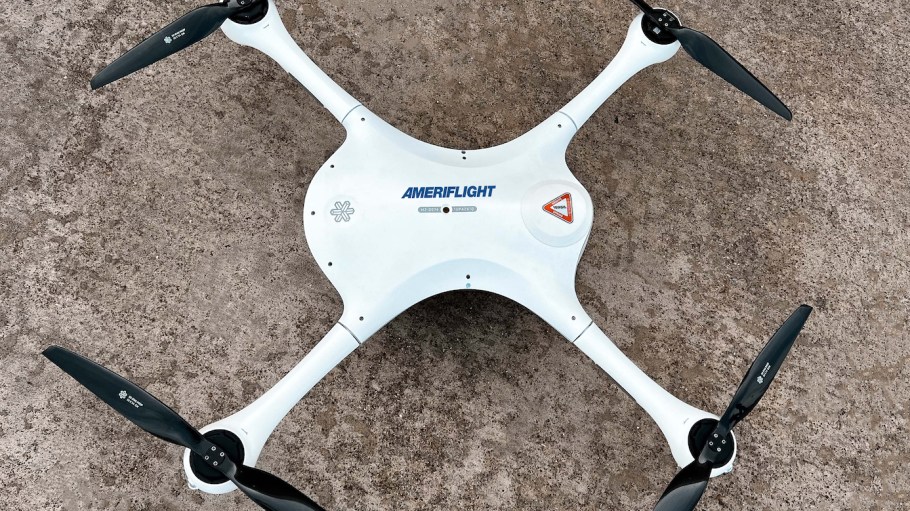
Ameriflight, a cargo airline that handles and delivers 75,000 packages daily, has received approval from the Federal Aviation Administration (FAA) to operate drone aircraft.
With the approval, Ameriflight marks the largest existing “Part 135” cargo airline to receive such an exemption. The air charter and cargo service carrier operates 14 bases, oversees 1,500 weekly departures and flies to 200 destinations, providing feeder services for overnight express carriers, as well as on-demand cargo charter services for customers.
Related Stories
Part 135 carriers operate on-demand, unscheduled air service that can offer passenger and cargo service to remote areas.
The newly granted exemption allows Ameriflight to conduct unmanned aircraft systems (UAS) operations under its current Part 119 Air Carrier Certificate for Part 135 operations.
Through a partnership with drone delivery systems developer Matternet, Ameriflight will operate the company’s Matternet M2 drone for commercial delivery, focusing on health care and e-commerce deliveries to customers located in dense urban and suburban environments across the country.
Ameriflight will deploy the M2 fleet of drones using Matternet’s software platform from a central remote network operations center. This can enable the company to expand its network, while also maintaining a higher level of pilot operator supervision and flexibility, the firm says.
“Adding this state-of-the-art, environmentally friendly aircraft and launching our UAS division allows us to expand our service offerings to off-airport alternative sites for time-sensitive small package needs,” said Alan Rusinowitz, president and CEO at Ameriflight. “Matternet’s technology is at the forefront of autonomous innovation and provides a revolutionary solution for customers. We’re looking forward to launching our first M2 flights very soon, and, as we move forward into future flight, developing additional areas of drone delivery.”
Ameriflight, which already has more than 100 aircraft flown by 150 pilots, plans to supplement its crewed operations by operating unmanned aircraft. The company says it has no plans to replace its current flying operation, aircraft or pilots.
“This partnership enables us to offer our customers turnkey access to fast and reliable on-demand delivery capabilities today,” said Andreas Raptopoulos, co-founder and CEO of Matternet in a statement. “This is not a test program or a future deployment concept—this is the real, scalable and safe drone-based solution that customers are looking for.”
The approval comes as the drone delivery space faces continued FAA regulatory hurdles, which has led to low adoption beyond trials. In order to license each new drone model, the FAA creates individual exemptions for every new craft, as well as a list of conditions for the company attached to the new drone.
Amazon is one company that’s run into drone challenges. The company initially targeted 10,000 deliveries between its two sites in California and Texas this year, but just last month, the e-commerce giant told CNBC that it had only completed 100 deliveries altogether.
Amazon has also reportedly cut some drone safety team employees during this year’s mass layoffs.
Walmart has had more drone success, saying it made more than 6,000 drone deliveries across seven states last year with three partners DroneUp, Zipline and Flytrex. In January, Walmart said that drone deliveries are available from at least 36 U.S. stores.
Despite other players in the space like Wing, UPS and FedEx popping up, most delivery drones are still required to avoid active roadways and people, which poses a significant problem to scaling as it largely confines drone tests to remote areas.
The FAA also limits drone operations beyond the visual line of sight of an observer. Beyond visual line of sight, or BVLOS, is meant to ensure a human can steer a drone away from other aircraft that could cause a crash, but requires paying more personnel. The restriction typically requires drones to fly only one or two miles from the takeoff spot and requires extra people to watch each flight.
Ameriflight is in exclusive company with the Part 135 air carrier certification. Only five drone other operators have been granted such certification: Wing and UPS in 2019, Amazon in 2020, Zipline in 2022 and Causey Aviation Unmanned in 2023.