Zipline secured a massive $600 million funding round last month, enabling the autonomous drone delivery provider to further scale its technology both domestically and worldwide.
The company says it will expand its U.S. operations to Houston and Phoenix in early 2026, followed by more undisclosed metro areas in four new states later in the year. With the latest capital infusion, the Walmart partner is now valued at $7.6 billion.
In January, Zipline said it surpassed 2 million commercial deliveries of 20 million different items, more deliveries than all other companies in the sector combined, the company says.
Related Stories
According to the startup, which says its drones have a three-minute median flight time, U.S. deliveries have grown by approximately 15 percent week over week for the last seven months. The fast growth has been attributed to weekly launches in new areas since August. The company also touted that it beat its third quarter daily delivery volume target by approximately 30 percent and reached its fourth quarter target six weeks early.
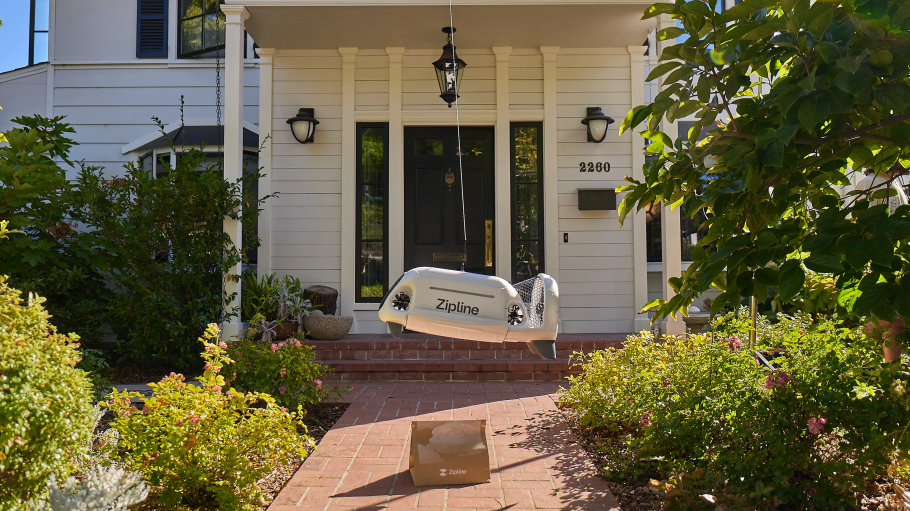
Zipline operates two drone platforms tailored to different delivery needs. Larger “Platform 1” drones are a fixed-wing aircraft designed for long-range flight, providing commercial items via parachute-controlled drops from about 60 to 80 feet above the ground. The “Platform 2” drones are smaller aircraft used by retailers and quick service restaurants (QSRs) for shorter distance home deliveries for contactless drop-off.
The drone technology manufacturer expanded its offering last year to launch a home delivery service, enabling customers to order from retailers and QSRs like Chipotle, Panera Bread and Sweetgreen via its mobile app.
The round saw participation from several new and existing investors, the company said, including Fidelity Management & Research Company, Baillie Gifford, Valor Equity Partners and Tiger Global.
“Autonomous logistics has been maturing for more than a decade, and the last year has made it unmistakably clear that when deliveries are faster, cleaner, safer, and cheaper, demand isn’t just high, it grows exponentially,” said Keller Cliffton, CEO and co-founder of Zipline, in a statement. “In 2026 autonomous logistics will become an everyday staple for people across several states in the U.S.”
Zipline and the wider drone delivery industry had perhaps its biggest vote of confidence yet late last year from the U.S. government.
While drone delivery has had its hangups in federal red tape for a decade, the Department of Transportation (DOT) proposed a new rule last August that would make it easier for businesses to obtain permission to operate a drone beyond a human’s visual line of sight.
These proposed Part 108 regulations would effectively grant companies a per-drone operating license and standardize the approval process, so that operators wouldn’t need individual waivers for each location it operates.
This would help retailers like Walmart, which has tested Zipline drones in its home state of Arkansas and Texas, accelerate the speed of adoption for drone-based e-commerce delivery capabilities.
The final rule is expected to be completed in February based on timelines established by President Donald Trump’s executive order issued last June, called “Unleashing American Drone Dominance.”
Zipline has directly benefited from government grants as well.
In November, the U.S. State Department announced it awarded Zipline a grant of up to $150 million to expand its medical logistics services across five African markets where it operates. The drone delivery company is aiming to triple the scale of its technology across the continent from 5,000 to 15,000 health facilities, further expanding access to medical supplies in Côte d’Ivoire, Ghana, Kenya, Nigeria and Rwanda.
Zipline’s work in these countries provide 24/7, on-demand, last-mile delivery of medical products like blood, vaccines and essential medicines via the drone technology to private hospitals and clinics, public health systems, suppliers, distributors and independent medical professionals.
That contract will also come with roughly $400 million of co-commitments from partner governments, according to Cliffton. The move will expand autonomous drone delivery to about 130 million people in Africa.
The State Department will release funding only when governments sign expansion contracts and commit to paying for ongoing logistics services to ensure long-term sustainability of the project.
The drone delivery startup is no stranger to high-capital funding rounds, securing a whopping $1.9 billion in money raised since its launch in 2014, according to data from Crunchbase.
Zipline reeled in $330 million of Series F funding in April 2023 before outdoing that number the next year with a $350 million Series G haul. Back in June 2021, the company generated $250 million. The technology firm received its first triple-digit financing of $120 million in May 2019, which elevated the company to unicorn status at a valuation of $1.2 billion.