A collaborative effort between Amazon and the Ports of Los Angeles and Long Beach has led the e-commerce titan to launch its first heavy-duty electric truck fleet made for ocean freight.
Alongside L.A. Mayor Karen Bass, representatives from the Biden Administration, the Port of L.A. and leading environmental groups, Amazon debuted the first of 50 electric drayage trucks that will eventually be deployed to haul cargo containers and packages from the ports to Amazon facilities for distribution throughout the region.
Related Stories
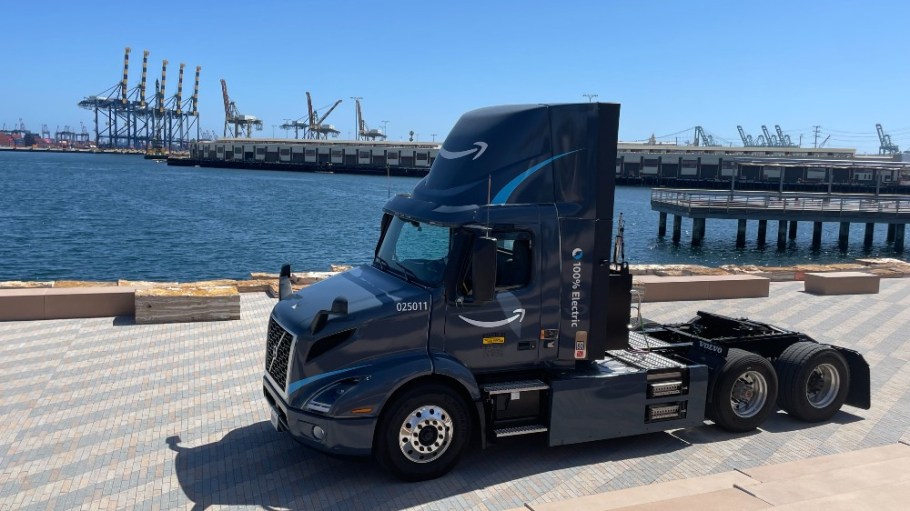
At a Tuesday press conference held at the Port of L.A.’s recently opened Wilmington Waterfront Promenade, the company showcased three trucks representing the first vehicles developed specifically to support its ocean freight operations. By the end of the year, a dozen electrified drayage vehicles are slated to hit the SoCal streets, and they’re expected to travel 1 million miles annually with zero tailpipe emissions.
These first-mile trucks will haul cargo to an Amazon facility in Santa Fe Springs, about 22 miles away, where it will be picked up by middle-mile electrified trucks and taken to fulfillment centers, sort centers, air facilities and delivery stations. From there, packages will be loaded onto last-mile delivery vans to be delivered directly to shoppers via the company’s custom electric delivery vans from Rivian. So far, Amazon has deployed 35 heavy-duty middle-mile trucks in Southern California.
The new drayage fleet is made up of battery-electric Class 8 Volvo VNR Electric trucks, which weigh in at 82,000 pounds and can drive up to 275 miles before needing a charge. The advanced vehicles contain collision mitigation technology as well as blind-spot detection, lane-departure warnings and adaptive cruise control. According to Keith Brandis, vice president of partnerships and system solutions for Volvo, they were designed to create significantly less noise. Alongside an ergonomic cab design, the trucks were developed with the comfort of drivers in mind, he said.
“We all know heavy-duty trucking is incredibly difficult to decarbonize, like many problems that are worth solving,” Amazon vice president of global logistics Adam Baker said in his prepared remarks. “The answer is complex, and there’s no actual playbook. These trucks are going to be carrying a large amount of cargo, a lot of weight and they require high power charging infrastructure. And when you look beyond just the drayage opportunities, they need to be able to travel long distances.”

Mayor Bass characterized the effort as “an example of the theme of my administration of locking arms.”
“This is locking arms with the private sector, and we know that that is required to confront the climate crisis, eliminate emissions from the transportation sector, and boost our local economy,” she said.
Bass said the project represents a meaningful step toward reducing port-related emissions, which have long impacted nearby communities and residents. “Today we continue to change that impact with a significant down payment in the clean goods movement, thanks to our private partners coming together to invest in advanced new technology,” she added. “We are beginning to see what is possible in the world of zero emission truck technology. And we’re getting closer to our goal of 100-percent clean energy by 2035 as we grow and expand.”
Ali Zaidi, assistant to President Joe Biden and national climate advisor, said 2024 will represent the largest build-out of electricity generation in the U.S. in two decades—96 percent of which will be clean energy. Sales of electric vehicles have quadrupled since the president took office, he added, increasing the number of charging stations lining American roads and highways by 80 percent.
“Now if there’s a layup in climate change, it’s getting clean electrons on the grid. It’s getting folks in passenger vehicles that don’t put pollution into the sky,” he said. “What we are talking about today is not a layup—it’s still a half-court shot. But that’s what we need to win the game.”
Moving forward, the challenge will be establishing a viable network of heavy-duty charging stations to support large trucks like those debuted on Tuesday. “You need to know that you have an anchor customer so that you’re putting all this money into developing a charging infrastructure, someone’s going to be there to utilize it,” he told Sourcing Journal.
“In this case, there is a customer that provided this anchor tenant,” he explained, referring to Amazon. “Then you’ve got the developer who has to work with the local utility commission, to get the approvals that are necessary to make the upgrade, so it takes everybody’s sort of working together.”
Port of L.A. executive director Gene Seroka told Sourcing Journal that “federal state and local monies like ours, that we’ve been investing here at the Port, are meant to give confidence to the private sector to invest behind this.” Seroka pointed to the administration’s Infrastructure Investment and Jobs Act, the Inflation Reduction Act and the Environmental Protection Agency’s (EPA) forthcoming Clean Ports Program grants as platforms for federal investment.
Meanwhile, the state of California has invested in cleaner equipment and energy products, in addition to a training campus at the Port of L.A. to teach the workforce how to maintain and drive the new electric trucks. These efforts will go a long way in helping the Port to reach its 2035 goal of having all trucks that call at the gateway reach zero-emission status, he said. “We have 20,000 trucks today registered to do business at the Ports of Long Beach and Los Angeles, and about 9,000 of them haul regularly or about once a week,” Seroka said.
Federal and state programs, along with the investments made by the Ports, are “meant to set the stage for great companies like Amazon to come behind us with their investment.”
Forum Mobility, a three-year-old San Francisco startup that manages charging depots and electric trucks for heavy-duty drayage, was selected by Amazon as a partner in the effort to build out a dedicated charging station near the Port of L.A.
“This will be our first big flagship project” with a single client, Matt LeDucq, the group’s co-founder and CEO, told Sourcing Journal. LeDucq credited Amazon with helping to secure the real-estate deal for the facility, which broke ground last week. “It will be one of the most powerful charging facilities in the country when it’s done at the end of the year,” he said, noting that the nine-megawatt depot will be able to create more green electricity than what’s needed to power L.A.’s SoFi Stadium.
“This this was actually a very complicated thing to figure out,” Amazon’s Baker added, noting that electrifying delivery vans that travel throughout urban and suburban neighborhoods is quite different than electrifying heavy-duty trucks meant to transport literal tons of cargo. The innovative spirit of partners like Forum Mobility and Volvo, which created the hardware to power these operations, has been essential, he said.
“This also can’t be done without the amazing work we’ve had with the Ports of Long Beach and L.A., as well as the different local governments,” he added. “It’s been really a great place to be able to launch something like this.”