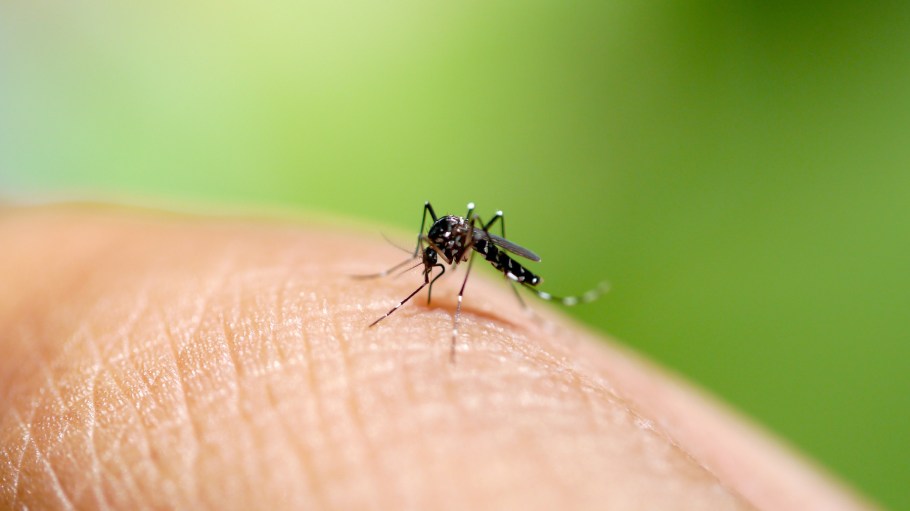
Researchers at the University of Alabama, Auburn, have come up with a mosquito-blocking apparel fabric that may mitigate the problem of 700,000 deaths worldwide annually from such insect-borne diseases as malaria, dengue fever, yellow fever, West Nile virus and Zika virus.
They have developed a knitted, bug-deterring textile that stops the insects with a physical barrier before they get even close to the skin. The micro-resolution knits are not chemically treated and contain no insecticides. Also, they are produced by robots so they rely very little on human labor, and their environmental footprint is minimal. John Beckmann, Ph.D., principal researcher at Auburn’s department of entomology and plant pathology, said the development is a big deal in the scientific community.
Related Stories
“A lot of research has gone into genetic modification and a lot of people aren’t comfortable with that,” he said. “This is a whole different solution that can change things without manipulating the environment.”
The team started out experimenting with weaves and knits and human subjects who exposed their arms to uninfected mosquitos bred in a lab. Woven fabrics were eliminated in favor of knits because of how a written knit code can be easily interpreted by modern, flat-bed computer numerical control (CNC) knitting machines, which can knit complicated structures with simple up-down needle movements.
The potential fiber combinations and knit configurations were limitless and the hypothesis was simple: certain textile configurations would block the bugs and others would not. They counted bug bites on the arms of lab associates, and experimented with common commercial fabrics, some of which failed the test. They included Under Armour compression heat gear, Nike socks, protective horse mesh and two products that advertise insect protection, including Rynoskin. Beckmann got the idea for the new fabric on a camping trip when insects bit him right through his supposedly bug-proof Under Armour gear.
Test failures all showed space through which mosquitos could probe with a proboscis, the bug’s needle-like protrusion that causes the skin welt upon injection in humans. Easy access means easy bites; if they can’t get their bloodmeal easily, the goal of the blocking knits, they move on. Under Armour also reduced the perception of bugs landing on a subject, while other garments were analyzed for how they cling to skin because how clothing fits individual bodies is also a factor in getting bitten (those that cling are not good).
One non-blocking knit was converted to a blocking knit by shrinking it in a washer and dryer, opening the door to finding ways that improve bug blocking. Researchers came up with three parameters: increasing thread diameter converted a single jersey knit into a blocking knit, growing spandex content converted jersey-skip knits into blockers, and decreasing stitch length enhanced blocking of the interlock knit.
Researchers determined that most blocking knits block more than one species of mosquito but that different recipes and optimizations would be required to generate the blocking effect in some knits.
Comfort was also analyzed against a nine-factor scale for grittiness, fuzziness, thickness, tensile stretch, hand friction, fabric to fabric friction, force to compress, stiffness and noise intensity that measures the sound of the fabric rubbing the skin. Researchers noted that blocking ability need not come at the expense of comfort, a notion which pre-empted experimentation with mosquito blocking textiles in the past.
Past launches of insect-repelling garments were not based on physical barriers but were chemically treated, one with a substance that eventually faded in the wash. ExOfficio launched the first, Bugsaway, in 2004, with sales spiking in 2016 in response to an outbreak of the Zika virus. Nobitech also launched a bug repellent line that year which, like Bugsaway, was treated with Permethrin, a substance that damages the insect’s nervous system.
Fiber content in the Auburn knit was a blend of synthetics with cotton, but Beckmann declined to give the exact proportions.
Adding to the total of 700,000 deaths per year is the cost of treatment for the diseases transmitted by vectors which includes $3 billion annually for the yellow-fever-transmitting Aedes species alone. There is also the threat to agricultural animals, which often affects those least able to afford it, and horses, who are susceptible to Eastern equine encephalitis, also carried by mosquitos.
Beckmann noted interest from U.S. textile mills in mass producing the mosquito blocking fabrics, mostly for active pursuits where insects can be a problem, like golf and camping. U.S. labor costs would keep the textiles out of the Third World where it is most needed. Its developer hopes a mill in one of the countries where mosquito-borne diseases are prevalent would get the technology and produce the goods more cheaply for foreign markets.