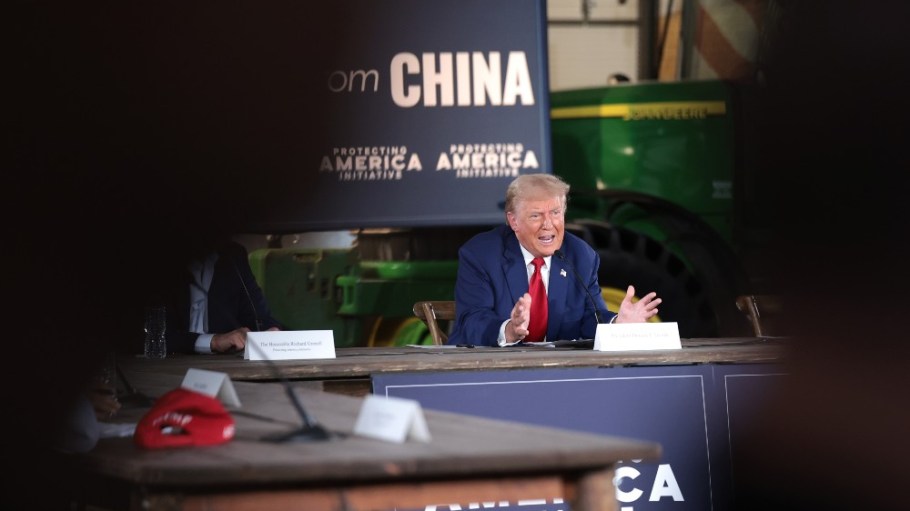
President Donald Trump’s trade policy once centered on divesting from China. But Trump 2.0’s shoot-from-the-hip style when it comes to duties may drive U.S. companies back into the sourcing superpower’s arms.
Research conducted by Dr. Sheng Lu, professor of fashion and apparel studies at the University of Delaware, shows that the anticipation of new tariff burdens and the uncertainty surrounding U.S. trade relationships is already interrupting the steady pace of supply chain diversification that has defined apparel sourcing in recent years.
Related Stories
Lu assessed 2024 trade data from the U.S. Office of Textiles and Apparel (OTEXA) and the U.S. International Trade Commission (USITC), along with other government agencies, and noted some surprising trends, he told Sourcing Journal.
“Before Trump took office, sourcing diversification could be a relatively effective way to mitigate sourcing risk related to geopolitics, but not anymore,” he said.
As firms try to navigate the logistical impacts caused by conflicts like the war in Ukraine, attacks in the Suez Canal, and ratcheted-up tensions between China and Taiwan (just to name several examples), they’re now also trying to understand the shifting landscape of U.S. trade relationships.
During the president’s first term, only imports from China were subject to punitive duties, “So the response to that situation was, ‘Let’s move orders from China to elsewhere in Asia or elsewhere in the world, because sourcing from these places have low risks of facing additional tariffs,’” Lu said. But with threats against Mexico, Canada, BRICS Alliance nations and the European Union, “there is no safety” to be found in sourcing from other locales. “So if that’s the situation, brands might as well enjoy the convenience and the price advantages of continuing to source from China.”
Whether or not the president is utilizing tariff actions “to focus on reducing trade deficits or achieving non-economic goals,” Lu said “the impact is not very helpful in sending a clear message to brands and retailers to diversify sourcing away” from the trade adversary.
Trump’s tenure has been short but jam-packed with trade action, and even before he took office, fashion firms were clocking his motives. Tariffs were a key theme of his campaign, and the constant rhetoric may have played into shifts already apparent in last year’s data.
According to Lu, while sourcing diversification remained a “pivotal trend in U.S. fashion companies’ sourcing strategy, Asia became a more dominant sourcing base in 2024.”
A record-high percentage of companies assessed in USFIA’s most recent benchmarking study reported sourcing apparel from over 10 countries last year, and said they hoped to continue to broaden their supplier bases to mitigate risks related to geopolitics, supply chain disruptions and environmental compliance. However, 72.2 percent percent of U.S. apparel imports hailed from Asia, up about one basis point from 2022 and 2023. Top suppliers China, Vietnam and Bangladesh accounted for 49 percent of imports in 2024, up half a point from the year prior, while the bloc including Vietnam, Bangladesh, Indonesia, India, and Cambodia reached a new high of 44.2 percent, compared to about 37.1 percent in 2019.
So while companies are indeed stacking their sourcing portfolios, they’re largely doing so in Asia, Lu said, and that’s significant because Chinese producers are integral to that supply chain. The range of viable emerging apparel sourcing destinations remains relatively limited, according to his research.
Lu applied two criteria to his assessment of popular up-and-coming sourcing locales: No. 1, the country accounted for at least 1 percent of apparel market share in 2024 (by value), meaning it had sufficient manufacturing and export capacity and No. 2, the growth rate of apparel imports into the U.S. market in 2023 and 2024 was higher than the global average, implying that U.S. firms had consistently upped their orders from that locale.
Only four countries met that criteria for cotton apparel: India (which captured 9.6 percent of market share, up 0.5 percent from 2022), Guatemala (2.9 percent of market share, up 0.4 percent), Egypt (1.5 percent, up 0.2 percent) and Peru at 1.6 percent, up 0.1 percent from 2022.
Similarly, for man-made fiber (MMF) apparel, only Vietnam (which accounted for 23.3 percent of market share in 2024, up 1.1 percent from 2022), Jordan (4 percent of market share, up 0.8 percent), Cambodia (4.1 percent of market share, up half a point from 2022), and Sub-Saharan Africa (SSA), which accounts for 2.1 percent of market share, a growth rate of 0.1 percent, met both criteria.
The limited list is a reminder of the significant time and effort required by companies to vet new suppliers and develop sourcing capabilities in new regions, Lu said. Still, the results were notable to him. “We thought U.S. fashion brands and retailers had many alternative sourcing opportunities, and now we know this could be a myth,” he said. “In other words, these so-called emerging sourcing destinations are much more limited than we thought.”
One issue is that new markets in places like Africa and Latin America require consistent investment to grow and scale. “They need new capacity building before they can be used as a mature sourcing base for U.S. fashion brands and retailers,” Lu said. Destinations like China, Vietnam, Bangladesh and India, by contrast, are already versed in supplying a wide range of products and have established regional verticalization to keep their supply chains humming.
American fashion firms simply aren’t committed to the task of building new value chains, in Lu’s estimation. “Their business model is about how to strengthen their capacity to reach directly to consumers; they’ll be happy to open new stores, but I don’t think they’re really committed to building new factories overseas,” he said.
What’s more, “Trump’s tariff threats really affect the interest in investment going to these emerging sourcing destinations,” he added. “It’s about the long-term capacity building, but it’s not happening.”
But if U.S. firms aren’t leading braving new sourcing frontiers, who is?
China, of course. Chinese firms are looking for more immediate access to the U.S. and Europe while seeking to skirt impending de minimis restrictions. They’re picking up factories and logistics operations in Africa and Latin America, and bolstering capacity across these markets may propel them to become “super vendors with multi-country manufacturing capabilities”—an amply marketable prospect.
And if those international ventures are stymied by Trump’s tariffs, “China’s capacity is still there; it has one of the most mature and sophisticated supply chains in the world,” Lu said.