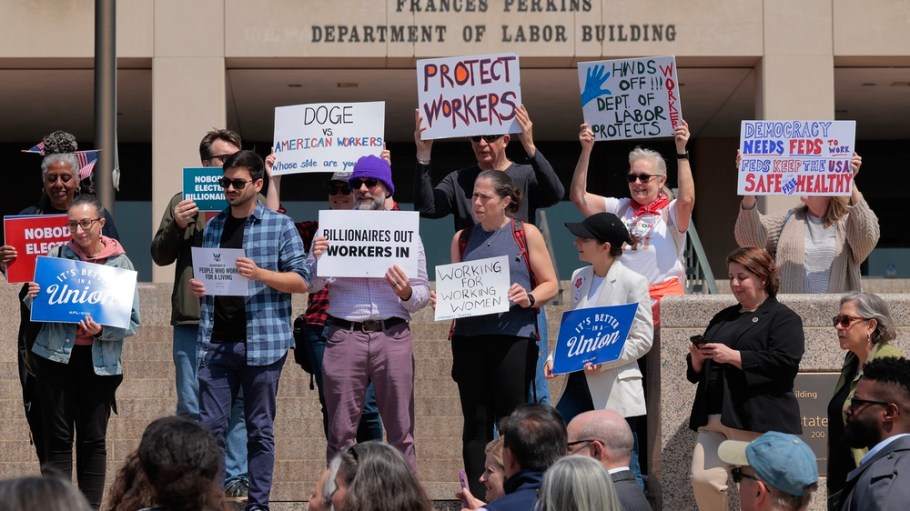
The Solidarity Center, Global March Against Child Labour and the American Institutes for Research filed a joint lawsuit in the U.S. District Court for the District of Columbia on Tuesday afternoon to challenge what they say is the U.S. Department of Labor’s “unlawful termination” of congressionally authorized international labor rights programs administered under its Bureau of International Labor Affairs, or ILAB.
The complaint, which also names Secretary of Labor Lori Chavez-DeRemer as a defendant, marks the escalation of a dispute over $577 million in canceled ILAB grants meant to buttress global labor standards, combat forced and child labor and deter unfair competition through exploitation, but that the Trump administration insists is putting “America Last” by using U.S. tax dollars to “bankroll foreign handouts.”
Related Stories
“These are programs that are designed to enhance working standards throughout the world, to eliminate child labor, to eliminate forced labor, that are designed to protect the health and safety of workers everywhere. It’s for the global good that these programs continue,” said Nicholas Sansone, an attorney at Public Citizen Litigation Group, which is representing the organizations. “In theory, it’s within the executive branch’s discretion to decide how best to carry out the goals that Congress has set. But what the executive cannot do is make those sorts of allocation decisions without explaining to Congress why. And there has been no effort here to do that. What we have here is a wholesale dismantlement of an entire bureau within the Department of Labor.”
He added that the plaintiffs seek declaratory and injunctive relief to prevent further harm, as well as to restore funding that had been previously—and lawfully—appropriated by Congress but is now being axed in a way that is “contrary to law, arbitrary and capricious.” And while the Department of Government Efficiency and President Donald Trump have “made clear what their priorities are,” Sansone said, it’s Chavez-DeRemer’s department that is ultimately responsible for essentially shutting down ILAB. The Department of Labor has been contacted for comment.
The Solidarity Center has already taken a wallop from the withdrawal of funding from one-third of its programs by the U.S. Agency for International Development, the all-but-dismantled humanitarian and development arm of the federal government better known as USAID, now under the auspices of the State Department.
Other sources haven’t fared much better: Though partially restored, its payments under the National Endowment for Democracy, which similarly filed a lawsuit against executive branch agencies and officials in the same district court in March, are still in a constant state of precarity, putting at risk more than half its budget. With the ILAB cuts, the Solidarity Center has been stripped of a further $78 million, over multiple years, that make up 20 percent of its financing. Already, the organization has laid off or furloughed 64 employees, or almost 60 percent of its workforce at its Washington, D.C. headquarters and 165 field-office staffers, amounting to 59 percent of its total strength, in more than two dozen countries, including Bangladesh, Cambodia and Lesotho.
Global March Against Child Labour was using its $4 million grant—the global network’s single-largest—to help its implementing partners, with the cooperation of national governments, to develop child labor-free municipalties in Uganda, Peru and Nepal. The funding loss will impact between 40,000 and 50,000 children, it estimates. The American Institutes for Research, which delivers data-driven technical assistance to strengthen the protection and promotion of decent work, had been deploying its three active ILAB grants—worth nearly $60 million at the start and of which $17 million still remains—to support labor justice reforms and law enforcement in Mexico. Now, it expects to lay off nearly all of its 64 staff members, plus an additional nine consultants, in the Central American nation.
While several laws, such as the U.S.-Mexico-Canada Agreement Implementation Act, require ILAB to spend a minimum amount tackling child labor and workers’ rights issues in trading partner countries, the issue goes beyond funding, said Shawna Bader-Blau, executive director at the Solidarity Center. She said that when companies squeeze workers to drive down costs, wages and standards suffer whether they’re in Honduras or Ohio. Eliminating ILAB programs, Bader-Blau said, rids the United States of one of its main tools for countering worker exploitation in the global economy.
“From the clothes we wear to the food we eat, most of what we buy is produced across complex supply chains that stretch around the world,” she said in a statement. “ILAB programs help make sure those workers aren’t being abused—and that businesses that don’t play by the rules don’t get an advantage by exploiting workers overseas. We owe it to workers in America and around the world, to responsible businesses and to our trade partners to do better.”