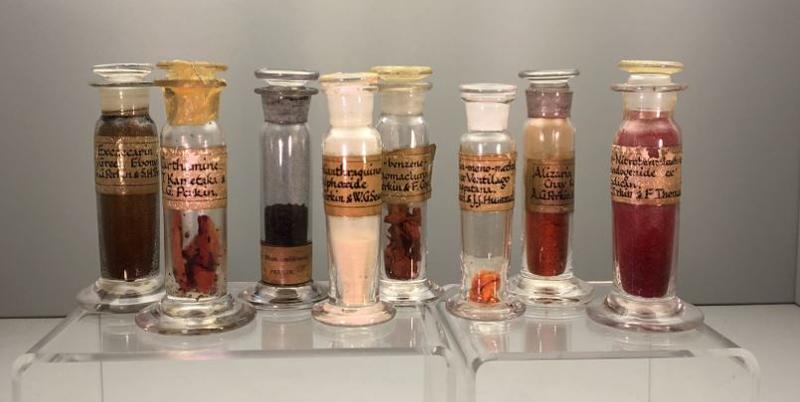
The UK-based Society of Dyers and Colorists has been busy working to preserve centuries of textile dyeing and printing history by compiling the digital Textile Collection archive.
The collection includes more than 50,000 artifacts, journals and books spanning hundreds of years of textile history. Digital images of 145 of those items have been uploaded to the database, so far, with many more to come.
“We are only at the beginning of this exciting journey, but the new website already allows us to engage with our community in a truly meaningful way,” said Shelley Hollingdrake, historical collections officer for the Society of Dyers and Colorists. “From 19th-century dyes to scientific equipment, the collection offers a unique glimpse into the evolution of color science and its global impact.”
Related Stories
Via the online database, researchers and textile professionals and enthusiasts can peruse a wide range of items, including dye sample bottles dating to the early 1800s, handwritten dyers’ notebooks recording the transition from natural to synthetic dyes and issues of “The Journal of Design and Manufactures” from the 1850s. The database, which is being catalogued by Hollingdrake, allows users to search the collection by maker, product type, production place, color and more.
“The Society has been building its collection since the 1940s. Over the years, individuals and companies related to the dyeing and textiles industry have given objects, papers, journals and ephemera, as well as recording the history and objects of the society itself,” Hollingdrake said. “It’s a fascinating collection of industrial heritage that gives insight into the people, innovations, and discoveries integral to the world of coloration.”

Hollingdrake said making the collection available to the public was important for the Society of Dyers and Colorists, as it allows them to discover a part of history they might not ordinarily encounter.
“Our collection is a really powerful window into our past, and is one that can inform our future,” she said. “It will be of use to scientific researchers, students, historians, creatives, and businesses looking for inspiration. Collections are important to people, not only as a place of knowledge, but as a record of lives lived and discoveries made.”
And while the Textile Collection archive is available to all, Hollingdrake said she sees it being particularly beneficial to those in the industry.
“In so many ways, (these artifacts) provide inspiration for textile designers and design students as well as researchers looking at dyeing practices from the past,” she said. “Textiles have been woven into the fabric of society for millennia – the textile industry ushered in the industrial revolution and the inception of the petrochemical industry. We can look back now and learn from our mistakes to create a better, more sustainable industry that treads lightly on the planet and its people.”
The Society of Dyers and Colorists, which was established in 1884 and provides color education and qualifications such as Chartered Colorist status, embarked on this project in honor of the organization’s 140th anniversary.
The group will display pieces from the collection this week at the International Conference on Dyes in History and Archaeology in Leeds, Oct. 23-25. And while Hollingdrake and her team at the Society of Dyers and Colorists have many more items to add to the Textile Collection archive, the current database can be found at collections.sdc.org.uk.
“It’s incredibly rewarding to share the rich history of textile dyeing with a wider audience,” Hollingdrake said.