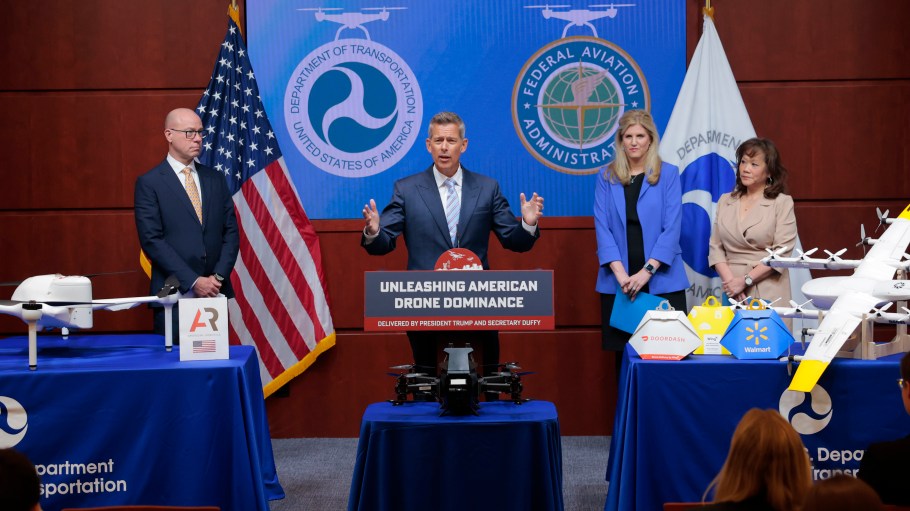
Drone operators have long had their eyes on the sky. Newly proposed regulations could change that.
U.S. Transportation Secretary Sean Duffy announced this month that he had proposed a new rule related to the permits drones need to fly beyond visual line of sight (BVLOS). The proposed rule, known as Part 108, would change how drone operators receive approval to fly BVLOS, which is to say that, when the drone is flying, a human operator doesn’t have to be able to see it in order for it to continue moving.
Related Stories
Today, BVLOS allowances are more of an exception than they are a rule; Amazon, for instance, has received some location-specific exemptions for its proprietary MK30 drone, which allows it to deliver parcels to consumers from sites in Texas and Arizona. These kinds of exemptions require case-by-case evaluation, depending on the location the drones will launch from and operate in.
If Duffy instates Part 108 as it has been proposed, the process for obtaining permission for BVLOS could become less arduous for companies, which could increase the speed of adoption for drone-based e-commerce deliveries. That’s because the rule would effectively grant companies a per-drone operating license; in the case of Amazon, the company would share information about the MK30 model with the Federal Aviation Administration (FAA) to attain the ability to fly that model of drone throughout the country, with some limitations in densely populated areas. The approvals would need to be updated accordingly if companies introduce new drone models.
Mark McKinnon, partner at law firm Fox Rothschild, said that approach provides more stability to companies looking into drone deployment for delivery.
“Up until now, BVLOS authorizations have been given on an ad hoc or experimental basis and have largely been limited to specific locations or airspace,” he explained. “With the new rules, the approvals will be more uniform and will allow operators to determine if their operations can be performed at scale at a reasonable cost, [making] everything more predictable from a business standpoint.”
While the adoption of drone-based deliveries and technologies would likely proliferate more rapidly if the rule goes into effect, drones still face some barriers. Many models struggle to operate in adverse weather conditions, and drones have weight limits for parcels. What’s more, delivering items via drone can be costly as compared with other, more traditional last-mile logistics methods.
Experts said that if Duffy’s rule becomes final, consumers’ safety in areas where drones become a routine part of delivery would be protected because the FAA will require a more uniform approach to regulating drones, rather than a piecemeal approach that incorporates some uncertainty.
Russell Kline, chief regulatory officer at Dexa, also known as Drone Express, said the uniformity of Duffy’s proposed rule is likely to provide a safer experience for the consumer than existing waiver-based approaches do.
“This rule will objectively improve consumer safety. Every person or company wanting to conduct drone delivery will have to meet the safety standards defined by the rule. That means, no corner-cutting or ‘I wonder if this will work?’ approaches to drone delivery,” Kline told Sourcing Journal. “When those approaches aren’t an option, consumers will see an approach to drone delivery that is safe and consistent—just like a passenger sees when they board an airline. We all get the same pre-flight safety and expect an equivalent level of safety from carrier to carrier.”
Retailers have acknowledged that drone-based delivery holds promise for e-commerce customers, but growth has been slow going, in part because of the regulatory burdens associated with flying them. Even Amazon, which has said it has seen some success with its drone deliveries, has deployed drones in limited areas and has shuttered its original Prime Air facility in Lockeford, Calif. The company has plans to expand into other areas, like Dallas and Kansas City, per the Associated Press.
Competitor Walmart has also been working on its drone strategy. It currently offers deliveries in the Dallas-Fort Worth region and has plans to expand to Atlanta, Charlotte, N.C., Houston, Orlando, Fla. and Tampa, Fla. The company previously halted its drone operations in Phoenix, Salt Lake City and Tampa.
Those expansions could be made easier by Duffy’s proposed approach, and President Donald Trump’s approach to date has been praised by drone operators, like Wing, which partners with Walmart.
“Getting this [BVLOS] rule right is key to unlocking the full potential of drone delivery, enabling safe, efficient and scalable services for communities across the country,” Margaret Nagle, head of policy, regulatory and community affairs at Wing, wrote in a blog post in June, just after Trump signed an executive order called Unleashing American Drone Dominance. Duffy’s proposed rule fulfills a directive outlined in that order.
If drones become more widely used for e-commerce deliveries, other technology companies stand to benefit, as well. Mailbox-as-a-service provider Arrive AI, which makes and licenses delivery points for drones to drop off and pick up parcels, believes the proposed rule could aid its business.
“The proposed BVLOS rule brings us significantly closer to a future where drones, robots and AI-powered, smart delivery points work together to move goods securely, efficiently and autonomously, particularly in…rural last-mile logistics,” Dan O’Toole, founder and CEO of Arrive AI, said in a statement. “Other countries are ahead of us in using drones for delivery, and in the few cases in the U.S. where it’s been allowed, consumers love it.”
O’Toole isn’t the only one who believes Duffy’s approach to BVLOS could change the way forward for rural delivery systems.
James McDanolds, a former drone flight test engineer and operator and current program chair at Sonoran Desert Institute’s School of Uncrewed Technology, said the rule is one many experts in the unmanned aircraft system field have been expecting to see since drones’ increase in popularity for a variety of use cases. In McDanolds’ mind, wider adoption of drones for delivery could be beneficial for smaller communities without immediate proximity to retail stores and certain resources.
“This is great for rural areas that need things like drone delivery to address certain logistical challenges based on environmental and landscape challenges, even here in the US. Many might think, when they think of drone delivery at first, as just something for e-commerce for larger metropolitan areas, which is certainly an added value, but much of the real value is for rural locations that may have smaller populations that need key things delivered on a more on-demand basis,” McDanolds told Sourcing Journal.
Duffy’s BVLOS rule is currently open for comment through mid-October, which means that its provisions are not yet final and have not been approved for enforcement yet. McDanolds said it’s likely that any final rule related to unmanned aircraft systems (UAS) would not take effect until 2026.
“It might not be till the beginning of next year when we see this rule come into effect,” he said. “This is good as this rule is large and is essentially separate from [existing FAA rules], it needs a lot of consideration and time for those in the industry to understand in full, and, if desired or newly required, gives time for UAS organizations to train, learn and fully understand this new ruleset before it releases.”