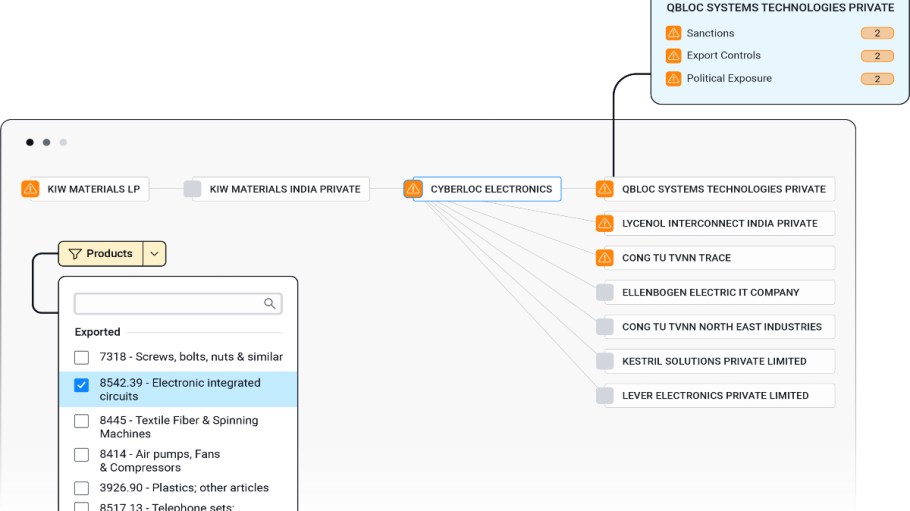
Sayari revealed new technology Tuesday that will help companies pinpoint supply chain risks.
The supply chain intelligence provider’s new tool, called Sayari Map, builds on the company’s existing technology, Sayari Graph.
Sayari Map allows brands and retailers to screen their supplier networks against potential issues or hazards to business, like non-compliance with the Uyghur Forced Labor Prevention Act (UFLPA) or other regulatory and geopolitical considerations.
Related Stories
Rhea Rakshit, senior director of product management at Sayari, said organizations can track both active suppliers and potential vendors as they work to ensure their supply chains are compliant and humane.
“Any entity you want to include in your master list or include into the [backend], it does not need to be only vendors you’re already working with. We’ve seen instances where organizations will use our [technology] to [look at] potential suppliers who they’re investigating or doing some amount of pre-screening or vendor due diligence for,” Rakshit said.
She highlighted the fact that while Sayari Map can help to steer companies clear of partnering with suppliers that have risk factors, that information is not speculative; it’s based on real-time data and shipment records.
“All supply chains on Sayari Map, as well as Sayari Graph, are based on actual shipment records—so these are not conjectural, predictive supply chains. These are supply chains where the shipment has occurred [and] there’s no doubt, no supposition, no ‘maybe this is a supplier, maybe it’s not,’” Rakshit told Sourcing Journal.
The Washington, D.C.-based company’s technology takes into account both shipment data and other information about sanctions and risk.
For instance, a company or supplier may receive a “critical risk” rating if it is listed on the UFLPA Entity List, is subject to trade restrictions by Customs and Border Protections’ Withhold Release Orders (WRO) and Findings List, has been named in Sheffield Hallam University’s forced labor reports and more.
From there, risk levels downgrade—suppliers may receive a “high risk” rating if they have headquarters in the Xinjiang Uyghur Autonomous Region (XUAR), conduct business in the XUAR and more.
The system also flags suppliers for “elevated risk.” Based on risk designations, companies can make decisions about their relationships with certain suppliers.
Clients can have analysis up and running in a matter of hours or days, Rakshit said. As Sayari prepared to launch the tool, it saw major interest from fashion and apparel providers, but also from other industries, like electronics, at-large retail manufacturing and more. Government agencies have also expressed interest.
John Foote, partner at Kelley Drye, said the tool has helped the firm advise its clients on business risks and compliance with trade regulations.
”Since we started utilizing Sayari Map, we’ve been able to provide our clients with unprecedented insight into over 200 upstream suppliers, enabling the assessment of risks and compliance in real time,” Foote said in a statement. “Previously, evaluating suppliers for compliance and supply chain risks was a labor-intensive process that involved sifting through numerous disparate sources to manually configure the risk landscape. Now, it can be done in just minutes, allowing us to better advise based on a clear view of a supplier’s situation and risk exposure. The data resolution and enhanced visibility features of the Sayari Map platform have transformed the way we advise on forced labor-related trade matters.”