The weekly Retail Tech Roundup compiles technology news across the supply chain, manufacturing, retail, e-commerce, logistics and fulfillment sectors.
Fulfillment
Maersk/Fabric
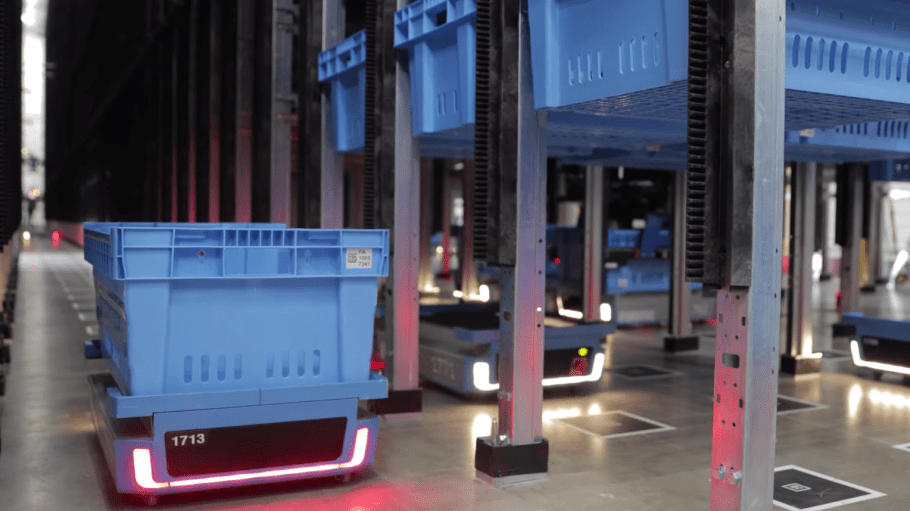
A.P. Moller-Maersk and automated fulfillment solution provider Fabric launched a new 38,000-square-foot automated fulfillment center in Dallas, powered by Fabric’s robotic and software technology. The new facility features an AI-driven, automated e-commerce fulfillment solution in an urban environment that maximizes warehouse productivity while minimizing real estate footprint requirements.
Related Stories
Fabric’s high-density, high-throughput cube-based storage system is designed to fully leverage warehouse ceiling heights to effectively maximize the potential of smaller facility footprints. And with the assistance of advanced robots and software, the system is optimized to fulfill orders of single-picked items for same- or next-day delivery.
This design makes the technology well-suited for distributed warehouse networks in urban areas, putting goods closer to population centers and cutting shipping costs while expediting delivery times. The Dallas facility is optimized for high-volume, business-to-consumer (B2C) e-commerce, and can manage up to 25,000 SKUs via 89,000 cubic feet of automation.
The site is expected to be fully operational this fall in support of an unnamed online B2C retailer, which is expected to reach 6.8 million consumers via same-day delivery, and 24 million for next-day delivery.
Oracle/Uber
Oracle and Uber launched Collect and Receive, a new offering on the Oracle Retail platform connecting retailers and consumers to enhance last-mile delivery.
Supported by the Oracle Retail Data Store and cloud platform technologies, retailers can now link to Uber Direct, the company’s white-label delivery solution, via pre-integrated APIs. This joint solution can enable retailers to rebalance inventory while giving customers more choices, including same-day and scheduled delivery options, order pickup and returns to the closest retail or postal location. The service is available for Oracle Retail customers in the U.S. and Canada.
“Every month, more than 3,500 brands use Uber Direct to power millions of same-day local deliveries,” said Dara Khosrowshahi, Uber CEO. “Together with Oracle, we can make it easier than ever for retailers to leverage on-demand delivery—and even returns—to delight consumers, streamline logistics, and ultimately boost loyalty and sales.”
This co-innovation builds on Uber’s recent seven-year strategic cloud partnership with Oracle to deliver new consumer experiences with last-mile logistics and drive increased profitability with Oracle Cloud Infrastructure (OCI).
New research commissioned by Uber shows that 75 percent of consumers expect express delivery as an option, and 72 percent are more likely to continue ordering from companies that offer this service. With Collect and Receive, retailers can leverage the power of the Oracle Retail Data Store Cloud Service to quickly connect to Uber Direct through bundled APIs.
Once connected, retailers can offer customers local delivery while better managing delivery costs and closing the gap between order and delivery to create a more agile supply chain geared to move merchandise more efficiently across their ecosystem.
All transaction data is captured in the Oracle retail cloud platform, enabling retailers to analyze buying behaviors and preferences to refine and improve services and offers moving forward.
“With this partnership, Oracle is enabling retailers to easily extend the value of their Oracle retail applications with last-mile delivery services from Uber,” said Jordan K. Speer, research director of worldwide retail product sourcing, fulfillment and sustainability strategies at IDC Research. “This will lower the cost of last-mile deliveries of whatever sort—whether product delivery to home, store-to-store transfers of merchandise, product returns, and so forth. This bilateral communication between Uber and Oracle is a significant step forward in providing retailers a more valuable, intelligent, end-to-end supply chain process.”
Artificial intelligence
Salesforce launched what it bills as the next generation of artificial intelligence (AI) technology, Einstein.
Einstein Copilot is designed to drive productivity by assisting users within their flow of work, enabling them to ask questions in natural language, and receive relevant and trustworthy answers grounded in proprietary company data from Salesforce Data Cloud.
The retail-specific version of the platform, Einstein Copilot for Merchants, helps merchants easily set up fully featured stores and generate new webpages, automate catalog data management, and generate personalized promotions, product descriptions and storefront codes—while identifying the fastest path to reach specific business goals.
With the platform, users can generate personalized promotions based on their customer data, in an effort to enable the right offers to reach the right customer, to optimize conversions. Promotions can be created with AI-guided strategies such as “frequently bought together,” “boost promoted products“ and “promote low-selling product.”
The platform also hosts AI-powered product descriptions, where users can customize product information and descriptions for different customer groups, at scale, making sure each customer gets an ideal content match.
Einstein Copilot for Merchants includes generative coding tools built to make website customization easier, powered by natural language prompts. The Commerce Setup function marries AI and storefront solutions to allow brands to build customized, feature-rich storefronts with automated setup flows and generative product descriptions.
In the Commerce Cloud console, users can receive AI-powered step-by-step guidance that recommends the best ways to increase average order value, boost website conversions, offload last season’s excess inventory or accomplish other merchant objectives.
Fit technology
Athletic Propulsion Labs (APL)/True Fit
Luxury performance athletic footwear brand Athletic Propulsion Labs (APL) said that working with AI-driven fit technology platform True Fit resulted in a 2 percent revenue increase while reducing fit-related returns by 15 percent from customers who used True Fit recommendations.
With its patented technologies and innovative designs, APL footwear is now stocked in more than 300 luxury retailers including Nordstrom, Harvey Nichols, Selfridges, Matches Fashion, Net-A-Porter and Mr. Porter.
In 2019, APL first began its partnership with True Fit as it scaled its direct-to-consumer (DTC) business, with the goal of offering its shoppers fit guidance to build confidence into their buying journeys. APL leverages True Fit’s Fashion Genome to provide best-in-class fit recommendations powered by the demographics, fit preferences and buying behaviors of millions of global shoppers, and then enhanced by AI.
This data can deliver high-fidelity size and fit guidance to 100 percent of traffic, from zero click product size guidance for all traffic to highly personalized fit recommendations to shoppers who register and create a True Fit profile.
“We know from the data that finding the right fit drives consumer loyalty and increases customer conversion. We choose True Fit because consumers have a trust level with the brand. It gives them confidence during the buying process as sizing can often seem complicated in the virtual world,” said NJ Falk, managing partner at APL, in a statement. “True Fit takes the guesswork out of the process making it easy for the consumer to determine their true size while reducing the likelihood of a consumer ordering and returning multiple sizes.”
Warehousing
Honeywell
Honeywell introduced the MesonX Warehouse Management System (WMS), a software solution designed to improve and streamline warehouse and distribution center operations.
From handling inbound receipt and put-away to managing replenishment, picking, order fulfillment and shipping, the software provides businesses with the flexible end-to-end control necessary to simplify their operations and excel in a demanding marketplace.
Companies can expect up to 80 percent lower implementation costs with this software. Honeywell said the software can be fully operational in two weeks with only 250 hours of onboarding services, versus the usual 2,000-hour implementation time.
Logistics companies often face high costs coupled with a long lead time in designing, developing, configuring and testing a WMS for their operations. These challenges can hamper companies with tight budgets and an even tighter project time frame. Some end up investing too much in systems that offer more features than they need, while others create their own homegrown WMS, only to outgrow it and drain internal resources. MesonX WMS tailors itself to specific workflows, eliminating the need for costly custom coding.
The software solution can integrate with numerous devices, including mobile computers, voice automation technology, printers, barcode scanners, robotics and more.
Supply chain visibility
Wiliot
Internet of Things (IoT) company Wiliot said that its IoT Visibility Platform can now sense and analyze humidity levels of individual products, in real time, throughout the supply chain.
By adding humidity sensing to the company’s Visibility Platform—on top of Wiliot’s existing temperature, location and carbon emissions sensing capabilities—Wiliot can help companies better ensure the safety, integrity, freshness and sustainability of moisture-sensitive products.
The Wiliot Visibility Platform connects the digital and physical worlds through the Wiliot Cloud and Wiliot IoT Pixels, which are low-cost, self-powered, mass-manufactured postage stamp-sized computer devices affixed to products and packaging.
IoT Pixels continuously and automatically transmit data to the Wiliot Cloud via standard Bluetooth devices, greatly reducing the staffing and operational cost of traditional tracking methodologies, while also reducing error rates, waste, mis-shipments, mis-picks and out-of-stocks.
By using the latest technology to connect any item to the internet and embedding it with intelligence and awareness, companies can generate more efficient, profitable, and sustainable supply chains, Wiliot said.
With this latest launch, Wiliot engineers have now introduced to IoT Pixels a tiny membrane that detects humidity in the air. When an IoT Pixel is exposed to different humidity levels, the information is relayed wirelessly to the Wiliot Cloud. In the cloud, this humidity data is combined with temperature and location data to generate insights and timely alerts for staff that can better optimize supply chain operations.
Mobile POS
Reitmans/Jumpmind
Fashion retailer Reitmans Canada Limited has partnered with retail technology provider Jumpmind to modernize and enhance the in-store experience for customers and store employees.
In business since 1926, Reitmans Canada Limited is a women’s specialty apparel retailer with over 400 stores throughout Canada and an e-commerce platform. The retailer is in the process of deploying Jumpmind’s advanced mobile-first point-of-sale (POS) solution to streamline in-store operations, drive efficiency and improve the store employee experience. Jumpmind’s mobile-first architecture and user interface help sales associates to execute tasks and engage with customers throughout the store, enhancing personalized service and convenience.
“We are embarking on a journey to transform our in-store experience to support a superior shopping journey for our valued customers, and to enhance the employee experience, forging our future success,” said Michael Strachan, president of Reitmans’ Penn and RW&Co. banners and executive sponsor of the project, in a statement. “With its innovative approach to retail technology and modern cloud foundation that we can build upon, easily adding more flexibility and complimentary solutions into our stores, Jumpmind is the ideal partner to bring an exciting next-gen in-store experience.”
Buy now, pay later
AliExpress/Splitit
Splitit, a buy now, pay later (BNPL) solution provider that allows customers to pay in installments using their credit cards, has rolled out on AliExpress across Europe in markets including the U.K., Germany, Spain, France, Italy and the Netherlands.
AliExpress also debuted the solution in Australia, and has expanded the Pay After Delivery service to customers in the U.S. While Pay After Delivery was already offered in Spain and Germany, AliExpress is now bringing Splitit’s installment service to those markets.
Pay After Delivery is Splitit’s latest service that allows consumers to pay for goods after delivery via a custom-branded experience embedded in the AliExpress checkout flow. Splitit’s flexible technology platform, coupled with Checkout.com’s payment-acquiring capabilities, enables AliExpress shoppers to pay after delivery with their existing credit card. Alipay is AliExpress’ global payment solution partner.
The partnership comes a month after Splitit announced a $50 million investment from specialty private equity firm Motive Partners. The company plans to use the funding to accelerate growth and support the execution of its strategic plan as it becomes a private corporation.
Mobile payments
Zebra Technologies
Zebra Technologies, a digital solution provider enabling businesses to intelligently connect data, assets, and people, launched Zebra Pay, an enterprise-grade mobile payment solution for the retail, hospitality, entertainment, field mobility and logistics industries.
Featuring enterprise-grade security and EMV Level 3 certification, Zebra Pay equips businesses to accept payment from all major credit card brands and payment technologies, including NFC-contactless tap, chip, and magnetic stripe.
Zebra Pay is currently certified with Global Payments in EMEA and Worldpay from FIS in North America, and there are plans to add more acquirers in the future including Fiserv. It is also Visa Ready, meeting Visa’s requirements for an optimal Tap to Pay POS acceptance experience.
The software expands the mobile payment capabilities on compatible mobile devices to include line busting, assisted selling, extended aisle, curbside and field-based sales, and reduces the need for customers to support multiple devices.
The solution helps business owners to rapidly deploy and activate the solution on existing devices, while the cloud-based Zebra Pay Merchant Portal gives them complete visibility into deployments, hardware status, transactions and an audit trail for all its locations.