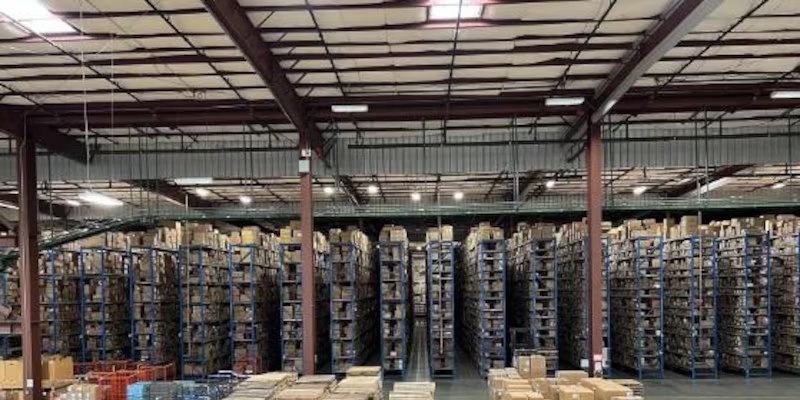
REI Co-op sold four Class A U.S. distribution centers to Madison Capital for $230 million in a sale-leaseback agreement, it announced last week.
Madison Capital now owns the company’s facilities in Sumner, Wash., Bedford, Pa., Goodyear, Ariz. and Lebanon, Tenn. Together, those buildings boast about 2 million square feet worth of space. Madison paid $101.3 million for the Washington facility, which is situated about a one-hour drive south of Seattle, where the company has its headquarters. REI did not individually specify how much it sold the other three warehouses for.
Related Stories
A sale-leaseback agreement typically sees one company—in this case, Madison Capital—purchasing real estate from its previous owner—in this case, REI—then leasing the same space back to the previous owner.
According to REI, it plans to continue to “maintain and operate all buildings with no impact to employees.” It further noted that, as part of that plan, it will keep ownership of all equipment inside the four distribution centers, which it uses to drive inventory to its stores and fulfill e-commerce orders.
Kelley Hall, REI’s chief financial officer, said the company’s reliance on leasing other facilities gave executives the confidence to transition these distribution centers to a similar system.
“Based on the success of long-term leases with our current headquarters and majority of our stores, we determined a sale-leaseback model was a great option as part of our overall financial and real estate portfolio management,” Hall said in a statement.
REI said it has expended time and resources into making the facilities more climate friendly. It has obtained LEED certifications for three of the four facilities and has also earned a TRUE Zero Waste certification for three of the distribution centers. Hall insinuated that sustainability continues to prioritize such goals for its supply chain and said the facilities’ new owner is aligned.
“Madison Capital was selected as the strongest partner after a thorough process that included interest from multiple buyers. We are enthusiastic about our partnership and their support of our commitment to sustainability,” she said in a statement.
REI’s choice to sell is the latest action in a slew of cuts that show the outdoor retailer’s books may be suffering. Already this year, the company closed its Experiences business, which saw it parting with 428 employees.
At the time, CEO Eric Artz said that piece of the business served “less than 0.4 percent of all co-op customers” and noted that it “costs significantly more to run than it brings in.”
In 2024, it laid off more than 350 people, and in 2023, it laid off just less than 300 store employees.
The company continues to worry about its financial progress; after several years of losses, Artz said upon shuttering Experiences last month that REI will “be close to breakeven for pre-dividend operating income and free cash flow” for fiscal year 2024.
Some of its 2025 investment priorities, he said, include inventory management systems that will increase in-stocks on desirable products and give the company a greater ability to create locally relevant assortments. It also has plans to “enhance the customer experience online and in stores with investments in areas including personalization and visual merchandising.” The co-op also has plans to open several new stores this year and next in New York, California and other states.
Artz announced last month that he will retire at the end of March and will be replaced by Mary Beth Laughton, who began serving as the company’s president early this month.