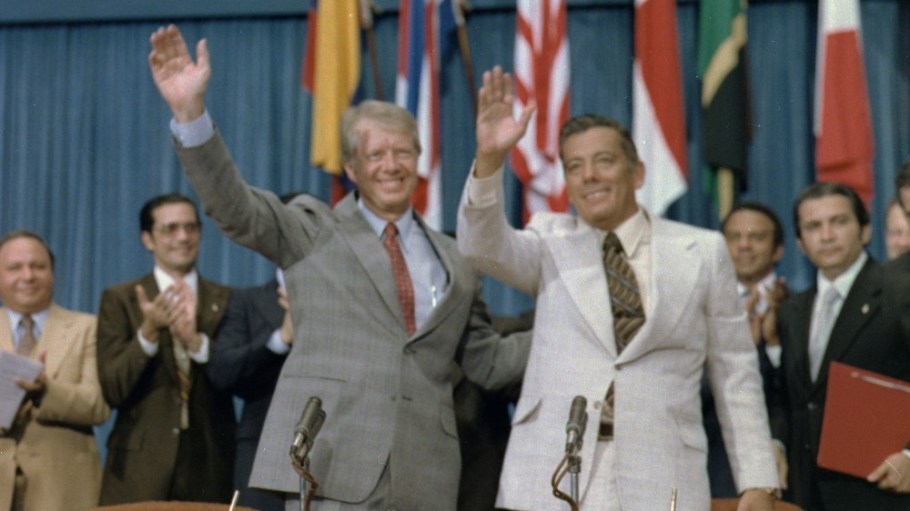
Former President Jimmy Carter passed away Sunday at the age of 100, leaving behind a nuanced legacy and a number of lasting trade and logistics policies.
Once a peanut farmer from Georgia, the 39th president was known chiefly for his post-White House humanitarian accomplishments. But as Commander in Chief, Carter had an outsized impact on trade relationships with both allies and adversaries, the consequences of which still reverberate today.
The Panama Canal Treaties
Carter was responsible for the Panama Canal Treaties of 1977, which sought to transition control over the essential trade route connecting the Atlantic and Pacific Oceans back to Panama.
Related Stories
Built in 1903 during President Teddy Roosevelt’s administration, the Canal has become integral to East-West trade, now accounting for about 40 percent of U.S. cargo traffic. It connects 160 countries and reaching 1,700 ports around the world, according to the International Trade Administration (ITA). The U.S. controlled the waterway, which was situated within an unincorporated Canal Zone, for more than 70 years.
But in the mid-1960s, anti-American sentiment began to percolate throughout the region, growing stronger throughout the ensuing decade. By the late 1970s, concern solidified around the idea that maintaining the status quo could spark a guerrilla campaign against U.S. forces, according to the non-partisan Council on Foreign Relations (CFR). The Joint Chiefs of Staff, alongside Carter, negotiated two treaties with Panamanian General Omar Torrijos Herrera, known as the Carter-Torrijos Treaties.
One established the neutrality of all ships passing through Canal and gave the U.S. the right to defend against threats to that neutrality from other parties. The other created a framework for dissolving the Canal Zone starting in 1979 and transitioning full control of the Canal to Panama by 1999, in effect establishing Panamanian sovereignty. The hard-fought legislation narrowly passed in the U.S. Senate, and earned Carter ample ire from conservatives.
For a quarter of a century, Panama has controlled the Panama Canal. But incoming President Donald Trump has suggested in recent days that the U.S. should “take back” control of the critical trade conduit in the face of mounting tariffs and fees being instituted by the Panamanian government.
Trump intimated that U.S. firms and the military are being fleeced by Panamanian leadership. In turn, President José Raul Mulino has pushed back, saying that the new rates, which will take effect in January, will support the “maintenance and modernization needs of the interoceanic waterway.”
Restoring ties with China
President Carter is credited with normalizing relations with the People’s Republic of China, granting the communist regime formal diplomatic recognition in 1979. That meant acknowledging the PRC’s “One China” doctrine, which in turn withdrew recognition of non-communist Taiwan, or the Republic of China.
Carter’s administration ended the 1955 Mutual Defense Treaty with the Republic of China in 1980—a decision that was challenged in federal courts by Republicans, who ultimately won. But an appeals court found that the president had the power to sever the mutual defense treaty without Senate consent.
Congress then worked to pass the Taiwan Relations Act (TRA), which the CFR think tank called “one of the seminal pieces of congressional foreign policy oversight.” Signed by Carter, the legislation mandated that the U.S. provide Taiwan with defensive arms and “maintain the capacity to resist” threats to Taiwan’s security.
According to research published by the University of Virginia’s (UVA) Miller Center, Carter’s act of recognizing China cooled tensions in East Asia, paving the way for a period of economic growth in China. With beneficial trade relations established between the two superpowers, Carter’s presidency kicked off the ballooning of consumer goods production and trade with China that persists today.
China ascended to the World Trade Organization (WTO) in May 2000, and Congress granted the country Permanent Normal Trade Relations (PNTR) the same year. Since then, China’s production dominance on the world stage has earned it the title of “The World’s Factory.” But relations between the U.S. and China have soured throughout the past two presidential administrations, and Trump has vowed to expand tariffs on China-made goods when he takes office on Jan. 20.
The bipartisan Congressional U.S.-China Economic and Security Review Commission this fall recommended that China’s PNTR status be revoked.
The International Emergency Economic Powers Act (IEEPA)
Signed into law by President Carter on Dec. 28, 1977, the International Emergency Economic Powers Act, otherwise known as IEEPA, authorizes the Commander in Chief to regulate international commerce in the face of a national emergency related to the presence of an “unusual and extraordinary threat” to U.S. security, foreign policy, or the economy that originates wholly or substantially outside of the country.
Once the president declares such a national emergency under the law, they are authorized to block transactions with other nations and entities and freeze assets as a means of mitigating the threat. If the U.S. is attacked, the president can confiscate the property of any country, group or individual involved.
According to the Congressional Research Service (CRS), which provides reporting for members of Congress, “IEEPA has become an important means to impose economic-based sanctions since its enactment.”
“Initially, Presidents targeted foreign states or their governments,” researchers wrote. “Over the years, however, presidential administrations have increasingly used IEEPA to target non-state individuals and groups, such as terrorists, persons who engage in malicious cyber-enabled activities, and certain persons associated with the International Criminal Court.”
Incoming President Trump has consistently expressed a desire to impose a universal baseline tariff of 10 percent to 20 percent on imports from countries across the globe, and he’s also recently taken to threatening Western Hemisphere allies like Mexico and Canada with duties as a means of deterring mass migration into the U.S.
During his first term, Trump touted his intention to leverage IEEPA to impose tariffs on Mexico until “the illegal migration crisis is alleviated…by Mexico.” According to CRS, political experts have identified IEEPA as “one of the more likely options” for Trump to pursue his proposed duty hikes in 2025.
Deregulating the transportation sector
Carter was also responsible for several legislative moves aimed at deregulating transportation logistics, like the Air Cargo Deregulation Act of 1977, which was intended to help soften inflation by allowing the market to control air cargo rates. Previously, carriers said they were unable to turn a profit based on low rates set by the federal government’s Civil Aeronautics Board (CAB).
The legislation eliminated the government’s jurisdiction over air cargo rates, as well as routes and services, and allowed new players to enter the sector without restrictions.
Meanwhile, the Motor Carrier Act of 1980 took a similar approach within the trucking industry, allowing providers to set their own rates and making it easier for newcomers to establish themselves in the market. According to the Government Accountability Office (GAO), the law had the effect of increasing competition within the trucking industry—however, that competition has “come primarily from existing firms expanding their operations, rather than from new firms entering the market.”
The same year, Carter signed the Staggers Act in the fall of 1980 into law, which removed a number of regulatory restraints from the rail sector. The industry was able to adjust rates and tailor services to meet shipper needs.
According to the Federal Railroad Administration, “the railroad industry’s financial health has improved significantly, service to rail customers has improved while overall rates have decreased, and rail safety, regardless of the measure, has improved” since the legislation’s passage.
“The evidence strongly indicates that rail deregulation has accomplished its primary goal of putting the U.S. rail freight industry on a more secure financial footing,” the Washington, D.C.-based Brookings Institute wrote. “Surprisingly, deregulation has also turned out to be a great boon for shippers as rail carriers have passed on some of their cost savings to them in lower rates and significantly improved service times and reliability.”