New jobs numbers paint an uncertain picture of the future of American manufacturing in the wake of President Donald Trump’s tariff announcements.
Despite promises that the country’s production force would come roaring back under the new trade policy, U.S. factories collectively dropped 1,000 jobs during the month of April, according to data from the Bureau of Labor Statistics.
“It’s not terribly surprising that factory jobs were flat last month, as they have been for the past five months, reflecting a modest but steady decline since early 2023,” Alliance for American Manufacturing (AAM) president Scott Paul said following the release of the jobs report Friday.
Related Stories
While there have been significant reshoring announcements in industries like semiconductors and pharmaceuticals over the course of the past three years, “it hasn’t been enough to tip the scales,” Paul said. “The bigger question is, what happens next? Until there is certainty on tariff policy, many manufacturers will likely be treading water.”
The production market for hard goods and technology has indeed seen only middling advancement in recent months, but the industries officials have been quick to write off may be the ones to buck the trend. Many footwear and apparel firms from coast to coast have experienced increased interest since the tariffs took effect—though its too soon to tell whether commitments are short-term or partners are in it for the long haul.
Mitch Cahn, owner and president of Unionwear, said he was surprised to see the decline in U.S. manufacturing roles. “We have seen a serious uptick in business since the tariffs went into effect.”
The Newark, N.J.-based manufacturer of hats, bags, promotional products and military gear “rarely get[s] real inquiries from the fashion business and the merchandise business for Made-in-U.S.A. products, and that’s been all the inquiries that we’re getting these days,” Cahn told Sourcing Journal. “I will say we worked overtime the entire month of April which is a rarity for us.”
Asked whether he has had to make any cuts to factory roles as a result of the duties, Cahn answered, “We haven’t.” The data could be skewed by the automobile industry, which has faced supply chain issues due to dependence on Canada and Mexico for parts and inputs, he believes.
On the flip side, “Most of the domestic sewing companies that I’m talking to are busy,” Cahn said. “However, we have only added a couple of heads because we are operating under the assumption that the tariffs are fleeting.”
No one knows whether the next news cycle will bring reports of a new tariff threat or a new trade deal, though the president and his cabinet have intimated that agreements with allies—and even a truce with China—could be imminent.
Asked whether such developments could halt the progress his business is seeing, Cahn said, “On a strictly fashion B-to-C basis, yeah, I think that if the wind blows in the other direction, we’re going to see brands, in general, go back to the cheapest possible product.”
“But there is the possibility, and I’m thinking the probability, that for many businesses, there is going to be more interest in the Made-in-U.S.A. product—and not because of the tariffs,” he added. Over the next three years alone, the U.S. will celebrate its 250th anniversary and it will host the World Cup and the Olympics. Not to mention, a 2028 election cycle will bring out a fresh batch of presidential hopefuls from both parties looking for branded merch—a key element of Unionwear’s offerings.
Alex Zar, CEO of Los Angeles-based Lalaland Production and Design, told Sourcing Journal he was in Washington, D.C. on Tuesday participating in discussions on The Hill designed to educate lawmakers about advanced manufacturing in the U.S. “Onshoring trends and vocational training is talk of the town in D.C.,” he said. “As far as Lalaland goes, we are just starting to ramp up hiring for traditional production as well as our 3D-printing technology we are building here stateside, to get ready for mass-scale local production.”
The manufacturer, which deals in premium and luxury leather goods, has been fielding inquiries from fashion brands looking to bring a portion of their production closer to their end market. Zar said he’s confident the trend will continue, but the industry could use the government’s support.
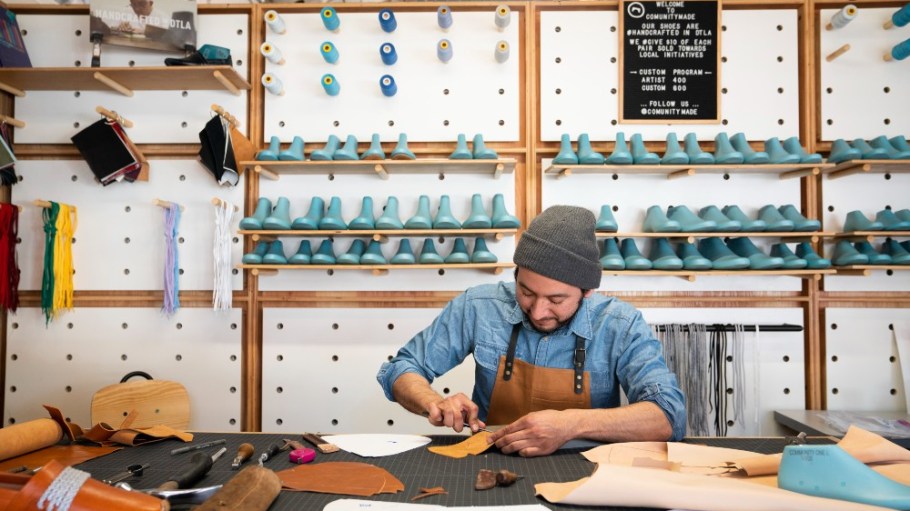
L.A. Fashion District neighbor ComunityMade is also experiencing “a surge in business,” according to Sean Scott, the company’s co-founder and CEO.
“We’ve been laying the groundwork for several years so we can’t attribute all new business to the tariffs,” he explained. Over the course of the past year, the footwear production studio and factory has seen a steady stream of new business coming through its doors.
“That said, since the tariffs were announced, our metaphorical phone has been ringing off the hook. So Comunity is growing and will be hiring people,” he added. “In short, these tariffs are a shock to the system that has heightened a trend toward local production that was already in progress.”
But there is still a “big question about what happens next,” Scott said, noting that the administration’s unpredictability and the resulting uncertainty are “business killers.”
Manufacturers are uniquely positioned to recognize the disruption on the horizon, from higher prices on consumer goods to order cancellations at China-based factories and significant supply chain disruptions like those at the ports, “as they manage the stops and starts from this administration’s actions and corrections.” And just like during the Covid-19 crisis, delays, frequent logistics rate changes and “Chaos, basically” are driving decision-makers to scramble.
“This disruption may not be on the same scale as the pandemic but that’s not a bad analogy either. This local production movement needs the active support of bigger brands so we can invest in infrastructure and grow the industry,” he said. “If these bigger brands suffer too much from tariff disruption, they may ‘pump the brakes’ on any unproven business, like local production. So, we don’t feel our recent uptick in business is stable.”
At Gambert Shirtmakers in Newark, N.J., “The tariffs are creating a lot of tire kicking from potential new business, but nobody is doing anything actionable per se,” said CEO and owner Mitch Gambert. Brands and retailers might be picking up the phones for informal conversations where they might probe their options, but they’re not signing on the dotted line. “As for employment, we have not had any layoffs, however, we are working a four-day work week because the normal volume is off.”
According to Gambert, whose business specializes in premium men’s shirting for brands and retailers across the U.S., many clients are seeing a 20-percent to 30-percent decline in business—and that’s impacting the firm’s orders. “I think consumer confidence is way off, and I know supply chain disruption as a result of the tariffs is not causing any boosts to the economy,” he said. Even if companies are open to producing closer to home, consumers may not be making as many discretionary purchases now that so many necessities have jumped in price.
“If crippling China was the only goal. they are succeeding; if it was to boost the American economy, it is not kicking in yet,” he added.
Gambert previously told Sourcing Journal that the small manufacturing operation has also experienced difficulty sourcing the materials and fabrics it needs from Canada, Europe and Asia, with prices on the rise and availability in question. “If they don’t eliminate tariffs on raw materials, then the tariffs imposed on all imported goods will only increase my prices and keep me still more expensive than off-shore production,” Gambert lamented, noting that he might not be able to capitalize on a Made-in-the-U.S.A. resurgence if the conditions aren’t right.
Needless to say, these factors complicate the firm’s future hiring plans. “I’m not really sure who is evaluating these policies, but they are not working from the perspective of someone with a manufacturing facility here in the United States,” he said.