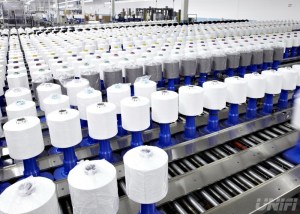
Lenzing has been awarded the EU Ecolabel for environmentally friendly fiber production at its Indonesian viscose production plant which just underwent an ambitious modernization to meet the demands of environmentally conscious consumers.
Additional capacity is planned for the site in Purwakarta (PT. South Pacific Viscose) which recently broadened its offerings to include Lenzing Ecovero and Veocel brands of specialty fibers for use in non-woven applications.
The conversion of the Purwakarta site enables a nameplate capacity of 303,000 tons per year, in a plant that has reduced sulfur emissions and annual CO2 footprint. It is expected to contribute to wastewater reduction as part of an overall lower environmental footprint.
Related Stories
In addition to reducing emissions at the Indonesian plant, its recent 100 million euro ($106.6 million) modernization has enabled Lenzing to begin getting energy from renewable sources. It is driving the company’s conversion to biomass in line with its goals of reducing carbon emissions per ton of product sold by 50 percent by 2030 and making it carbon neutral by 2050. Purwakarta has already reduced CO2 emissions by 130,000 tons annually.
Lenzing Group CEO Stephan Sielaff said he views the EU Ecolabel designation as an affirmation of the company’s environmental policies.
“We are working tirelessly to make the industries in which we operate even more sustainable and to drive the transformation of the textile business model from linear to circular,” he said. “Our investments in Indonesia, as well as in other Lenzing sites around the world, put us in an even better position to meet the growing demand for specialty fibers with low environmental impact.”
The location of the converted Purwakarta plant allows it to reduce the overall carbon footprint of the textile supply chain by putting it in close proximity to value chain partners in the Asia-Pacific region, allowing larger quantities of viscose fibers to be transported shorter distances. Lenzing’s EU Ecolabel-endorsed Ecovero viscose fibers are already produced using up to 50 percent less fossil energy and water than generic viscose. In another move toward environmental responsibility, the Purwakarta plant will soon be producing Ecovero Black specialty fibers that use a low-carbon spun dyeing process to significantly reduce water and energy consumption in dyeing.
“As brands and retailers continue to reconfigure their manufacturing network, the region has become a convergent of all components of the supply chain from spinners, weavers, knitters to garment makers and sourcing offices,” said Florian Heubrandner, executive vice president of global textiles business for Lenzing, which works with such brands as M&S, H&M and Levi’s.
“As demand for responsible viscose continue to rise in the region, the increased production of responsible viscose in the Purwakarta site will not only allow us to work more closed with our existing customers but also allow us to introduce Lenzing Ecovero to new prospects in the region who are keen to switch from generic viscose to responsible viscose,” he added.