Traceability has become a top priority for the industry as companies look to meet escalating legislative and disclosure demands as well as market expectations. Brands want to protect their product standards, and consumers are increasingly curious about the provenance of their purchases.
“Product integrity…aligns with traceability and social compliance, because we’re in an age now where your customers are asking, ‘Where did this come from?’” Sophia Legros, vice president, product integrity, compliance and sustainability at SPARC Group, the parent company of brands like Brooks Brothers, Forever 21 and Nautica, said during a panel at Sourcing Journal’s Fall Summit.
Related Stories
Legros and her fellow panelists noted that making full supply chain traceability a reality requires all hands on deck. This starts with finding the right partnerships. When moderator Lauren Parker, director of Sourcing Journal Studios, asked what SPARC Group looks for in suppliers, Legros likened it to dating. The group lays out what it expects of suppliers—including codes of conduct, traceability, quality and social compliance—from the start, determining if there is a fit before entering a business relationship. “If they are not aligned, and if we feel that it’s not going to be a match, then sometimes you just have to walk away,” she said. “It’s like matchmaking. You’re not going to date somebody who you just have no chemistry with.”
SPARC Group bases its testing, social compliance and traceability standards on the regulations and requirements of its destination markets. This includes aligning with the expectations of each of its seven brands’ consumer audiences, based on insights from other internal SPARC teams.
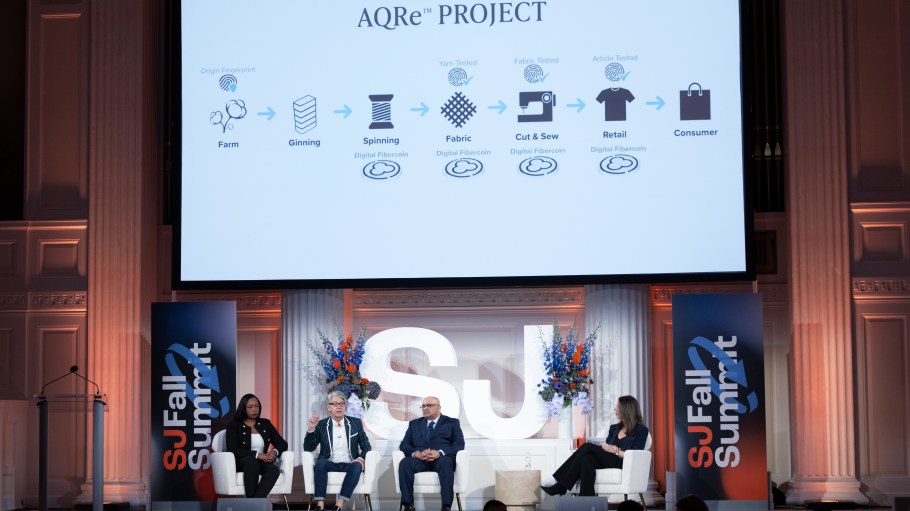
Offering an example for what can be accomplished if the entire supply chain gets involved, Supima’s AQRe Project has established end-to-end supply chain traceability for the American-grown Pima cotton it promotes. The platform, which stands for Authenticity, Quality and Responsibility, tracks Supima cotton from the field forward rather than trying to map the complicated supply chain web back from the finished product. AQRe encompasses Oritain’s physical fiber testing and TextileGenesis’ blockchain-inspired chain of custody tracking.
“What we wanted to create with our platform was really an ecosystem for brands that held the same values to work with each other, and to work so collaboratively and in community,” said Buxton Midyette, vice president marketing and promotions at Supima.
Oritain’s technology looks at trace markers left on natural materials from their growing environment, enabling it to then test fibers at subsequent stages of the supply chain to match them with an “Origin Fingerprint,” or a specific location profile. Although Supima is grown in just a handful of Southern and Southwestern U.S. states and represents only 1 percent of the total cotton market, it still took two years for Oritain to map the crop’s entire growing region.
Each bale of U.S. cotton is issued a Permanent Bale Identification (PBI). When a spinner buys a bale of cotton for a Supima program, they enter the PBI into the TextileGenesis platform. Each kilogram of cotton is represented with one digital Fibercoin, which then tracks each entity that touches the fiber in the supply chain through to retail.
Companies can choose whether they want to brand their American pima cotton as Supima, however every product that now licenses the Supima brand name must track the cotton through AQRe, creating a fiber-wide traceability requirement. Eliminating debates over who should “foot the bill,” the 55-cent fee for AQRe—including both the licensing fee and the traceability solution—is positioned at the spinning stage, integrating it into the yarn price so the cost can be spread across the supply chain.
Extra-long staple Pima cotton commands a premium, selling for around $1.80 per pound compared to 60 cents for the same weight of medium and short staple cotton species. “There’s an incredible incentive to substitute…lesser fiber for Supima when those opportunities exist,” said Midyette. “So that’s…why Supima has focused on authentication and supply chain integrity.”
Grey Matter Concepts, which manufacturers categories like underwear and socks for licensed brands like Wrangler, DKNY and Lee, joined the AQRe Project when it started using Supima earlier this year. The firm is on a constant quest for newness, and Masood Rafi, director, compliance testing & sustainability at Grey Matter, noted that Supima offers a recognizable ingredient name. AQRe also fits with the company’s focus on putting sustainability and traceability at the heart of its sourcing choices.
As Grey Matter was working on its first Supima program for a major retailer, Supima and TextileGenesis worked closely with its compliance teams to help get them up to speed. “They made sure that each part of our supply chain…[understands] exactly what needs to be done,” said Rafi.
Aside from a means to a compliance end, traceability also creates the potential for companies to better know their supply chains and collaborate more, which Midyette noted is a competitive advantage.
SPARC’s Legros also emphasized the importance of supplier engagement. For instance, the company’s compliance efforts have included educating suppliers about sourcing risks. The other piece of the puzzle is face time and “boots on the ground.”
“When people were traveling more into these factories, the relationships were better,” she said. “And I think we need to get back to that now, so…these factories are aware that we’re watching. We do trust you, but we just want to make sure that we’re doing the right thing, and it will strengthen your business.”