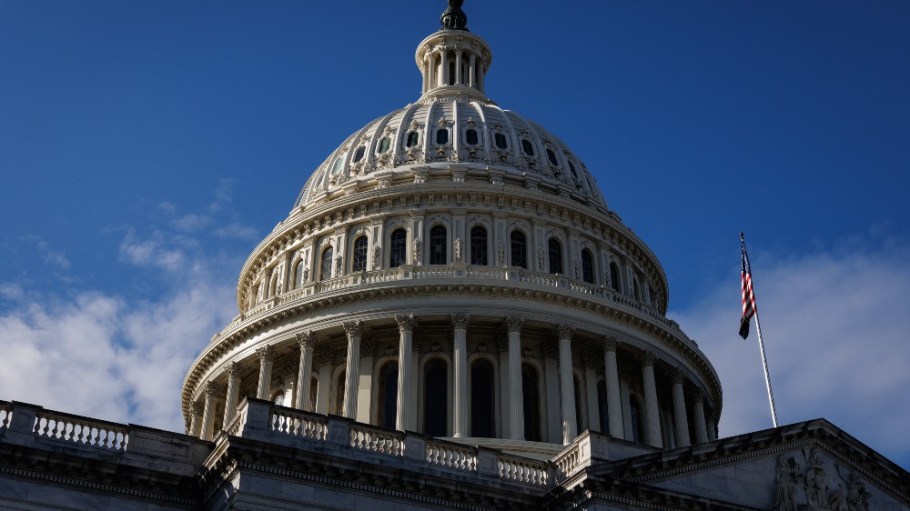
House lawmakers have made quick work of passing a bill that aims to target China for its violations of U.S. trade laws.
Introduced in late July by the Select Committee on the Chinese Communist Party (CCP), the Protecting American Industry and Labor from International Trade Crimes Act passed in the lower chamber on Tuesday via a voice vote.
The legislation will create a new framework for stopping international trade crimes, establishing a system for detecting, investigating and prosecuting trade fraud and other subversive trade actions, from duty evasion and transshipment to market flooding and the use of forced labor to create products.
Related Stories
Committee Chairman John Moolenaar (R-Mich.), alongside Congresswoman Ashley Hinson (R-Iowa) and Ranking Member Raja Krishnamoorthi (D-Ill.), who introduced the bipartisan bill, said it would initiate the formation of a task force within the Department of Justice’s (DOJ) Criminal Division to take on trade crime.
The task force would also beef up nationwide responses through training for federal, state and local law enforcement, allowing officials to take on criminal and civil complaints in tandem. If passed, the Attorney General would be charged with compiling an annual report for Congress on the DOJ’s progress. The lawmakers are looking to earmark $20 million for fiscal 2025 to fund these efforts.
“For decades, companies operating under the control of the Chinese Communist Party in the People’s Republic of China have systematically violated U.S. trade laws,” and those actions have allowed overseas companies to undercut American producers, Hinson said on the House floor Tuesday.
She pointed to the Select Committee on China’s uncovering of trade fraud perpetuated by a China-based auto manufacturer, Qingdao Sunsong, wherein the firm used transshipment to evade Section 301 duties. Hinson said the skirting of tariffs undermined an Illinois auto company’s business, forcing it to lay off a quarter of its workforce.
“Sunsong is far from the only Chinese company taking action to exploit our trade system to bolster China’s non-market economy, crippling American industry and manufacturing, threatening workers’ wages and livelihoods, and enabling slave labor,” she said.
The DOJ is currently “inadequately equipped” to take on the massive volume of trade-related crime across the country, and while tariffs represent “one tool in our toolkit,” Hinson said the DOJ’s trade fraud enforcement efforts must be supported by legislation.
Congress has been working with a greater sense of urgency in recent months to limit China’s influence on the U.S. market by stripping it of long-held trade privileges.
In mid-November, Select Committee Chairman Moolenaar introduced the Restoring Trade Fairness Act, which would revoke China’s Permanent Normal Trade Relations (PNTR). The movement to roll back China’s PNTR privileges has also gained traction in the Senate, with companion legislation introduced earlier this year.
The U.S. granted China PNTR status in 2000, recognizing China’s ascension to the World Trade Organization (WTO). Duties on China-made products were established at rates set forth in Column 1 of the U.S. Harmonized Tariff Schedule—the same rates applied to most countries across the globe (aside from American free-trade partners).
Before the Thanksgiving holiday, the U.S.-China Economic and Security Review Commission released its yearly findings and recommendations to Congress. The non-partisan group of commissioners also recommended the removal of China’s PNTR status, in addition to eliminating the de minimis trade provision for goods sold on online marketplaces. Doing so would help stem the heavy flow of e-commerce shipments making their way into the U.S. from China each day, the Commission said.
President-elect Donald Trump’s pick for U.S. Trade Representative (USTR), Jamieson Greer, is sympathetic to these objectives. The agency veteran testified in front of the Commission in May and recommended that China’s PNTR status be repealed and its access to de minimis trade eliminated. With bipartisan momentum in Congress and a new administration on the way, a reframing of the China-U.S. trade relationship may be imminent.