The global cotton industry has reached a critical inflection point where paper-based documentation and supplier declarations are no longer sufficient to satisfy regulatory and consumer demands.
As the European Union rolls out its anti-greenwashing crackdown—now being enforced in early-moving markets like Germany—and the United States keeps pressure on forced-labor risk through UFLPA enforcement, boutique supply chain consultancy GenuTrace and digital traceability platform Kinset have partnered to help companies substantiate cotton origin claims.
Related Stories
“Regulation has fundamentally changed the question brands must answer,” said MeiLin Wan, founder and CEO of GenuTrace. “It’s no longer ‘Where did you intend to source from?’ It’s ‘Can you prove that the cotton in this product actually comes from where you say it does?’ By linking physical origin verification directly to digital records, we help companies respond to enforcement with evidence, not explanations.”
In short? Generic claims of “sustainability” or “ethical sourcing” are becoming increasingly prohibited—with the burden of proof now shifting entirely to the brand and manufacturer. In response? GenuTrace and Kinset pitched a two-part approach to cotton traceability: lab-based origin testing paired with a data trail designed to stand up to regulators and DPP-era scrutiny.
“Digital traceability tells you what should be happening in your supply chain; physical verification tells you what actually is,” Wan said. “When those two are connected, brands can move from assumptions to evidence—using data they already have, without rebuilding their systems or slowing operations. That’s what makes this approach both effective and practical.”
The United States’ UFLPA enforcement maintains a strict “rebuttable presumption” that goods containing cotton from Xinjiang are produced with forced labor—what Holland & Knight said places the burden of proof entirely on importers, according to the firm. To release detained goods, companies must provide clear and convincing evidence, such as comprehensive supply chain mapping, supplier documentation—and, if necessary, lab testing—to demonstrate compliance, per Braumiller Law Group.
In turn, the nation’s U.S. Customs and Border Protection (CBP) continues to ramp up enforcement, placing the burden on importers to prove that cotton is not linked to forced labor.
In Europe, due diligence directives—such as the EU Deforestation Regulation—require clear, verifiable chain-of-custody documentation for materials. On Jan. 30, Germany’s Bundesrat approved amendments to the Act Against Unfair Competition (UWG) to implement the EU’s Empowering Consumers for the Green Transition Directive—restricting self-certified sustainability labels and explicitly prohibiting generic, vague or unverifiable environmental claims as of Sept. 27.
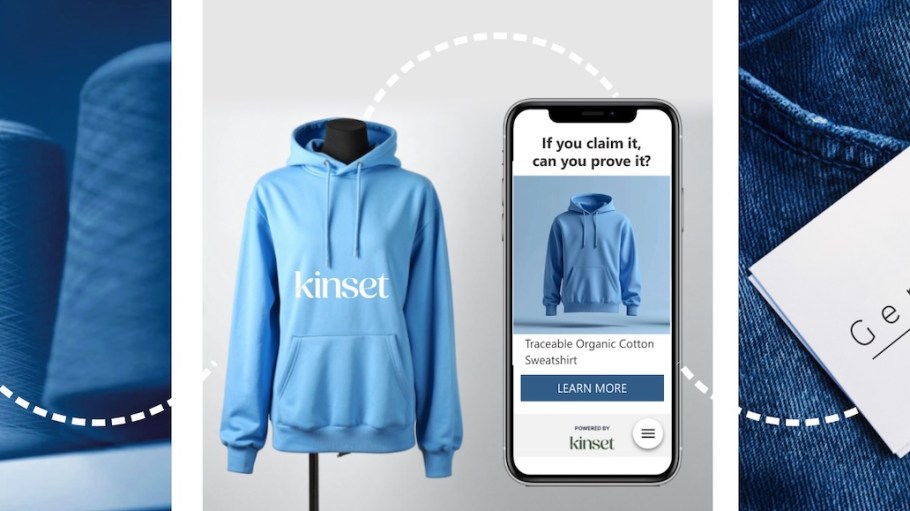
And while it’s worth noting that not all quick response codes are created equally, the DPP’s launch speed is a data problem—not a QR problem, according to Kinset, a Dublin-based company that provides a digital platform to connect supply-chain data across global networks for organizing data with greater transparency and management control.
“Digital Product Passports and due-diligence systems only work if the data behind them is credible,” said Katie O’Riordan, CEO of Kinset. “Our collaboration focuses on connecting existing supply-chain data with independent physical verification, so companies can strengthen compliance without rebuilding their systems from scratch.”
Here’s how the partnership works: GenuTrace offers fiber-level isotope testing to verify where cotton was grown by analyzing the material itself, as opposed to relying solely on paperwork. Kinset, meanwhile, supplies the digital system to capture and link supplier, site and transaction data across the value chain—producing a record the companies say is structured for Europe’s emerging DPP requirements.
Claims must be limited to what can be substantiated, per the partners; systems must be designed with enforcement in mind.
“Most companies already hold a huge amount of valuable supply chain data, but the challenge is turning it into something trustworthy and usable,” O’Riordan said. “Our role is to structure and connect that data so it can sit alongside physical verification where it adds value, without slowing teams down or forcing them to rebuild their systems from the ground up.”