Digitalization can cross off multiple lines on fashion’s sustainability to-do list, from waste reduction to lower resource consumption.
This intersection of environmental action and technological innovation was discussed in multiple sessions at the World Fashion Convention co-hosted by the Sewn Products Equipment & Suppliers of the Americas (SPESA) and the International Apparel Federation (IAF). Speakers shared how gaining a better read on demand with artificial intelligence reduces overproduction and waste, how virtual design cuts back on sample creation and how using scannable technology for care and product labels can reduce material use.
Related Stories
“[Sustainability] is a direct correlation with digital in a lot of ways,” said Katie Crumpton, executive account manager at Cotton Incorporated. “You see physical samples and prototyping, and really the advantages of moving towards digital fabric and 3D creations.”
Data and demand planning
Roughly a third of the 150 billion garments currently produced each year will end up in landfills, according to Stylumia founder and CEO Ganesh Subramanian. He stated that fashion’s overproduction could be stemmed with improved forecasting. Although companies are currently performing market research to get a read on demand, there is a “gap” between what customers want and what brands think they want. To overcome this, he suggested incorporating consumer-centric decision-making across the entire supply chain.
“The only way to bridge this gap is to have a fashion trend information which is not static, which is dynamic,” Subramanian said. “I call it a perpetual demand information, which is available to everybody in the value chain.”
This involves capturing information on consumer preferences daily and using artificial intelligence and computer vision to analyze photos to uncover trends. Subramanian also advised manufacturers to not just follow brands’ directives, but to use consumer-level data to better serve their customers. He added that having better intelligence can be suppliers’ “biggest differentiation.” For instance, knowing what is on trend can help manufacturers target and narrow their sample creation. These consumer-centric styles will also perform better at market, improving sell-through while also reducing carbon footprints and waste.
With Stylumia’s technology, users can upload an image of a sample and predict the demand for it based on the brand’s target market. This helps companies produce the right volume. “There is no bad product if you made the right quantity,” said Subramanian.

Data also comes into play to support a company’s sustainability efforts, including corporate social responsibility and supplier information. As Rik Veltman, fashion tech evangelist at K3, noted, the industry has gone from fragmented spreadsheets to sharing more data and improving connectivity between supply chain parties.
“What we are trying to achieve is not to connect within your single company, but also connect outside that company,” Veltman said. In addition to connections between immediate buyers and suppliers, the idea is to create links further up and down the chain. “All that information needs to be connected, needs to be available for ultimately—and that’s what legislation is leading to—to consumers so that they have more visibility on their products.”
To assist companies in going back further than Tier 1, K3 has developed a tool that traces transactions through the supply chain. Veltman noted the challenges in getting the industry—particularly suppliers—to “open up,” including worries about revealing a “secret ingredient” and the complexities of the parts of the supply chain that stretch beyond the fashion industry to chemicals, agriculture and more. “Everybody knows we need to open up, we need to make this transparent,” he said. “And at the same time, we fear the transparency.”
Veltman urged the industry to adopt transparency, adding that it will change the supplier and buyer relationship by making the vendors more visible to the end consumer. “By opening up, the balance between supplier and brand will also shift,” he said. “It will be more equal partners because they both have benefited.”
Jo Anne Benson, senior director product solutions at Pivot88, spoke about how quality and inspection data can support decision-making, such as predicting supply chain issues and determining where to allocate production based on factory performance. Pivot88’s platform also houses raw material and supplier data, helping companies have traceability and visibility to meet compliance demands. Using the example of eyewear brand Oakley, she explained that it took the company three to four years to be able to use quality systems to deal with laws. “Start today, start yesterday, because all the legislation is coming,” Benson said. “If you don’t have data, you’re really not going to survive.”
Ramping up 3D design
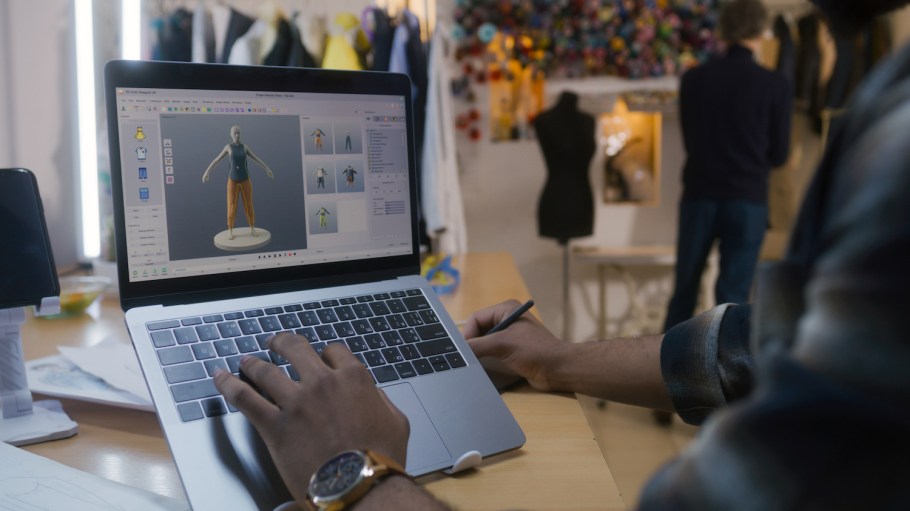
Turkey-based manufacturer TYH Tekstil A.Ş. has been working to cut back on its physical sampling to achieve the related cost and natural resource savings. Aside from the materials needed to produce samples, there is also the carbon footprint associated with shipping them to customers. TYH has been using 3D modeling for about four years, leveraging it as a collaboration and communication tool. “As the technology develops, our jobs become easier in 3D modeling, because 3D models [have] now begun to resemble the real samples,” said Aysegül Kaya, innovation and sustainability manager at TYH. “So we can collaborate with the customers through 3D design.”
Kaya noted that some brands still have “trust issues” with 3D samples, leading them to request physical versions in addition. TYH is encouraging these customers to up their digital sampling. Dominic Sluiter, 3D adoption partner at EnhanceThat, pointed out that brands don’t usually understand the cost of a sample, and bringing this to light or charging customers for samples could help convince brands of the ROI on switching to 3D.
Per Sluiter, what has changed in 3D design in the last few years is the focus on achieving ROI with the technology. He noted that one way to make a difference with these solutions is by using them in season. Since many different factories are involved in the creation of one collection, Sluiter pointed to the significance of having a “unifying idea of what quality is in the industry” and “all speak[ing] the same language.” He added, “A lot of factories over the years have been embracing the use of 3D with some exceptional results. But I think now it’s the moment to come from an individual focus to collective focus on how can we actually align our understanding.”
Part of 3D design is translating physical fabrics to digital programs. Providing a resource and source of inspiration for the industry, Cotton Incorporated has created a library of knit and woven digital fabrics that can be used in 3D software like Clo and Browzwear. Now, every fabric sample released by Cotton Incorporated launches with a digital twin in the organization’s Fabricast library.
As Crumpton noted, brands are at different stages when it comes to digital product creation. Some are beginners, while others are more advanced. “We see a great need in that curious beginner age areas where these brands may not have the funds, the power to create their own internal libraries,” she said.
Crumpton sees standardization as a key hurdle for the industry in digital design, since different programs use different file types, and the methods of testing fabrics’ physics such as weight vary. “If we’re going to move to the world of really having confidence in our 3D products, we need to make sure that I think all of that is to the standard that is expected at the consumer level and for the brands and retailers,” she said.
Making virtual design happen also requires workers with the right skillsets. At the collegiate level, Thomas Jefferson University is teaching students to create digitally and giving them access to tools like rendering software. The college’s Bruner Material Characterization Lab also allows them to test substrates at different stages. “We train our students on both hand practice and in the digital space so that when they build things, they can deconstruct it and build it better,” said Becky Flax, professor of textile design at Thomas Jefferson University. “It’s not just about creating something in the digital realm. We are informing and creating datasets that allow us to do this more effectively moving forward.”
Digital labeling
Digitalization can also extend to clothing products themselves—or more specifically, clothing tags. This July, the American Apparel and Footwear Association (AAFA) and the IAF, along with 128 other organizations, distributed a letter globally calling for governments to update labeling standards to allow for digital dissemination of required information. This would have a sustainability impact, since currently it is estimated at least 5.7 million miles of label tape is produced per year.
“There’s an opportunity to dramatically shrink the amount of label tape that gets used, while providing more information, so consumers actually read what’s on the labels, they actually absorb the information, they use it,” said AAFA president and CEO Steve Lamar during a one-on-one with Matthijs Crietee, secretary general of IAF.
Lamar added that in many cases, companies spend millions of dollars ensuring that all the right information is on a label, only to have consumers cut or rip the tags off. Switching to digital labels can also assist with recalls, allowing companies to disseminate information to customers.
As with other sustainability topics, Crietee explained the goal of these cross-organization initiatives. “It’s not so much that we want governments to do something, to support, to create something,” he said. “We want them to take away something that’s blocking progress.”