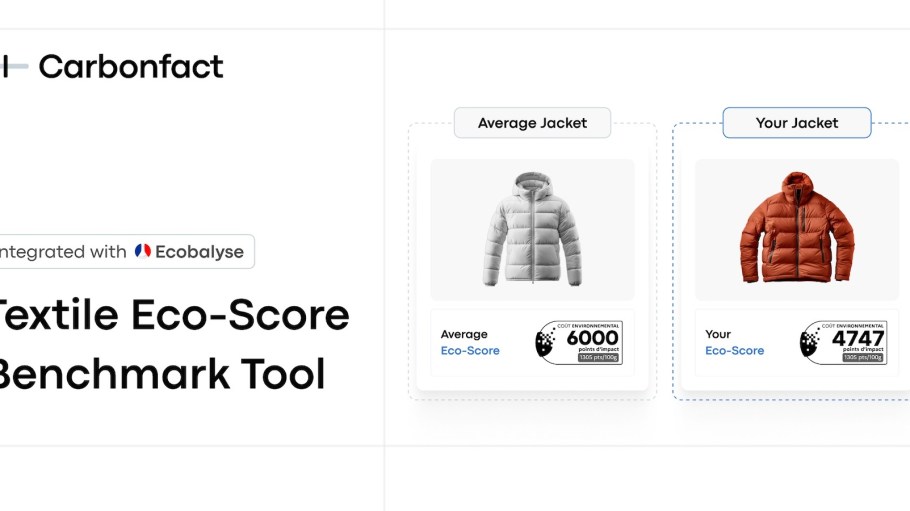
Carbonfact, an environmental data platform for the apparel and footwear industry, just shared the first free solution that lets brands calculate their official French Environmental Cost—and compare it, instantly, to industry benchmarks.
“Many sustainability teams ask us the same question: How do we know if our eco-score is good or bad compared to other products from the same category?” said Marc Laurent, co-founder and CEO of Carbonfact. “This tool gives brands a simple, official and private way to answer that question.”
Related Stories
The carbon management software startup developed the benchmarking tool ahead of France’s upcoming affichage environnemental scheme. Introduced under the Anti-Waste Law for a Circular Economy (AGEC) law, the new environmental labeling mandate requires brands—specifically Decree 2022-748 for textiles and footwear—to disclose product sustainability details.
The French Textile Eco-Score—also known as Environmental Cost—is an environmental label that rates the environmental impact of clothing across its full lifecycle. It’s calculated through Ecobalyse, the official methodology and platform provided by the French government. The ecological assessment tool estimates a product’s impact—based on criteria like weight and composition—developed as an open-source tool within the framework of the various French constitutional digital incubators and accelerators.

This experimental API interface backs Carbonfact’s Eco-Score Benchmark Tool. The Parisian startup takes this official methodology and benchmarks it against hundreds of product scenarios per category (like jeans or T-shirts) drawn from the 50 million LCAs in Carbonfact’s database to build a realistic comparison. That comparison covers all 16 environmental indicators required by the European Commission—otherwise known as a PEF score—including climate change and microplastic pollution.
“It’s encouraging and even more necessary to see the industry preparing for Environmental Cost,” Pascal Dagras, intrapreneur responsible for Ecobalyse at the French Ministry for the Ecological Transition, said. “Carbonfact’s tool proposes simulations backed by the Ecobalyse simulator and gives textile brands a practical way to compare their Environmental Cost and get ready to publish their own results.”
However, if one doesn’t calculate the Environmental Cost themselves, others can. Outside entities—like retailers and wholesalers and marketplaces and NGOs—may publish a company’s Eco-Score using the worst-case-scenario; by default, Ecobaylse assumes the brand flies goods, uses grid-average energy and offers no repair services—leading to scores up to 40 percent worse.
While the label is voluntary, complying is probably a good idea.
Starting in 2026, brands selling apparel in France will be able to voluntarily publish their official score. If they don’t, third parties—like retailers and NGOs—can publish scores on their behalf using publicly available product information. Where data is missing, government-provided defaults will be applied.
“If you don’t calculate your own score, it will be generated using Ecobalyse’s default assumptions, which are intentionally conservative,” Carbonfact said, noting they usually lead to higher, less favorable scores than a brand’s real footprint.