Textile-to-textile recycler Circ announced Tuesday that H&M Group will use its recycled fibers to make ready-to-wear products.
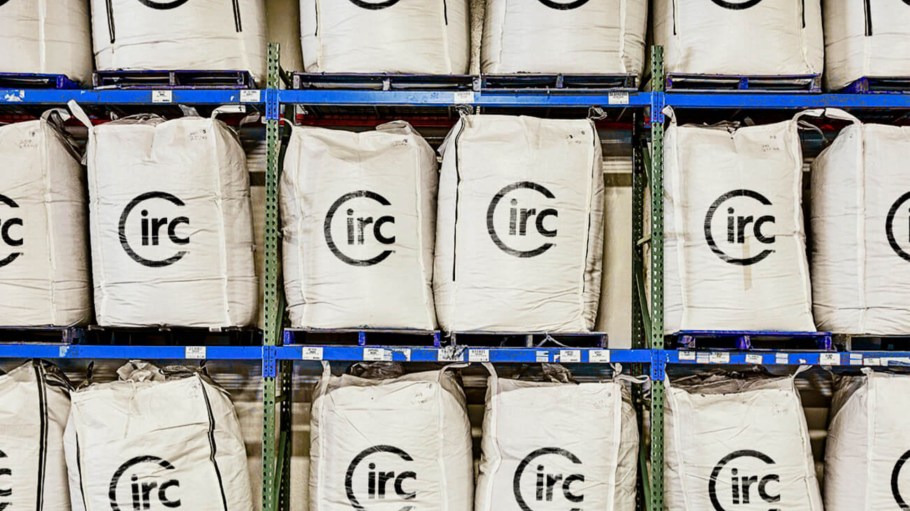
Circ uses technology to separate and recover polyester and cotton from polycotton blends; the pulp that remains can be reused to create other fibers, fabrics and garments.
The Swedish retailer will create a women’s fleece sweatshirt made with polyester recovered by the Danville, Va., recycling company. The sweatshirt will launch this fall, and it marks the first time H&M has worked to purchase and integrate Circ’s recycled output at scale.
Related Stories
But the collaboration isn’t limited to just one item. According to Circ, H&M will continue using its output as part of a men’s denim collection set to launch in spring 2026. The apparel purveyor will work with both Circ and lyocell producer Lenzing on the project.
Lenzing will use Circ’s recycled pulp to create Tencel|Circ lyocell, using Refibra technology. Refibra transforms textile waste and wood into cellulose fiber. The new collaboration will see the Austrian fiber producer using 30 percent Circ pulp to create the Tencel|Circ lyocell, which will be the base of men’s denim H&M plans to put out next year. H&M did not immediately disclose whether the fiber Lenzing creates with the Circ pulp will be used to launch an entire denim line, a single pair of jeans or otherwise.
Florian Heubrander, executive vice president commercial textiles at Lenzing Group, said the three-way collaboration could set an example of the type of partnership the industry needs to participate in to make recycled and next-generation materials scalable.
“True circularity will require the entire value chain to work together. By integrating Circ’s recycled pulp into Lenzing’s Refibra technology and partnering with H&M Group, we’ve demonstrated how existing mill relationships and fiber platforms can be leveraged to make circular fashion commercially viable,” Heubrander said in a statement.
Relationships with large companies interested in instituting more sustainable solutions is one of the best ways for material innovation and textile recycling companies to get a jump on seeing their work come to life at scale.
H&M has worked to support some material innovation players for several years; for instance, the company has a standing relationship with Circulose, formerly Renewcell. In June, the company signed a contract with the textile-to-textile recycler to “source significant volumes” of Circulose for H&M apparel, rather than using virgin viscose.
That collaboration, and the newly inked work with Circ, seem to be a pathway toward H&M’s goal of using recycled or “sustainably sourced” materials for 100 percent of its items by 2030.
Cecilia Strömblad Brännsten, head of resource use and circularity at H&M, said working with Circ and Lenzing provides a better way forward as the apparel purveyor considers its production strategies.
“Collaborating with key partners on projects like Circ is essential to our vision: to grow our business decoupled from resource use and extraction, with products and materials circulating at their highest value,” Strömblad Brännsten said in a statement.
For its part, Circ has been on its way up. Earlier this year, the company announced that it would begin construction on a commercial-scale facility in Saint-Avold, France, in 2026. The company is targeting being operational by 2028, at which point it plans to have the capability to recycle 70,000 metric tons of polycotton textiles annually.
Beyond Lenzing, Circ has worked to ink deals with other producers, like Birla Cellulose, on scaling its pulp for fiber creation. In the past, the company has also worked with designers like Mara Hoffman for small-batch collaborations.
Peter Majeranowski, CEO of Circ, said the partnerships with Lenzing and H&M are another exciting milestone for the company as it creeps up on its 15-year anniversary.
“H&M Group brings global fashion scale, and Lenzing brings decades of fiber expertise. Together they provide the infrastructure needed to make circular fashion commercially viable,” Majeranowski said in a statement. “By working with partners of this caliber, we’re showing how fiber producers and global brands can close the loop at commercial volumes.”
The partnership comes on the heels of Circ’s participation in the SWITCH2CE program, which the United Nations Industrial Development Organization (UNIDO) oversees, and a two-year pilot Circ conducted with Intellecap and H&M. Both the program and the pilot saw Circ proving that its technology is applicable to local supply chains. Majeranowski called the H&M and Lenzing partnerships “the next step of turning pilots into global practice.”