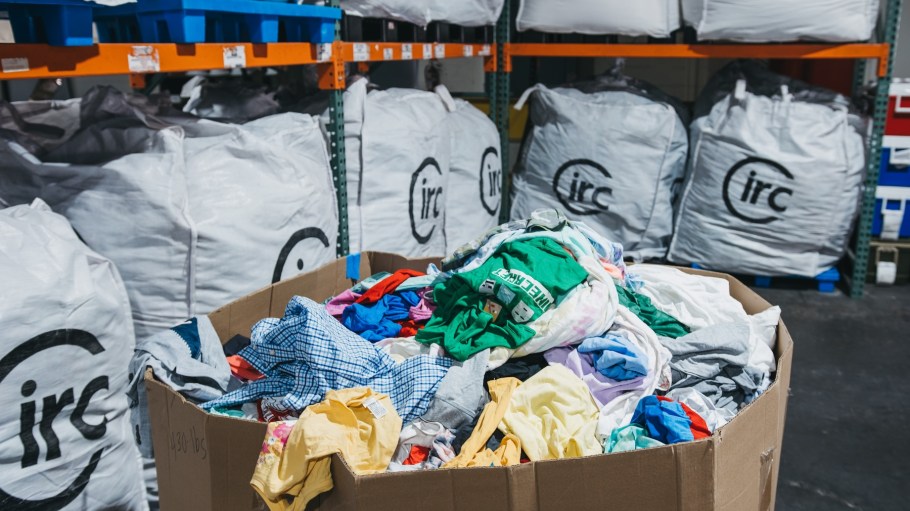
Circ is expanding its Fiber Club program to help scale textile-to-textile recycling from small pilot projects to broader commercial use.
The Danville, Va.-based recycler said Madewell, Reformation and C&A have joined the program’s second cohort, alongside supply chain partners Lenzing and Linz Textil. The initiative, which launched last January with Bestseller, Eileen Fisher, Everlane and Zalando, was designed to address minimum order quantity and pricing challenges that have historically limited the adoption of next-generation materials.
Related Stories
“Brands are increasingly facing pressure from the market to reduce waste and use better materials; there’s a shared understanding across the industry that the status quo can’t continue,” Peter Majeranowski, chief executive officer of Circ, said. “The Fiber Club model operates within existing manufacturing systems to address the costs and complexity that have held brands back—making circular materials viable today.”
For said participating brands, the structure is meant to remove volume constraints while preserving existing supplier relationships.
Katie O’Hare, vice president of sustainability of J.Crew Group, said Madewell’s decision to join the Circ Fiber Club is a logical progression of the brand’s existing focus on circularity and the use of responsibly sourced materials, while executives over at Reformation framed the approach as a way to accelerate next-gen material integration.
“Working with Circ through the model has been an exciting innovation partnership,” said Nikki Player, senior director of raw materials at Reformation. “By removing traditional volume constraints, they’ve given us a much clearer and faster pathway to develop and integrate next-gen and higher recycled-content fibers into our long-range strategic materials portfolio.”
Carrie Freiman Parry, Reformation’s senior director of sustainability, added that pooling purchasing power and supply chain networks helps innovators aggregate demand across multiple brands, improving the pathway to commercialization.
Supply partners echoed the need to move beyond experimentation. Linz Textil CEO Friedrich Schopf joined the Circ Fiber Club’s second cohort to advance circularity through the company’s “spinning excellence.” As a strategic partner, Linz Textil is responsible for converting recycled fibers into yarn for the initiative’s fashion brands.
“True circularity in textiles won’t happen through pilots alone—it needs collaboration and scale,” said Jemma Breen, director of global brands and retailers at Lenzing Group. “Fiber Club is an important step in bridging that gap; we’re proud to partner with pioneers like Circ to help brands integrate circular materials into existing supply chains.”
Day-one members also signaled continued support for the expanded cohort.
Everlane’s Katina Boutis, senior director of sustainability, added that bringing more partners into the model could “unlock broader market access” and cut operational complexity.
“As a founding member of Fiber Club, Zalando remains committed to the belief that the scaling of textile-to-textile materials requires pre-competitive collaboration and demand pooling,” said Pascal Brun, vice president of sustainability at Zalando. “The expansion of Fiber Club 2.0 marks a critical milestone in the journey to scale textile-to-textile recycling from pilots to commercial reality.”
Circ, which separates and recovers polyester and cellulose from blended polycotton, is currently developing its first industrial-scale facility in France as it builds out textile-to-textile recycling infrastructure globally.