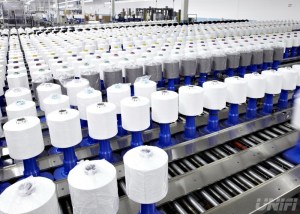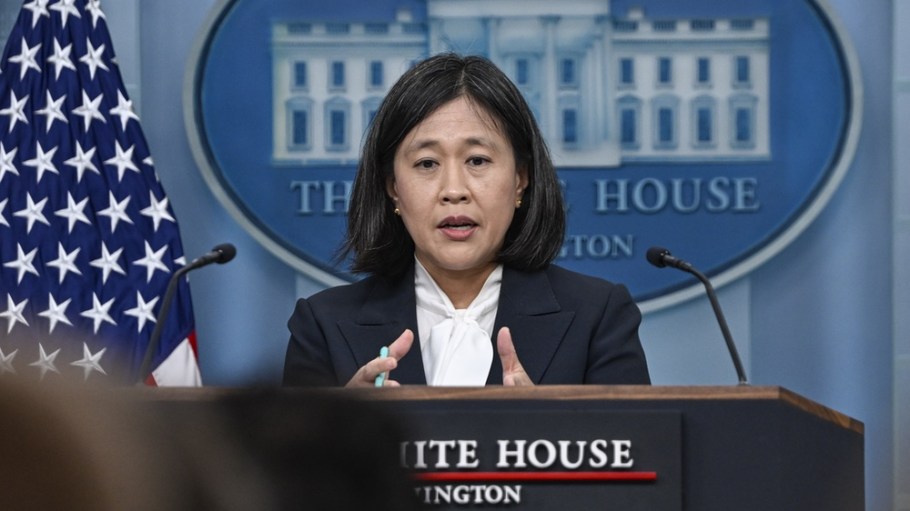
America’s largest domestic textile manufacturer is in a state of acute distress. It claims that it’s been “especially harmed” by what it alleges is Nicaragua’s abuse of a free trade agreement that it says allows goods made with Chinese forced labor to enter the Dominican Republic-Central America market duty-free, lowering prices, hurting competition and “ultimately decimating” U.S. businesses.
Writing to United States Trade Representative Katherine Tai earlier this month, Milliken & Company said it has lost more than $50 million in sales—the equivalent of 61 million square yards of fabrics—over the past two years. This loss of business, coupled with “strong macroeconomic headwinds” in the textile industry, it added, has resulted in a 29 percent decline in its apparel volumes, a 15 percent reduction in its textile workforce and the closure of three plants—again, within a span of 24 months.
Related Stories
Tai had put out a request for public comments in December after initiating a first-of-its-kind Section 301 investigation into “acts, policies and practices” relating to Nicaragua’s handling of human and labor rights. She said that the government was concerned that the Central American nation’s Ortega-Murillo regime was engaging in “repressive and persistent” attacks on the rule of law, including politically motivated arrests, religious repression, extrajudicial killings and restrictions on freedom of expression that could undermine U.S. commerce and destabilize the region.
Allen Jacoby, EVP and president of Milliken, which makes technical and performance fabrics in 13 states along the East Coast for workwear manufacturers and the Department of Defense, said he harbored the same concerns about actions that are “harming American businesses and workers” by tilting the playing field, including through increased transshipment of forced-labor products from China into the region.
Calling for the imposition of tariffs on Nicaraguan imports to the United States, specifically on textiles and apparel, Jacoby cited the fact that Customs and Border Protection detained six shipments from Nicaragua for testing positive for Xinjiang cotton in July 2023, mere months after Nicaragua and China inked a free trade agreement that included “raw materials for textiles.” He also quoted Laureano Ortega Murillo, son of the president and vice president and head of the Nicaraguan delegation to the China International Import Expo in November, for saying that he was “under the guidance of our president to facilitate everything we can do for Chinese businesses.”
“Clearly, this demonstrates that the Chinese-owned and Chinese-invested companies in Nicaragua are operating both at the behest and with the endorsement of Nicaraguan authorities,” Jacoby wrote. “Based on our analysis of margins and raw material costs, we suspect many of these companies are purposely operating at a loss to deliberately harm U.S. industry, thereby eliminating competition from U.S. companies.”
‘Critically intertwined’
Kim Glas, president and CEO of the National Council of Textile Organizations, also urged the United States to take “aggressive action” on Nicaragua and its government, though she said that duty-free goods qualified under the trade pact better known as CAFTA-DR and that contain U.S. and regional inputs need to be protected “so as not to create economic harm more broadly.”
What should be “forcefully” sanctioned or tariffed, she said, are CAFTA-non-qualified textiles and apparel from Nicaragua, all Chinese-owned textile and apparel investments and “blacklisted” companies found to be “cheating” textile and apparel enforcement or facilitating labor and human rights abuses.
Glas also pressed for the “immediate” closure of the Section 321 de minimis “loophole” that she said allows imports to bypass current and future enforcement actions. Unless de minimis is addressed, she said, any trade actions against Nicaragua will prove ineffective.
“Absent reforms, there is also much to lose,” she said. “Much is at stake not just for Nicaragua, but also for broader stability and economic opportunity within the United States and the Americas. In response to U.S. trade policy over the last 30 years, the U.S. textile sector has formed co-production relationships with Western Hemisphere free trade agreement partners that have created an integrated and highly valuable, regional textile and apparel production chain.”
Glas pointed out that the CAFTA-DR region is “critically intertwined,” meaning it would be impossible to penalize Nicaragua with a “broad-brush approach” without hurting the United States and other free trade agreement partners. She said that disrupting the ability to import CAFTA-qualifying garments into the United States from Nicaragua would have “enormous adverse effects” on workers in the United States, Nicaragua, the Northern Triangle countries and, indeed, the entire region, leading to economic destabilization and exacerbating the migration issues the pact was designed, in part, to mitigate.
Nicaragua is an important part of the CAFTA-DR scaffolding. In 2023, the United States imported $2 billion of apparel from Nicaragua, making up 24 percent of apparel imports from the Central American region overall. Nicaragua, in turn, is the third-largest export destination for U.S. textile and apparel products, accounting for $350 million in U.S. exports in 2023. To further underscore the regional integration, Glas said that many U.S. textile companies export yarns and fabrics to other countries such as Honduras and Guatemala for fabric creation and finishing before being shipped to Nicaragua for final assembly.
Unintended consequences
Beth Hughes, vice president of trade and customs policy at the American Apparel & Footwear Association, agreed with Glas that “because this region operates as a region, action against one country is felt by all throughout the region.” Because U.S. apparel imports face “regressively high” tariffs, she said, the duty-free benefits that free trade agreements like CAFTA-DR provide create “powerful incentives” to source apparel and textiles in the region competitively for American consumers.
“These duty-free benefits are key to unlocking investment in the region, which in turn supports responsible employment in the U.S. and throughout Central America,” she said. “As a permanent free trade agreement, CAFTA-DR affords a measure of predictability during these uncertain times, enhancing its ability to attract new investment. The possibility that these trade flows could be directly or indirectly subjected to additional tariffs undermines the economic viability of CAFTA-DR while casting doubt into whether CAFTA-DR is a sound investment choice. Even a whisper of increased tariffs causes a chilling effect to those plans.”
Hughes said a “full and thorough” process must be conducted to determine whether any future bans or tariffs will achieve their objectives or wreak other “collateral damage.” Referring to Nicaragua’s capital, she said “we cannot expect to influence behavior in Managua by making it more expensive for Americans to get dressed every day, by hurting U.S. workers and their communities that rely upon the CAFTA-DR partnership, or by harming our other CAFTA-DR partners.”
“While we share the administration’s frustrations that are prompting this Section 301 investigation, we are deeply concerned that any proposed actions will make the situation worse by directly harming those we are trying to help and by injuring other U.S. economic interests (American workers and our CAFTA-DR partners) in the process,” Hughes wrote. “Moreover, such actions may, in fact, create and trigger the ‘burden or restriction to U.S. commerce’ that this Section 301 investigation is searching for and is attempting to cure.”
Other CAFTA-DR countries may also lack the capacity to absorb the “repositioning of apparel production” currently in Nicaragua, said Marc Doyon, vice president of commodities at Gildan Activewear, for which the country is the primary sewing location within the CAFTA-DR region. Even with the renewal of the Haiti HOPE-HELP trade preference schemes, over which looms much uncertainty, finding enough jobs would be a tall order, he said.
Then there is the impact on reshoring and near-shoring writ large. CAFTA-DR was meant to create “economic synergies” within the Western Hemisphere, shoring up U.S. agricultural sectors and creating “stable, high-quality” jobs in adjoining countries, Doyon said.
“Sanctions of U.S. apparel imports eligible for CAFTA-DR would almost certainly result in much of the Nicaragua apparel production migrating to low-cost Asian suppliers,” he said. “Indeed, the U.S. government has made it a priority to strengthen domestic manufacturing, secure regional supply chains, and reduce dependence on overseas suppliers, particularly in Asia. Moving apparel production from Nicaragua would undermine these critical policy goals and ultimately erode U.S. manufacturing.”
Section 301 or bust?
Julia Hughes, president of the United States Fashion Industry Association, questioned if Section 301 was even the right vehicle for human and labor rights and rule-of-law sanctions. There are other statutory authorities that “explicitly” penalize bad actors, such as the Global Magnitsky Act. The Nicaragua Investment Conditionality Act, signed by President Donald Trump in 2018, prevents Nicaragua from receiving additional multilateral loans until it holds free, fair and transparent elections.
“Since Congress enacted Section 301 more than 50 years ago, Section 301 has never been employed in an attempt to address a general degradation of the rule of law in a trading partner, including violations of human rights and labor rights,” she said. “This may be because a despot undertakes his or her deplorable activities because they would like to rule as a despot—not because they are attempting ‘to burden or restrict U.S. commerce’ as required by Section 301.”
Meanwhile, while Tai’s office “accurately recounts” the many “unacceptable” transgressions of the Ortega-Murillo regime, including rewriting the national constitution to centralize power in the presidency and nullifying the independence of the legislature, it’s unclear how it restricts or burdens U.S. commerce, Hughes said.
“USFIA would simply urge USTR to strongly consider whether Section 301 authorizes tariffs or other trade restrictions to counter the stated activities of the Ortega regime,” she said. “By ‘stretching’ its statutory authorities beyond what Congress intended, USTR would not exactly further its stated objective of promoting the rule of law.”
Milliken just wants something to be done, for instance by imposing public sanctions via both the Office of Foreign Assets Control and the Uyghur Forced Labor Prevent Act on companies in Nicaragua known to use forced labor. The existence of it and those like it depends on it: More than $90 million worth of business could be at risk within the next few years if foreign-owned companies in Nicaragua continue to “violate the spirit of our free trade agreements,” Jacoby said. Any further loss of business on Milliken’s end will also shutter additional plants and result in more layoffs.
“Free trade is only truly free if it is fair,” Jacoby said. “In our view, Nicaragua’s lack of customs enforcement and the Ortega regime’s blatant disregard for human rights makes trade from Nicaragua unfairly traded. We hope the administration will exercise its ability to protect American industries and workers against these unfair trade practices.”