Byte-Sized AI is a bi-weekly column that covers all things artificial intelligence—from startup funding, to newly inked partnerships, to just-launched, AI-powered capabilities from major retailers, software providers and supply chain players.
Walmart ups the ante on personalization
Walmart announced earlier this month that it had developed a series of large language models (LLMs) it calls Wallaby. The LLMs are trained on information specific to retail—including “decades of Walmart data,” which the retailer plans to use to bolster the customer experience, while still using brand voice, style and values.
Related Stories
In working on its generative AI initiatives, the company announced it has also refined the personalization capabilities on its customer assistance chatbot. The company said the upgraded chatbot can immediately identify the shopper it’s interacting with, which allows it to find orders, manage returns and more. In piloting the technology, Walmart said, consumers reported higher rates of satisfaction with their interactions with the chatbot.
The company has plans to release “dozens of additional gen AI tools for customers, members, associates and partners.”
One of those tools, which Walmart shared some details of but has not officially released, is a personalization engine. The company said it has developed a tool it calls the Content Decision Platform, which combines the power of legacy AI and generative AI systems to personalize each shopper’s homepage. The U.S. version is slated to launch by the end of 2025.
Suresh Kumar, Walmart’s global chief technology officer and chief development officer, said creating technology-led experiences allows Walmart to be on the cutting edge of the customer experience, delivering before consumers even know what they want.
“A standard search bar is no longer the fastest path to purchase, rather we must use technology to adapt to customers’ individual preferences and needs,” Kumar said in a statement.
Ex-Alexander McQueen employees secure $17M in Series A funding
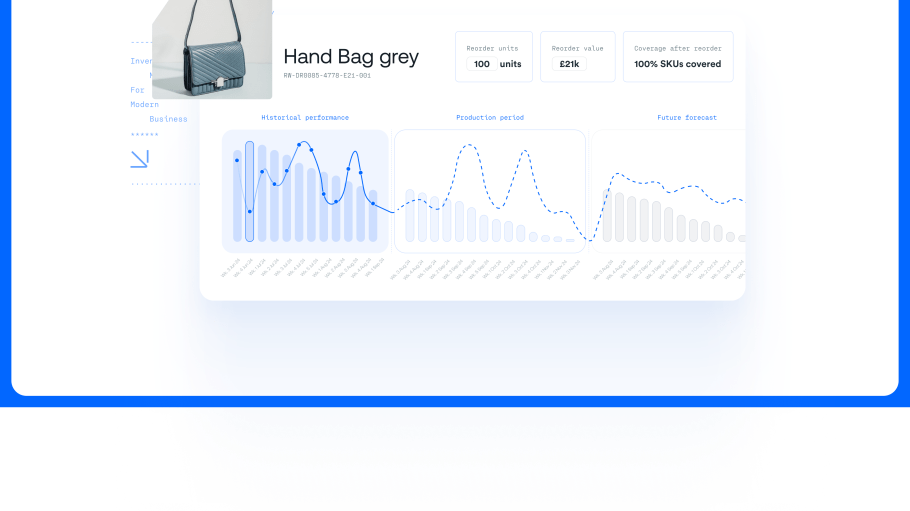
Autone, which uses AI to help brands with demand forecasting and allocation, announced this week it had secured $17 million in Series A funding, led by General Catalyst. YCombinator, Speedinvest, Seedcamp, Motier, Financère Saint James and 2100 VC also participated in the round.
The Series A comes on the heels of pre-seed and seed rounds that Autone announced in 2022 and 2023, respectively.
Adil Bouhdadi, CEO and co-founder of Autone, said he and his co-founder Harry Glucksmann-Cheslaw’s first inspirations for the product were issues they ran into during their time spent working in the retail industry: inefficient systems that made inventory management difficult—and often siloed it to Excel sheets.
The technology allows companies to have insight into the type of inventory they need in each specific store, as well as the opportunity to interface with generative AI about how potential changes to the business would affect their revenue.
Rather than forcing clients’ employees to use daunting AI systems, Bouhdadi said the founder pair wanted to make it as easy as possible to use their system, which he believes will translate to a more natural migration onto an AI system without as much reversion to antiquated technologies.
“Outside of work, our users will be interacting with Airbnb, Spotify, Instagram—we need to give them that level of experience when they come to work…versus something that’s a black box, that’s clunky,” Bouhdadi told Sourcing Journal.
The founders plan to use the funding to expand their sales and product marketing teams internationally—from the U.S. to the United Arab Emirates, where it has now launched a partnership. They will also use it to refine their existing products and build out further functions that would make the platform more of an end-to-end supply chain tool, rather than an isolated function. Already, Bouhdadi said, the company has 24 engineers on its team—it commenced that hiring before officially announcing the Series A raise.
Autone’s current clients include Roberto Cavalli, Stussy, Zadig & Voltaire and more. As Bouhdadi and team grow the company, they plan to onboard more clients, both in the luxury and ready-to-wear spaces.
“If you look at our academic background, if you look at what we’ve done, we’re not VC-likable people. We didn’t do BCG, Harvard, McKinsey, all of that. We just had that resilience—we know what we are building is actually meaningful, and is what people need and want. We’ve kind of started to prove the market wrong,” he told Sourcing Journal.

Attentive uses consumer data to ensure stronger outcomes for personalization
The SMS and email marketing platform announced this week that it had enriched its proprietary Attentive Signal tool, which enables brands and retailers to better understand their customers based on other activity across the web.
The company said the technology comes at a time when cookies that help measure and store important information to help bolster the consumer experience are in flux. While consumer behavior alone can be enough to make them difficult to keep tabs on—whether because they use multiple devices, switch between email addresses or otherwise—the shortening of the period cookies are stored for could spell trouble for brands trying to retain a fickle consumer.
Attentive Signal now has two new features: Enhanced Tag, which is still in beta, and Smart Resolution. Enhanced Tag allows customers to assign more persistent cookies, allowing a better understanding of the user journey, while Smart Resolution can match site views on different devices and with different emails even without the use of cookies.
Clients like Steve Madden and SwimOutlet found in tests that Attentive Signal—complete with its newest capabilities—has given them the ability to better communicate with consumers via SMS and email, offering a 20 to 30 percent boost in revenue based on abandonment journey messages.
To make this possible, Attentive Signal uses a shopper’s phone number, as well as tagging and tracking mechanisms, to identify and learn about customers throughout their shopping journeys.
Amit Jhawar, CEO of Attentive, said the new features allow the provider’s clients to take their customer understanding to new heights.
“As the backbone of AI-powered marketing, data quality is key,” Jhawar said in a statement. “From day one, we built our platform for mobile consumers around the most reliable ID—phone numbers. With the Enhanced Attentive Tag and Smart Resolution, we’re enhancing our identity solution to drive even better results. We capture rich, accurate data behind the scenes, turning online activity into real-time signals that power the highest level of personalization for brands.”